
Reviewed by Josh N · Updated September 4, 2026 · How we verify
Reported Phenomena
- Projection booth malfunctions
- Lady in White apparition
- Child seen in lobby
- Named resident spirits
Reported by visitors & local legend. Stories, not verified claims.
Downtown Tampa’s grandest surviving movie palace still runs film, and the stories that trail it are almost as old as the projector. The Tampa Theatre ghosts are among the best known in Florida: a long-serving projectionist blamed for balky equipment, a woman in a 1930s evening dress on the balcony, and a child said to turn up in the lobby. None of that is documented fact. What is documented is the building itself, which is remarkable enough to justify the trip whether or not anything follows you out.
Quick Orientation
- Opened: 1926, in the boom years of the American movie palace
- Architect: John Eberson, who specialized in fantasy interiors
- Style: a Mediterranean courtyard under a starlit ceiling, with Italian Renaissance and Byzantine detail
- Status: restored, actively operating, and open for screenings, concerts and ghost tours
A Starlit Courtyard Built Indoors in 1926
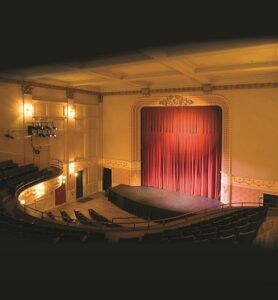
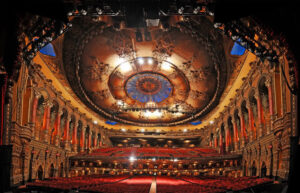
Eberson’s specialty was the atmospheric theater: instead of a plain hall, the audience sits in what appears to be an open-air courtyard, walls dressed as building facades, ceiling painted and lit to read as a night sky. That is what he delivered in Tampa in 1926. The design borrows freely, Italian Renaissance in places, Byzantine in others, and the effect is deliberately theatrical rather than archaeologically correct. It remains one of the most striking movie palaces in the United States, and it is the reason the building is treated as a landmark rather than simply an old cinema.
Palaces like this were built for a specific business model: enormous single-screen houses drawing crowds downtown. When that model collapsed in the second half of the twentieth century, most of them were gutted, subdivided or leveled.
How the Tampa Theatre Escaped the Wrecking Ball
The theater came close to demolition in the late twentieth century and was saved by a community-driven campaign rather than by any single wealthy patron. It has since been restored toward its original appearance and put back to work. The programming today is a mix: independent film screenings, repertory bookings, and major music concerts. The building earns its keep, which is the single most reliable way for a historic theater to survive.
That continuous use matters to the ghost stories too. Buildings that stay staffed accumulate decades of employee accounts, and theaters in particular are full of dark corners, unstable old equipment and long shifts alone after the crowd goes home.
Fink Finley, the Lady in White, and Maria
Three figures dominate the theater’s reputation, and all three come from the oral tradition of staff and visitors rather than from any verified record.
Foster “Fink” Finley was a long-time projectionist at the theater. He is the name most often attached to activity in the projection booth, where unexplained equipment malfunctions are traditionally credited to him. It is worth being clear about the logic there: aging projection gear fails on its own, and attributing a jam or a flicker to a former employee is a story staff tell, not a diagnosis.
The “Lady in White” is described as a figure in a 1930s evening dress, reported on the balcony. She has no established identity, which is common with figures of this type; the costume dates the apparition, not the woman.
The third is a young girl called Maria, said to appear in the lobby and generally described as playful rather than frightening. Again, the name comes from tradition, not from any confirmed death or documented incident at the building.
Visiting the Tampa Theatre
This is a working theater in the middle of downtown Tampa, so the easiest way in is to buy a ticket to whatever is playing. The building itself is the attraction: arrive early, look up at the ceiling, and walk the balcony while the house lights are still on.
The theater does not hide its reputation. It runs ghost tours that cover the haunted lore alongside the architecture and the preservation fight, which is the most honest way to encounter the stories: told as stories, inside a building that can stand on its own history.
Sources
- Our Pathway to a Better Tomorrow
- USF Libraries – University of South Florida Libraries Home (Usf (official site))
- Sulphur Springs – Ghost Town
- Wikipedia: Sulphur Springs (Tampa)
Frequently Asked Questions
Where is Tampa Theatre located?
Tampa Theatre is located at 711 N Franklin St.
Can you visit Tampa Theatre?
Tampa Theatre is open to the public. Always follow posted rules and respect private property.
Reader sightings
Nobody has reported anything here yet. If you have been, you would be the first.
Report your own visit to Fink Finley’s Booth and the Tampa Theatre Ghosts
How haunted is this place?
Be the first to rate
Ghost Tours Nearby
 The Official Ybor City Ghost Tourfrom $35
 Tampa Terrors Spirits & Spirits Haunted Pub Crawlfrom $29
 Tides of Tethered Terror: Tampa Ghost Toursfrom $26
Affiliate links: BeyondHaunted may earn a commission, at no extra cost to you.
Leave a Reply