

Reviewed by Josh N · Updated September 13, 2026 · How we verify
Reported Phenomena
- Cigar smoke
- Footsteps on staircase
- Man in blue
- Cold spots
- Doors unlocking themselves
- Children's laughter
- Apparition on observation deck
Reported by visitors & local legend. Stories, not verified claims.
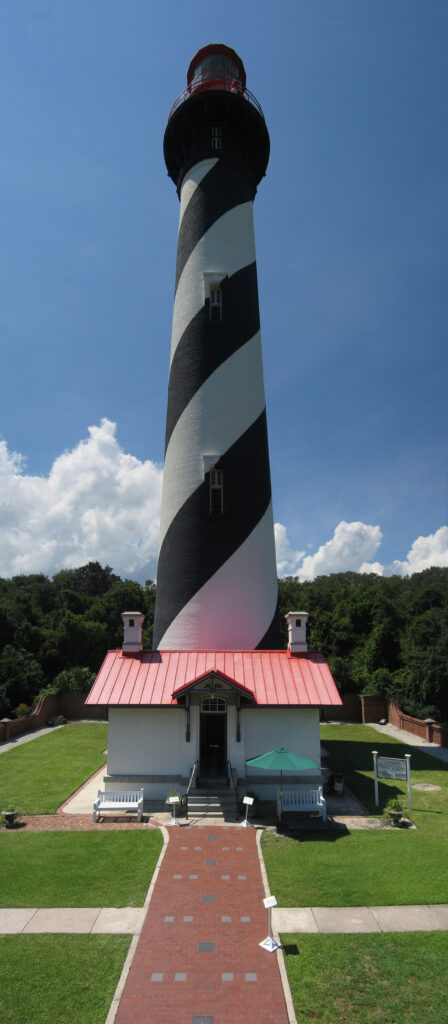
The St. Augustine Lighthouse is a black and white striped tower on the north end of Anastasia Island, still burning as a private aid to navigation, and still collecting stories that its own museum staff will tell you they cannot explain. Florida has older streets and older forts, but few sites layer four centuries of watchkeeping, a drowned predecessor tower, a Civil War sabotage plot and a modern ghost-hunting industry into one piece of ground quite like this one.
Quick orientation: the current tower was built between 1871 and 1874, stands 165 feet tall, and is owned along with its original first-order Fresnel lens and grounds by the St. Augustine Lighthouse & Maritime Museum, Inc., a not-for-profit maritime museum. The site is open to the public 360 days a year.
Before the Tower: Watchtowers, Coquina and Sir Francis Drake
Spanish and British governments both operated a major aid to navigation on this stretch of coast, including a series of wooden watch towers and beacons dating back to 1565. A map of St. Augustine drawn by Baptista Boazio in 1589, depicting Sir Francis Drake’s attack on the city, shows an early wooden watch tower, described in Drake’s account as a beacon.
By 1737, Spanish authorities had built something more permanent: a tower of coquina quarried nearby on the island. Whether the Spanish actually used it as a lighthouse is not settled by the archives, though it seems plausible given the volume of maritime trade by then. From the start of the British period in 1763, ships’ logs and nautical charts routinely called it a lighthouse. When Spain retook St. Augustine in 1783, the structure was improved again. The Swiss-Canadian engineer Joseph Frederick Wallet DesBarres marked a coquina “Light House” on Anastasia Island in his 1780 engraving of the harbor, and the Royal French Hydrographer Jacques-Nicolas Bellin referred to the coquina tower in his Petit Atlas Maritime.
Florida’s First Lighthouse and the Tower That Fell Into the Sea
The American territorial government lit St. Augustine’s first official lighthouse in May 1824, making it Florida’s first. Archival records and maps suggest it stood on the site of that earlier Spanish watchtower. Its early lamps burned lard oil, and multiple lamps with silver reflectors were swapped for a fourth-order Fresnel lens in 1855, which extended its range and cut down on maintenance headaches.
The sea had other plans. By 1870, beach erosion was eating toward the tower. A jetty of coquina and brush was thrown up to buy time while a replacement rose nearby. It was not enough. The old tower crashed into the sea in 1880, and its ruins are now a submerged archaeological site, one that the lighthouse’s own archaeologists have since gone back to study.
Hiding the Lens: Sabotage at the Start of the Civil War
One of the sharpest episodes in the station’s record has nothing to do with ghosts. At the outbreak of the Civil War, local Menorcan harbor master and future mayor Paul Arnau, working with lightkeeper Maria Mestre de los Dolores Andreu, removed the lens from the old lighthouse and hid it, both to block Union shipping lanes and to help blockade runners slip past unseen. The lens and clock works were only recovered after Arnau was held captive on a ship offshore and forced to give up the location. Andreu, in her role as keeper, became the first Hispanic-American woman to serve in the Coast Guard.
The 1874 Tower and the Keepers Who Lived Beside It
Construction on the current tower began in 1871, during Florida’s Reconstruction period, with a trolley track hauling building supplies up from the ships at the dock. The tower was finished in 1874 and put into service with a new first-order Fresnel lens. Keeper William Russell lit it for the first time that October. He was the first keeper in the new tower and the only man to have worked both.
For twenty years afterward, the station was run by head keeper William A. Harn of Philadelphia, a Union war hero who had commanded his own battery at the Battle of Gettysburg. He and his wife Kate Skillen Harn, of Maine, raised six daughters here, and the family became known for serving lemonade on the porches of the keepers’ house, built during Harn’s tenure as a Victorian duplex.
The log books also caught the odd shock. On August 31, 1886, the Charleston earthquake made the tower “sway violently,” according to the keeper’s log, though no damage was recorded. The lamp was converted from lard oil to kerosene in 1885 after long experimentation. Indoor plumbing reached the station in 1907 and electricity reached the keeper’s quarters in 1925. The light itself was electrified in 1936 and automated in 1955, and as it was, three keeper positions dwindled to two, then one. During World War II, Coast Guard men and women trained in St. Augustine and used the tower as a lookout for enemy ships and submarines working the coastline.
Arson, Rifle Fire and Fifteen Women With a 99-Year Lease
By the 1960s no lighthouse families lived at the station. The keepers’ house was rented to local residents, eventually declared surplus, and bought by St. Johns County in 1970. That same year an unknown arsonist gutted it.
The rescue came in 1980, when a group of fifteen women from the Junior Service League of St. Augustine signed a 99-year lease with the county for the house and grounds and started a full restoration. The League soon signed a 30-year lease with the Coast Guard to take on the tower as well. The lighthouse was added to the National Register of Historic Places in 1981, largely through the efforts of local preservationist and author Karen Harvey.
The antique lens kept working until 1986, when it was damaged by rifle fire and 19 of its prisms were broken. Lamplighter Hank Mears called in the FBI. As the lens weakened further, the Coast Guard floated replacing it with a modern airport beacon. The Junior Service League fought that off, and the nine-foot lens was instead restored with the help of retired Coast Guardsmen Joe Cocking and Nick Johnston, the first restoration of its kind in the country.
Who Is Said to Walk the 219 Steps
None of what follows is in the historical record. It is local lore and visitor report, and it should be read that way.
The keepers most often named are Peter Rasmussen and Joseph Andreu. Rasmussen, remembered for his diligence and his cigars, is credited with the smell of cigar smoke that visitors say drifts through the tower with no source. Andreu is said to have died while painting the lighthouse, and the heavy tread reported on the spiral staircase is attributed to him.
A figure known only as “the man in blue” is described descending the tower’s 219 steps. Storytellers also place a suicide at the site, with almost nothing known about the man or his reasons, and say his presence lingers.
The most repeated tale belongs to the Pity sisters, the elder of whom is said to have drowned along with her sister. She is reportedly seen in the blue dress she wore that day, and some visitors claim to have photographed a figure in a flowing dress standing on the observation deck. Alongside those specific figures, staff and guests describe the usual grammar of a haunted building: doors that unlock themselves, cold spots, and children’s laughter carrying through the halls.
Ghost Hunters, TV Crews and the Case for the Seagulls
The lighthouse has become one of the most filmed paranormal sites in the Southeast. It appeared in episodes of the Syfy series Ghost Hunters and on the program My Ghost Story, and it was featured on the Travel Channel’s Most Terrifying Places in America in an episode titled “Restless Dead,” which aired in 2018.
The skeptical reading deserves equal billing. Researcher Joe Nickell, who investigated the site, has written that there is no credible evidence the lighthouse is haunted. He pointed out that the spooky noises and sounds reported from the tower have mundane explanations: seagulls, and wind moving through a 165-foot masonry cylinder open at the top. Anyone who has climbed the stairs on a gusty day will recognize the sound he means.
Shipwrecks, Cannon and the Museum’s Archaeology Program
The museum runs an unusual research arm. The Lighthouse Archaeological Maritime Program, formalized in 1999, is one of the few research organizations in the country employing full-time professional marine archaeologists and conservators without being attached to a university or government agency. Its divers have located and studied wrecks across the First Coast.
The oldest identified wreck in St. Augustine waters is the sloop Industry, a British supply ship lost on May 6, 1764, while trying to make port with munitions and tools for Britain’s newly acquired Florida garrisons. Cast-iron cannon, a swivel gun, millstones, axes, shovel blades and handsaws came up well preserved, and many have been displayed in the keeper’s house. A second site, the “Storm Wreck,” is believed to be a vessel from the December 18, 1782, evacuation of Charleston at the end of the American Revolution, carrying Loyalist refugees and troops to what was then still a loyal British colony. As many as sixteen vessels were lost on the sandbar in front of the St. Augustine inlet when that final British fleet arrived between December 24 and 31, 1782.
Visiting the St. Augustine Lighthouse & Maritime Museum
The light station today takes in the 1874 tower, the 1876 keepers’ house, two summer kitchens added in 1886, a 1941 U.S. Coast Guard barracks and a 1936 garage that served as a jeep repair facility during World War II. The site also functions as a National Oceanic and Atmospheric Administration weather station.
The museum opened full-time to the public in 1994 and took the name St. Augustine Lighthouse & Maritime Museum in 2016. In 2002 ownership of the tower and its historic Fresnel lens passed from the U.S. Coast Guard to the non-profit, the first transfer of a U.S. lighthouse to a non-profit organization. It is open 360 days a year, employs close to 50 people and draws more than 200,000 visitors annually, including some 54,000 school-aged children. Admission fees fund preservation of the tower and five other historic structures, plus programs in maritime archaeology, traditional wooden boatbuilding and maritime education.
Expect a real climb. The tower stairs are steep and narrow, and the reward at the top is a working light and a view across the inlet. Whether you come for the Fresnel lens, the shipwreck artifacts or the man in blue, treat the staff’s stories as stories and the building as what it plainly is: one of the best-preserved light stations in the country, still doing its job.
Sources
- Inventory of Historic Lighthouses: St. Augustine Light
- Project Archive – St Augustine Light House
- An Encyclopedia of American Women at War: From the Home Front to the Battlefields
- About LAMP
- Lighthouse names director for marine archaeology
- Wikipedia: St. Augustine Light
Frequently Asked Questions
Where is St Augustine Lighthouse located?
St Augustine Lighthouse is located at 100 Red Cox Road, St. Augustine, FL 32080.
Can you visit St Augustine Lighthouse?
St Augustine Lighthouse is open to the public. Always follow posted rules and respect private property.
Reader sightings
Nobody has reported anything here yet. If you have been, you would be the first.
Report your own visit to The Man in Blue: Ghosts of the St. Augustine Lighthouse
How haunted is this place?
Be the first to rate
Ghost Tours Nearby
 Haunted Trolley Tour of St Augustinefrom $37
 Riding with the Ghosts a Golf Cart Ghost Tour in St Augustinefrom $39
 St. Augustine Haunted Pub Crawlfrom $35
Affiliate links: BeyondHaunted may earn a commission, at no extra cost to you.
Leave a Reply