

Reviewed by Josh N · Updated October 20, 2026 · How we verify
Reported Phenomena
- Ship captain apparition
- Girl in white dress
- Disembodied whispers
- Phantom footsteps
- Guardian spirit legend
- Buried treasure folklore
Reported by visitors & local legend. Stories, not verified claims.
Sixteen miles of open water separate Leland, Michigan, from a three mile square of limestone, sand and abandoned farmsteads where nobody lives anymore. South Manitou Island sits in the Manitou Passage, the shipping lane that carried schooners and steamers the length of Lake Michigan, and its empty buildings, its 100 foot lighthouse and the rusting hull wedged off its south shore have made it one of the state’s more atmospheric destinations. The island’s documented history is unusually well preserved. Its ghost stories are a different matter, and worth separating out carefully.
Orientation: An Uninhabited Island in Leelanau County
- Where: Lake Michigan, roughly 16 miles west of Leland, in Leelanau County, within Sleeping Bear Dunes National Lakeshore.
- Size: 8.277 square miles of land, about 3 miles wide and 3 miles long. Larger North Manitou Island lies to the north.
- Population: none. The island is uninhabited and most of its buildings lie in ruins.
- Access: passenger ferry from Leland. Guided tours on open-air vehicles are available, but most visitors travel on foot.
- On the ground: a system of trails and campsites, one inland lake called Florence Lake, and dunes formed by wind driving sand inland from the high western bluffs.
The island is the exposed crest of a ridge of tilted limestone layers buried under glacial debris. When meltwater filled the Lake Michigan basin, the high ground stayed above the surface. On the southwestern corner stands a grove of Northern white cedars among the oldest and largest in the world. The biggest measures 18 feet around and is estimated to be more than 500 years old, which means it was already a mature tree when the first lighthouse appropriation passed Congress.
William Burton’s Cordwood and the Harbor Between Chicago and Buffalo
Settlement began in the mid-1830s, when William Burton arrived to supply cord wood for the Great Lakes steamships. He built his dock in the middle of the crescent-shaped bay on the eastern shore, and the reason that bay mattered is simple geography: it was the only natural deep-water harbor between Chicago and Buffalo.
By 1847 the village around the wharf included a house, a blacksmith shop, a grocery store, a barn, and a wooden tamarack railroad track running inland from the dock to haul fuel wood down to the steamers. The first post office opened there in 1870. When the logging finished and the dock decayed, that original settlement shrank. In 1923 Burdick’s moved their general store from the old dock to a site near the Lifesaving station on the southeastern shore, and the center of island life moved with it, to the spot where the passenger ferry lands today.
Prize-Winning Rye and the Farms That Emptied Out
Agriculture came slowly, but by 1870 most islanders were self-sufficient farmers selling surplus to passing ships and mainland markets. Isolation turned out to be an asset: cut off from mainland cross-pollination, South Manitou produced prize-winning rye, beans and peas.
None of that survives as a working concern. There are no active farms on the island now. What remains is the physical evidence, farm buildings, abandoned machinery, the old school and the cemetery, which is the entire reason visitors describe the place as a ghost town. The decline was economic and technological, not catastrophic. Steamships stopped burning wood, the harbor stopped mattering, and the people left.
Three Lighthouses on the Same Sandy Knoll
With the Erie Canal completed in 1826, commercial traffic on the Great Lakes grew fast, and the Manitou Passage became the most important route for vessels working the 300 mile length of Lake Michigan. Congress appropriated $5,000 in 1838 for a light here, and construction began in 1839.
Remarkably little is known about that first structure. Its specifications matched the Old Presque Isle lighthouse, a 30-foot circular tower and a stone keeper’s dwelling, but written accounts instead describe a one and a half story house with a light tower on one gable end. No sketches or photographs exist, and even the exact location on the 30-foot sandy knoll near the shore is uncertain.
In 1858 the U.S. Lighthouse Establishment replaced it with a two-story brick residence carrying a 35-foot tower and a Fourth Order Fresnel lens. A fog signal building went up alongside it, and both structures still stand. Then, in 1871, traffic justified something far larger: a 100-foot tower, 18 feet in diameter at the base, with hollow walls 5 feet thick at the bottom tapering to 3 feet at the top, joined to the keeper’s dwelling by a passageway. A Third Order Fresnel lens from Paris with a three-wick lamp threw light 18 miles. In 1875 the first steam fog signal on Lake Michigan replaced the fog bell here.
The big tower worked from 1871 until 1958. It remains in good condition, and restoration has returned the light tower to operational status during the summer months. The United States Life-Saving Service built a station on the island in 1901, which passed to the Coast Guard when the services merged in 1915 and closed permanently in 1958. That building is now the island’s ranger station and is not open to the public.
Fifty Wrecks and the Francisco Morazan
The Manitou islands are ringed by more than 50 known shipwreck sites, dating from 1835 to 1960, and a preserve was established in 1988 to protect their historic and archeological value. Several are popular dive sites.
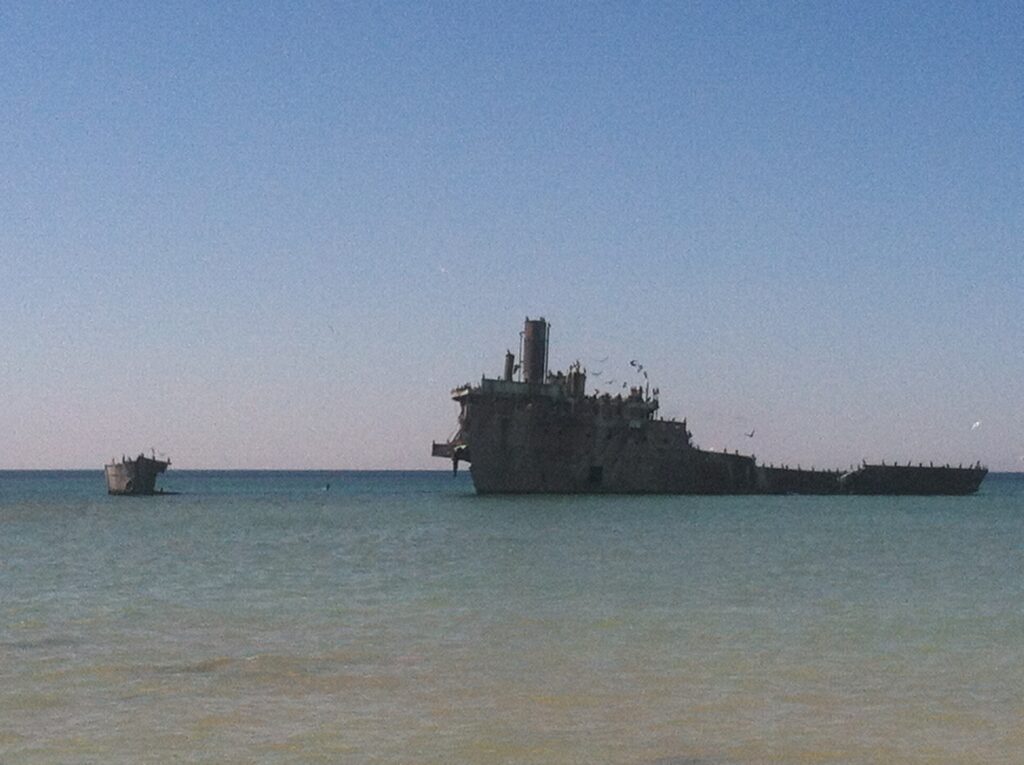
The most visible is the Francisco Morazan, which grounded off the south shore in 1960 and became a total loss. She came to rest over the wreck of the bulk freighter Walter L Frost, stranded on November 4, 1903 with a cargo of corn and general merchandise. Two hulls, one on top of the other, in sight of the beach.
The bay on the eastern side has saved as many ships as the passage has taken. It stays deep until very close to shore, and vessels have ridden out storms inside it. During the Big Blow of 1913, Captain John Stufflebeam drove the bow of the passenger and packet steamer Illinois onto the beach and held his engines at full for 49 hours so the wind could not push her back out, long enough to put two seamen ashore to make fast to a stout tree. When the storm let go 24 hours after that, he untied, reversed off the sand and carried on.
The Captain, the Girl in White, and What Gets Reported
None of what follows is documented. The island’s written record covers wood docks, rye yields, lens orders and station closures. It does not record a haunting, and no verified death is attached to any of the figures described below. These are stories told by visitors and repeated in local folklore.
- A ship’s captain said to appear near the wreck on the shore.
- A young girl in a white dress reported moving through the island’s woods.
- Whispers with no source, usually described around the ruins.
- Footsteps heard on paths and in empty buildings.
- A guardian spirit that older island legend holds appears in moments of danger, along with a tale of buried treasure findable only by the pure of heart. Both belong firmly to folklore rather than any recorded event.
It is worth noting how much of this fits the setting rather than any specific tragedy. An uninhabited island with a cemetery, a school nobody attends, collapsing farmhouses and a freighter rotting offshore supplies its own unease. Wind through 500 year old cedars and across open dunes makes noise. That does not invalidate what visitors say they experienced, but nobody has produced evidence tying a single reported apparition to a named person or a documented death here.
Planning a Trip to South Manitou Island
The ferry from Leland is the only practical way across, and crossings are seasonal and weather dependent, so check the operator’s current schedule before committing to a date. Day trips are possible, but the island rewards an overnight stay: there are established campsites and a trail system, and the walk out to the cedar grove and down to the overlook above the Francisco Morazan takes real time.
Guided tours on open-air vehicles run for those who would rather not cover the distances on foot. The lighthouse is the centerpiece of any visit, with its light tower restored for summer operation. The former Life-Saving Service station now serves as the ranger station and is closed to visitors.
Treat the ruins as what they are: unstabilized remains of a working community, in a national lakeshore where the usual rules apply. Carry water, since there is no village to resupply from. Stay out of derelict buildings, respect the cemetery, and remember that the ferry leaves whether or not you are back at the dock.
See South Manitou Island for Yourself
Sources
- Feature Detail Report for: South Manitou Island (Usgs (official))
- National Park Service, South Manitou Island
- Archives (official)
- Census.gov | U.S. Census Bureau Homepage (US Census Bureau)
- Loc (official)
- Wikipedia: South Manitou Island
Frequently Asked Questions
Can you visit South Manitou Island?
South Manitou Island is open to the public. Always follow posted rules and respect private property.
Reader sightings
Nobody has reported anything here yet. If you have been, you would be the first.
Report your own visit to The Francisco Morazan and the Ghosts of South Manitou Island
How haunted is this place?
Be the first to rate
Leave a Reply