Reviewed by Josh N · Updated August 17, 2026 · How we verify
Reported Phenomena
- Apparition of Cyrus Teed
- Shadowy figures
- Disembodied whispers
- Phantom conversations
Reported by visitors & local legend. Stories, not verified claims.
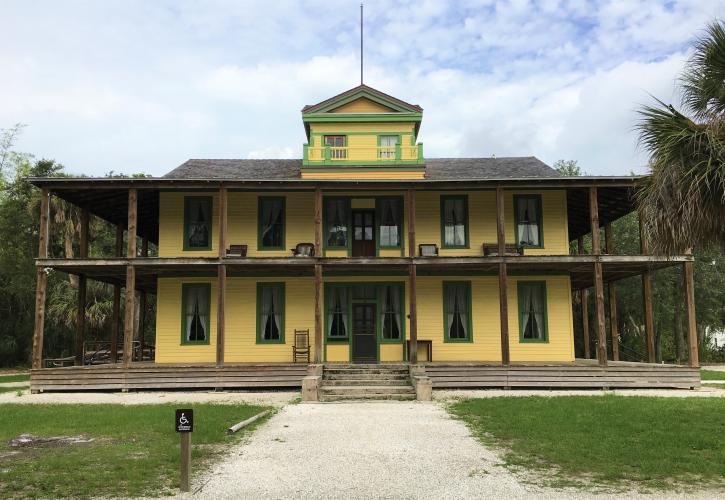
Nine miles south of Fort Myers, on a slow bend of the Estero River, the Koreshan State Historic Site preserves the physical remains of one of the strangest religious experiments ever attempted in Florida: a settlement whose founder taught that the entire universe sits inside the earth, and that he would rise from the dead. The buildings still stand under imported bamboo and African sausage trees. The visitors who walk the grounds at closing time sometimes say the founder never left.
Quick Facts on Koreshan State Park
- Where: Estero, Florida, on U.S. Highway 41 at Corkscrew Road
- What it was: the home settlement of the Koreshan Unity, a communal religious colony founded by Cyrus Teed
- How it became a park: the Unity’s last members deeded the land to the state in 1961
- Listed: added to the National Register of Historic Places on 4 May 1976 as the Koreshan Unity Settlement Historic District
- Hours: like all Florida state parks, open 8 a.m. to sunset, every day of the year
- Reported activity: an apparition identified by witnesses as Teed, shadowy figures, whispers and distant conversation. Anecdotal, with no documented incident behind it.
Cyrus Teed and the Doctrine of Cellular Cosmogony
Teed was a physician who announced a divine revelation in the late 19th century and built a following on the strength of it. The theology he assembled, which he called Cellular Cosmogony, held that the earth is hollow and that humanity lives on its inner surface, with sun, stars and sky contained within the shell. It was not a metaphor to the Koreshans. They treated it as measurable physics and pursued it as science, alongside communal ownership, celibacy for the inner circle, and a working belief that a small disciplined community could out-engineer the world outside it.
Followers left conventional lives behind to join him in southwest Florida and to build something self-sustaining. They largely succeeded. The settlement ran its own businesses, founded a university, and generated electricity for itself long before the surrounding countryside had any. Its Art Hall hosted concerts, lectures and theatricals, which is a remarkable thing to find in what was then a near-frontier stretch of the Gulf coast.
The Death That Ended the Utopia
Teed died in 1908, following a violent altercation. His theology had promised that death would not hold him, and his followers waited with the body in the expectation of a resurrection. It did not come. The community continued afterwards but never recovered its momentum, and the membership thinned decade by decade until only a handful remained. In 1961 those last members deeded the land to the State of Florida, which is why the settlement survives at all rather than having been cleared for highway frontage. Fifteen years later the federal government recognised what they had left behind, listing the grounds on the National Register of Historic Places in May 1976.
What Visitors Report Among the Koreshan Buildings
Nothing in the park’s documented history involves a disaster, a fire or a mass death on the site, and the ghost stories here are informal accounts from visitors and campers rather than anything on the record. Read them as folklore that grew in the space Teed’s failed resurrection left open.
The most repeated claim is a sighting of Teed himself, described as a figure moving through the settlement clearing as though still supervising it. Beyond that, accounts describe shadowy shapes at the edge of the buildings and auditory experiences: whispers, and the sound of conversation carrying from somewhere out of sight, as though the settlement were still populated. The park’s layout probably helps. A cluster of preserved wooden buildings under heavy subtropical planting, on a river, in the dark, will produce noises with or without the dead.
Imported Trees, Alligators and the Estero River
The Koreshans were compulsive planters, and their botanical ambition is one of the genuine pleasures of the site. They imported species from across the world: an Araucaria bidwillii, or false monkey puzzle, native to Queensland and prone to dropping seed pods the size of a football; several African sausage trees, a favoured food of giraffes; eucalyptus, mango and other fruit trees; and a quantity of Japanese bamboo that originally came from the Edison and Ford Winter Estates. Flowering trees and plants of many kinds fill in around them.
The rest of the park is pine flatwoods habitat with a working ecosystem inside it. Gopher tortoises, bobcats, gray foxes, North American river otters and American alligators all live here. Birders can look for swallow-tailed kites, bald eagles, northern bobwhites and red-shouldered hawks.
Camping, Canoeing and Visiting the Settlement
This is a fully functioning state park rather than a monument you view through a fence. Fishing, picnicking, boating, camping, canoeing, hiking and wildlife viewing are all on offer, with a boat ramp, trails and a picnic area on the Estero River. There are 60 campsites, four of them set up for glamping. Kayak rentals are available from Estero Bay Outfitters on the river, a short distance outside the park boundary.
Gates open at 8 a.m. and close at sunset, every day of the year including holidays, which means anyone hoping to test the ghost stories after dark needs a campsite booking rather than a day pass. The settlement buildings are the reason to come early: walking them in the quiet, before the day use crowd arrives, gives the clearest sense of what several dozen people believed they were building here, and what they thought was waiting inside the world.
See Koreshan State Historic Site for Yourself
Sources
- Florida Memory: State Library and Archives of Florida
- floridastateparks.org
- GeoHack – Koreshan State Historic Site
- Luxury Camping in Fort Myers, FL, Timberline Glamping
- Wikipedia: Koreshan State Historic Site
Frequently Asked Questions
Where is Koreshan Historic Site located?
Koreshan Historic Site is located at 41 at Corkscrew Road.
Can you visit Koreshan Historic Site?
Koreshan Historic Site is open to the public. Always follow posted rules and respect private property.
Reader sightings
Nobody has reported anything here yet. If you have been, you would be the first.
Report your own visit to Hollow Earth Utopia: The Koreshan State Historic Site Ghosts
How haunted is this place?
Be the first to rate
Ghost Tours Nearby
 Footsteps of the Forsaken Frights: Fort Myers Ghost Tourfrom $26
 Haunted History of Fort Myers Walking Tourfrom $30
Affiliate links: BeyondHaunted may earn a commission, at no extra cost to you.
Leave a Reply