
Reviewed by Josh N · Updated August 24, 2026 · How we verify
Every piece of equipment on this page measures something real. None of it measures ghosts. That distinction is the single most useful thing a new investigator can learn, and it is the reason most people who buy a kit end up disappointed within a month.
An EMF meter measures electromagnetic fields. A thermometer measures heat. A recorder captures sound. If something is present that none of our instruments were built to detect, then none of our instruments will detect it. What the equipment is genuinely good for is the opposite job: ruling things out, building a record, and telling you when a room is behaving differently from how it behaved an hour ago.
That is a less exciting pitch than the television version. It is also the only version that will keep you interested after your first few nights out.
What each instrument actually tells you
The list below is ordered the way we would actually buy it, starting with the one instrument worth owning if you own nothing else, and ending with the unglamorous items that do more for the quality of an investigation than any meter.
12 items·Every link checked 1 week ago
As an Amazon Associate we earn from qualifying purchases. That costs you nothing, and it does not decide what appears here.
The first thing to buy
A single axis EMF meter
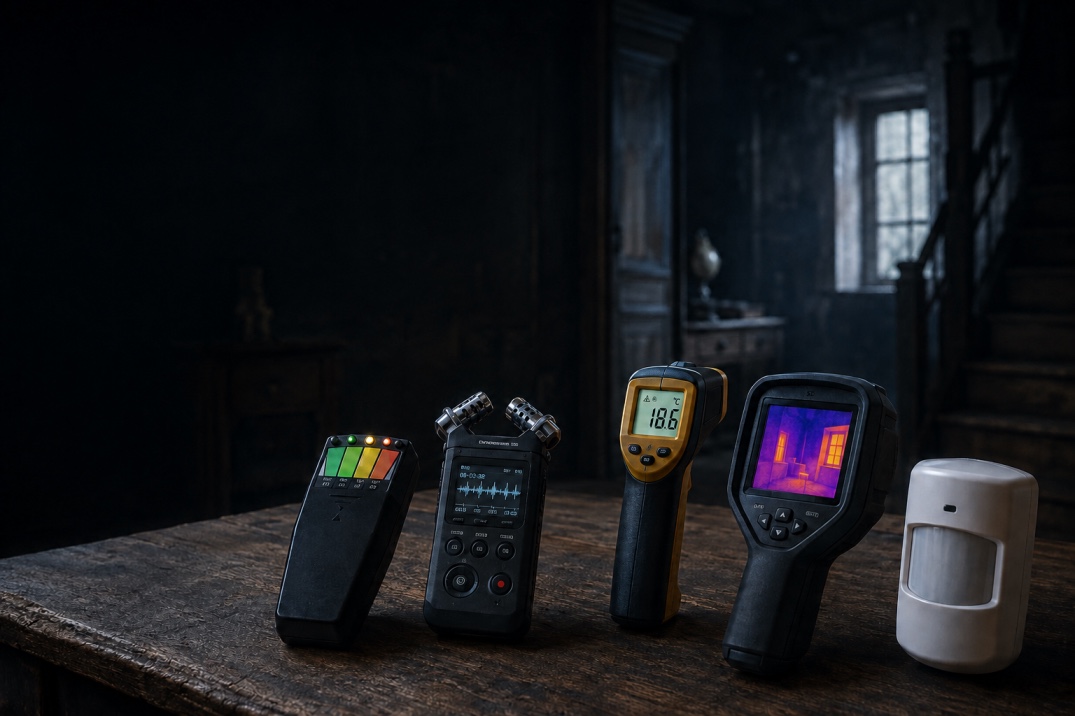
The K-II style meter is the one you have seen on television: five lights, no numbers, no setup. It measures electromagnetic fields, which is all it measures. That is worth being clear about, because a meter lighting up next to old wiring is a meter working correctly.
Buy this before anything else. If you only ever own one instrument, own this one.
A numeric EMF meter
A meter that gives you an actual reading in milligauss rather than a row of lights. Slower to read in the dark, far more useful afterwards, because "it spiked" means nothing and "it went from 0.3 to 8.1 and back" means something.
The upgrade once the light-up meter stops satisfying you.
Sound
A digital voice recorder
For EVP work, the recorder matters less than the file it writes. Look for uncompressed recording, because compression invents artefacts in exactly the frequency range people mistake for voices.
Record the room before and after. A recording with no control is a recording that proves nothing.
An external microphone
Built-in microphones pick up the recorder's own handling noise, and handling noise is responsible for a great many famous EVPs. An external mic on a stand removes the single largest source of false positives in the hobby.
Seeing in the dark
A full spectrum or infrared camera
A camera with the infrared filter removed sees a little beyond what your eyes do. What it mostly sees is dust, insects and lens flare, all of which look remarkable at two in the morning and ordinary in daylight.
Learn what dust looks like on your own camera before you take it anywhere interesting.
An infrared illuminator
An infrared camera in a genuinely dark room needs infrared light, the same way an ordinary camera needs ordinary light. Most disappointing night footage is an illumination problem rather than a haunting problem.
Temperature
An infrared thermometer
Cheap, instant, and widely misunderstood. It reads surface temperature at a single point, not air temperature, so pointing it at a wall and calling the result a cold spot is measuring the wall.
Useful for finding draughts and cold masonry, which is more often than not what a cold spot turns out to be.
A thermal imaging camera
The phone attachment versions have become genuinely affordable. A thermal camera shows you the whole room at once instead of one dot, which is the difference between guessing where the cold is and seeing it.
The most expensive thing on this list, and the one that most often explains what is happening.
The unglamorous half
A tripod
A fixed camera that ran all night beats a handheld camera that was pointed at the interesting thing after it happened. It also removes camera shake, which accounts for a good share of moving orbs.
A red light headlamp
Red light preserves your night vision, and a headlamp keeps both hands free. Every experienced investigator owns one, and it costs less than any instrument on this page.
Far more batteries than you think
Equipment draining its batteries is treated in the field as paranormal activity more often than anything else on this page. Carry spares, log the changes, and the phenomenon usually stops.
A notebook and a watch
The single most valuable habit in the hobby is writing down the time of everything, including the ordinary. A log of what the building did all night is what turns an anecdote into something anyone else can check.
How to use any of it without fooling yourself
Take a baseline first. Walk the whole building before anything interesting happens and write down what every instrument reads in every room. Wiring, fuse boxes, appliances and phones all produce fields, and a meter that jumps near a wall usually means there is a cable in the wall. Without a baseline you have no way of knowing.
Log the time of everything, including the ordinary. The value of a night is not the one dramatic moment; it is being able to say afterwards what the building was doing all night and how the moment differed from it.
Change one thing at a time. If the meter spikes, do not immediately ask a question, turn on a torch and move across the room. Stand still and see whether it spikes again. Most reported activity does not survive being repeated.
Record the room before and after. An audio file with no control is a file that proves nothing, and controls are free.
Learn what your own gear does wrong. Photograph dust in a beam of light in your own kitchen. Handle your recorder badly on purpose and listen to what it produces. Almost every famous artefact in this hobby has an ordinary twin you can create yourself in ten minutes, and knowing what they look like is worth more than any upgrade.
What we would not bother with
Anything sold as detecting spirits directly. If a device claims to do the thing no instrument can do, the claim is the product.
Word generating boxes and apps that speak from a fixed vocabulary. Given enough words and a room full of people hoping, something relevant will always be said. That is a property of the vocabulary, not of the building.
Very cheap bundled kits. They tend to pair a usable meter with three items you will never take out of the bag. You are better off buying one good instrument at a time.
Before you go anywhere
Get permission. A great deal of what is written about ghost hunting quietly assumes trespass, and the places worth visiting almost always have an owner, a caretaker or a historical society who can say yes. Asking also tends to get you the building’s actual history, which is more interesting than anything a meter will tell you.
Never go into a derelict building because it is atmospheric. Floors, asbestos and open shafts have hurt far more investigators than anything else has.
And go with someone. Two people who both saw it is the beginning of a record. One person alone at three in the morning is a story, and this site already has several hundred of those.
Reader sightings
Nobody has reported anything here yet. If you have been, you would be the first.
Leave a Reply