
Reviewed by Josh N · Updated August 3, 2026 · How we verify
Reported Phenomena
- Rocking chair apparition
- Smiling spectral figure
Reported by visitors & local legend. Stories, not verified claims.
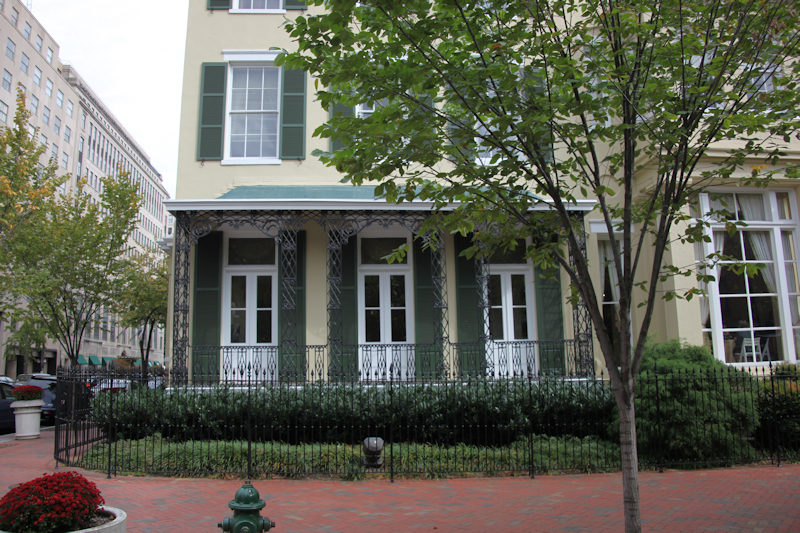
Every account of the Dolley Madison House ghost places her in the same spot: seated in a rocking chair on the west side of a brick house on Lafayette Square, smiling at people walking past. The odd detail is that the porch she is supposed to be rocking on has not existed for well over a century. The Cutts-Madison House still stands at 1520 H Street NW in Washington, D.C., but it now works for a living as part of a federal courts complex, and the porch became a window in the 1850s.
Quick orientation: the house is a Federal-style residence at 1520 H Street NW, built by Richard Cutts, later home to former First Lady Dolley Madison from November 1837 until her death in July 1849. It sits within the Lafayette Square Historic District, a National Historic Landmark District, and is now owned by the federal government and used as part of a federal courts complex. There is no public tour.
What Richard Cutts Built on Square 221
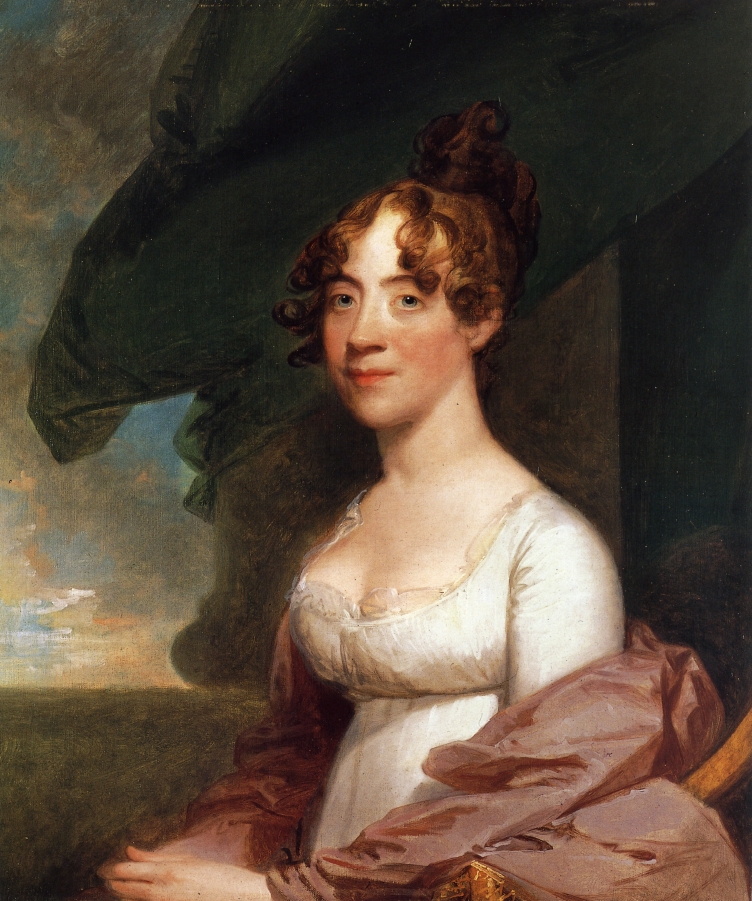
Richard Cutts bought lots 12, 13, 14, and 15 of square 221 from the heirs of Samuel Davidson on October 3, 1818, and the house was constructed in 1818 for himself and his wife, Anna Payne Cutts, who was Dolley Payne Madison’s sister. It rose two stories with a gabled roof, dormer windows and chimneys at the north and south ends, and the exterior was originally grey stucco rather than the brick face most visitors picture. The front looked out onto Lafayette Square, and a large garden of flowers and fruit trees filled the east and south sides of the lot. Contemporaries considered it one of the more pretentious homes in the young city.
Cutts had borrowed to build it. On August 22, 1828, the bank holding the mortgage sold the property to ex-President James Madison for $5,750.
Dolley Madison’s Years at 1520 H Street
When James Madison died in 1836, Dolley Madison held the mortgage, and her husband’s death had left her in a financially difficult position. To reduce her expenses she took up residence in the house in November 1837. What followed was one of the most sociable addresses in the capital. Presidents James Monroe, John Quincy Adams, Andrew Jackson, Martin Van Buren, William Henry Harrison, John Tyler, James K. Polk and Zachary Taylor all visited her there, as did John C. Calhoun, Henry Clay and Daniel Webster.
Her money troubles did not ease. She left in 1839 to live once more at Montpelier and see if she could save the estate, renting the H Street house out in the meantime. Montpelier could not be stabilised. She returned to the house in 1843, and sold Montpelier in 1844.
The Matches in the Shutters
In 1844 or 1845, after her return, arsonists pushed lit matches into the shutters at the rear of the house, and Dolley Madison had to be wakened and saved from death by a servant. The fire was put out quickly and the damage to the building was not extensive. She went back to her own bedroom the same night. This is recorded history rather than legend, and it is worth separating from the ghost story, because the two are often blurred together by retellings.
She lived in the house on Lafayette Square until her death on July 12, 1849. Her only surviving child, John Payne Todd, from her first marriage to the Quaker lawyer John Todd, inherited the property, and on April 3, 1851, Todd sold the house to Charles Wilkes.
How Charles Wilkes Erased the West Porch
Rear Admiral Charles Wilkes remodelled hard. He moved the entrance from Madison Place NW around to H Street NW and turned the porch on the west side of the house, the one facing Madison Place, into a window. The gable roof was eliminated and a flat roof installed, an outbuilding went up at the rear, and a bay window was added on the south side. Later tenants were consequential: after the First Battle of Bull Run, General George B. McClellan used the house as his Washington headquarters, first occupying it on July 26, 1861.
In 1886 the Wilkes family sold the house to the Cosmos Club for $40,000. The club raised the roof to improve the third floor, added a large meeting hall, and in the 1890s removed the eastern garden entirely to make room for a three-story addition. The Cosmos Club left in 1952 to move to the Townsend Mansion at 2121 Massachusetts Avenue NW, at which time the building was purchased by the U.S. government and used for offices.
Nearly Demolished for a Marble Vision
The house came close to being lost. The McMillan Plan proposed that all the buildings around Lafayette Square be razed and replaced by tall Neoclassical buildings clad in white marble. Resistance built slowly. The American Institute of Architects devoted the February 1961 issue of its journal to a “Lament for Lafayette Square,” and in February 1962 First Lady Jacqueline Kennedy lobbied General Services Administration director Bernard L. Boutin to stop the demolition and adopt a different design plan. Architect John Carl Warnecke’s answer was to build tall, flat structures in red brick as a background to the older houses. The Cutts-Madison House, the Cosmos Club building and the Benjamin Ogle Tayloe House were joined, with a courtyard set between them and the National Courts building. The complex today houses offices and chambers for the United States Court of Federal Claims and the United States Court of Appeals for the Federal Circuit.
The Woman in the Rocking Chair
The reported haunting is narrow and consistent, which is unusual. Since the mid-19th century, witnesses have claimed to have seen the ghost of Dolley Madison rocking in a chair in the space where the porch on the west side of the house used to be, smiling at passersby. That is the whole of it: no footsteps in corridors, no cold spots, no voices. Note the chronology, because it is the most interesting thing about the story. Wilkes bought the house in 1851, two years after her death, and it was Wilkes who converted that west porch into a window. The sightings are said to begin in the same rough era, which means the apparition has always been described as sitting on a feature that had already been taken away. Whether that makes the account more curious or simply more suspect is left to the reader. No verified event underlies it.
Seeing the Cutts-Madison House from Madison Place
This is a working federal courts building, not a museum, so treat it as an exterior visit. The house faces Lafayette Square, and Madison Place NW gives the view of the west elevation where the porch once was and where the rocking figure is reported. Look for the seams in the fabric: the flat roof that replaced the gable, the H Street entrance Wilkes installed, and the later Cosmos Club additions on the south and east where a garden of fruit trees once ran toward the Tayloe House.
Address: 1520 H Street NW, Washington, D.C.
Sources
Frequently Asked Questions
Where is Cutts Madison House Lafayette Square located?
Cutts Madison House Lafayette Square is located at 1520 H Street NW, Washington, D.C.
Can you visit Cutts Madison House Lafayette Square?
Cutts Madison House Lafayette Square is on private property and best viewed from a distance. Always follow posted rules and respect private property.
Reader sightings
Nobody has reported anything here yet. If you have been, you would be the first.
Report your own visit to Dolley Madison House Ghost and the Porch That Vanished
How haunted is this place?
Be the first to rate


Leave a Reply