

Reviewed by Josh N · Updated October 3, 2026 · How we verify
Reported Phenomena
- Room 217 tidying
- Children
- Cold presence in bed
- Objects moving in halls
- Apparition on staircase
- Presence in billiard room
- Presence in music room
Reported by visitors & local legend. Stories, not verified claims.
Five miles from the entrance to Rocky Mountain National Park, the Stanley Hotel sits on a granite shelf above Estes Park, Colorado, a white Georgian Revival building that looks as though it was lifted off a New England hillside and set down in the Rockies by mistake. It has 140 rooms, a view that takes in Lake Estes and Longs Peak, and a reputation as one of America’s most haunted hotels. That reputation is younger than the building. For most of its life this was a summer resort for wealthy Easterners and people trying to outrun tuberculosis. The ghosts arrived, in the public imagination at least, after 1977.
Quick Facts: The Stanley in Estes Park
- Opened: July 4, 1909, built by Freelan Oscar Stanley of the Stanley Motor Carriage Company
- Size and style: 140 rooms, Colonial Revival, part of a National Register historic district of 11 contributing structures
- Claim to fame: the model for the Overlook Hotel in Stephen King’s The Shining, and the filming location for King’s 1997 television miniseries
- Still operating: yes, with a restaurant, spa, bed-and-breakfast lodging and paid tours
The Lunger Who Decided to Build a Resort Town
In 1903, Freelan Oscar Stanley, co-inventor of the steam car that carried his name, suffered a life-threatening resurgence of tuberculosis. The standard prescription of the era was dry air, sunlight and good food, so Stanley did what many consumptives did and went west. He and his wife Flora reached Denver in March and, on the recommendation of Dr. Sherman Grant Bonney, moved up to Estes Park in June for the rest of the summer. His health improved dramatically. He decided to come back every year.
By 1907 he had recovered completely, and he had also decided that the valley’s rustic cabins were not good enough. Construction began that year on a 48-room grand hotel pitched at the moderately wealthy urbanites of the Stanleys’ Eastern social circle, and at consumptives seeking the same climate that had saved him. The land was bought in 1908 from the representatives of the 4th Earl of Dunraven, the Anglo-Irish peer who had claimed some 15,000 acres of the Estes Valley between 1872 and 1884 in a failed attempt to fence off a private hunting preserve. Dunraven was so unpopular with local ranchers that when Stanley floated “The Dunraven” as a name for the hotel, 180 people signed a buckskin petition asking him to use his own name instead.
The main hotel and concert hall were finished in 1909 and the Manor, now called The Lodge, in 1910. Guests came up from the train depot at Lyons in purpose-built steam-powered Mountain Wagons made by Stanley’s own car company. Stanley ran the place almost as a hobby and once remarked that he spent more each summer than he made. He sold out in 1926, bought the hotel back out of foreclosure in 1929 after the venture failed, and sold it again in 1930 to the Denver hotel magnate Roe Emery. Until 1983 the resort closed every winter.
A Hotel Designed Around a Pair of Lungs
The architecture is not just decoration. Stanley designed the buildings himself with help from the Denver architect T. Robert Wieger, Henry “Lord Cornwallis” Rogers and contractor Frank Kirchoff, and the layout follows the siting and ventilation rules laid out in Bonney’s book on pulmonary tuberculosis: a southern exposure, mountains at the back, deep porches, and spectacular views intended to break the monotony for invalids. There was no central heating and no ventilation system. The Palladian window above the grand stair opened to pull a cross-breeze through the lobby, French doors opened onto verandas, and two curving staircases kept air from stagnating upstairs. The hotel never operated as a sanitarium, but it was built as though it might need to.
It opened as one of the first fully electrified hotels in the country, powered by the Fall River Hydroplant that Stanley built, which also brought electric light to the town of Estes Park for the first time. Every room had a telephone. The exterior was originally yellow ocher with white trim and was not painted white until around 1935, under Emery. In 1983 a service tunnel was cut straight through the living granite beneath the hotel to connect the basement corridor to the staff entrance, a detail that has since become a fixture of the ghost tours.
What Actually Happened on June 25, 1911
The incident at the root of the hotel’s best-known ghost story is real, though the details have been worn smooth by retelling. Despite the hotel’s all-electric boast, available power proved insufficient, and an auxiliary gas lighting system was installed in June 1911. On June 25, the day after the pipes were filled, an explosion tore into the building and injured a maid.
Contemporary newspapers disagree about almost everything after that. A brief Associated Press item telegraphed to the York Dispatch in Pennsylvania reported that the hotel, built at a cost of $500,000, was “partly wrecked” by a gas explosion, that eight people were hurt and one seriously, that no guests were injured, and that a hotel employee named Elizabeth Wilson of Lancaster, Pennsylvania, was thrown from the second floor to the first and broke both ankles. The other seven injured were waiters. When the Lancaster paper reprinted the story, its editor noted that no Elizabeth Wilson appeared in local directories and that she could not be identified as a Lancastrian at all. Colorado papers called the maid Elizabeth Lambert. The most detailed account, published in the Fort Collins Express on June 29, flatly refutes the claim that she was hurled from one floor to another.
The version told on the ghost tours is tidier: the power failed after a flood, Stanley issued gas lanterns to the rooms, and head chambermaid Elizabeth Wilson walked into room 217 with a lit candle, triggering a blast said to have sent a bathtub flying through the air. She survived and returned to work. What survives in the newspaper record is an explosion, an injured maid, and a name nobody could verify.
One Night in 1974, and the Overlook
Stephen King and his wife Tabitha were living briefly in Boulder in 1974 when locals recommended a mountain resort an hour north. They arrived as everyone else was leaving, because the hotel was shutting down for the winter, and found themselves the only guests in the building. Everything known about that night comes from interviews King has given since, and he has told it more than one way.
In a 1977 Literary Guild interview he described dinner served in an empty dining room with every chair but theirs stacked on the tables and canned orchestral music echoing down the hall: by the time he went to bed, he said, he had the whole book in his mind. In another telling, he dreamed of his three-year-old son running through the corridors screaming, pursued by a fire hose, woke up soaked in sweat, and sat by the window with a cigarette until the bones of the novel were set. George Beahm’s Stephen King Companion adds a third strand: King wandering the halls, drinking at the bar where the bartender was named Grady, then pulling back the pink curtain on a claw-foot tub and thinking, what if somebody died here.
The Shining was published in 1977. King’s front matter politely insists the Overlook “and the people associated with it exist wholly in the author’s imagination.” Room 217 at the Overlook is the novel’s bad room, and room 217 at the Stanley is said to be the one King was given, which is plausible enough given that the hotel was empty and 217 is one of the better rooms in the house. Stanley Kubrick did not film at the Stanley, but King’s own 1997 miniseries did, with the hotel standing in for the Overlook. The hedge maze on the front terrace is a 2015 addition built in homage to Kubrick’s film; the novel has topiary animals and no maze at all.
What Guests Say Happens Here
The hotel’s early history was, by all accounts, peaceful. The paranormal reputation grew after the novel and has been amplified by appearances on Ghost Hunters and Ghost Adventures. These are reported experiences, not documented events.
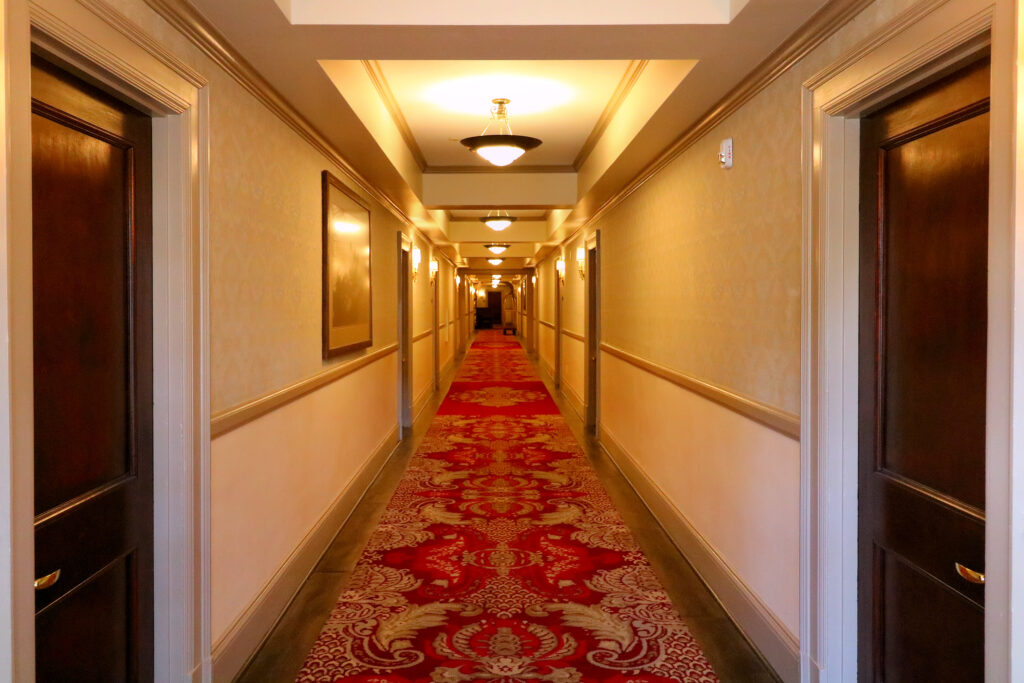
Room 217 attracts most of them. Guests describe waking to find the room tidier than they left it, clothes folded and suitcases organized, which is attributed to Elizabeth Wilson still working her shift. The lore draws a line between married and unmarried couples: married guests report only the housekeeping, while unmarried couples have claimed a cold presence settling into the bed beside them. On the fourth floor, visitors report children running and laughing in the corridors and objects shifting in the halls, with nobody there when they look. Guests also say they feel or glimpse F.O. Stanley himself, most often in the billiard room and the bar, fitting for a man who did not smoke or drink but loved billiards. Flora Stanley’s presence is reported around the piano in the music room. Stanley died of a heart attack in Newton, Massachusetts, on October 2, 1940, aged 91, a year after his wife.
Longer-running tour lore adds figures that do not appear in the hotel’s documented history: a cowboy seen sitting on beds in certain rooms, a former employee called Paul who is said to enforce an eleven o’clock curfew, and a girl in a white nightgown near the main staircase. Treat those as stories told about the building rather than anything on the record.
The Frozen Dead Guy in the Ice House
In August 2023 the hotel acquired Colorado’s strangest resident. Bredo Morstøl, the cryogenically frozen man behind the state’s annual Frozen Dead Guy Days festival, was moved from a shed in Nederland to the Stanley’s ice house with help from the Alcor Life Extension Foundation, which set up a new cryonic chamber for him. The hotel renamed the building the International Cryonics Museum and sells tours of it.
Staying at the Stanley Hotel
This is a working hotel, not a ruin, so the simplest way to see it is to book a room. There is a restaurant, a spa, bed-and-breakfast accommodation in The Lodge, and a schedule of guided tours covering both the history and the hauntings. The concert hall, restored in the 2000s, still hosts events, and the indie rock band Murder by Death have played an annual run of winter concerts at the hotel since 2014. From 2013 to 2015 the property hosted the Stanley Film Festival, a horror festival run by the Denver Film Society, which went on hiatus in 2016. Film pilgrims should note that the hotel also stood in for an Aspen resort in Dumb and Dumber in 1994.
Expect construction. In May 2025 it was reported that the hotel had been bought for $400 million by The Stanley Partnership for Art Culture and Education, a public-private partnership involving the Colorado Educational and Cultural Facilities Authority, former owner John Cullen IV as chairman of the ownership board, and private bond investors. The new owners have announced a $60 million, three-year project to preserve the surrounding land while adding 64 rooms, a new lobby and a porte cochere. Anyone hoping for the empty off-season hotel King found in 1974 is about forty years too late: the main building has been heated and open year-round since the 1980s, and in high season it is anything but quiet.
See The Stanley Hotel for Yourself
Sources
- Would you dare to stay at the 'haunted' hotel that inspired horror classic The Shining?
- Hauntings Of The Stanley Hotel
- The Stanley Hotel's (Supposedly) Haunted History
- Stanley Hotel sold in $400 million deal with plans to expand
- The Haunted Stanley Hotel in Estes Park, Colorado
- Wikipedia: The Stanley Hotel
Frequently Asked Questions
Where is The Stanley Hotel located?
The Stanley Hotel is located at 333 Wonderview Avenue.
Can you visit The Stanley Hotel?
The Stanley Hotel is a place where you can stay overnight. Always follow posted rules and respect private property.
Reader sightings
Nobody has reported anything here yet. If you have been, you would be the first.
Report your own visit to Room 217: The Stanley Hotel’s Explosion and Its Ghosts
How haunted is this place?
Be the first to rate
Leave a Reply