
Reviewed by Josh N · Updated August 25, 2026 · How we verify
Reported Phenomena
- Disembodied voices
Reported by visitors & local legend. Stories, not verified claims.
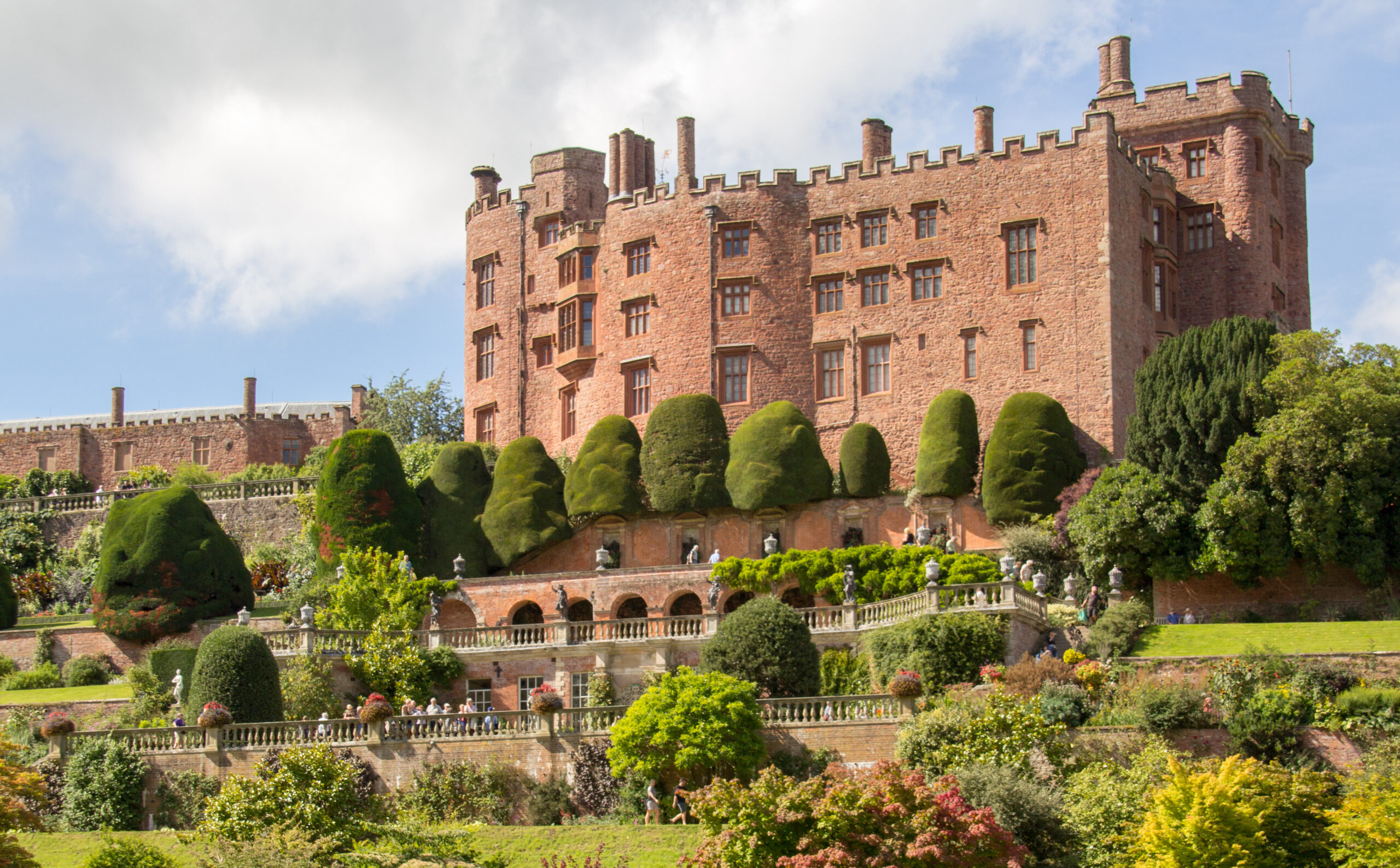
Search for haunted Powis Castle and the name comes back attached to the usual promises: figures on stairs, cold rooms, watching eyes. What the documentary record supports is something different and, in its way, heavier. Powis Castle is a medieval castle, fortress and grand country house near Welshpool, in Powys, and across nine centuries it has absorbed a razing, a siege, a family exile, a fatal shooting and the loss of an entire garden. None of that is a ghost story. All of it is on paper.
The castle and gardens are under the care of the National Trust, and Powis Castle is a Grade I listed building. It receives around 200,000 visitors a year. The Herbert family continue to live in part of the castle under an arrangement with the Trust, which makes this an unusual site: a working home wrapped around a museum wrapped around a thirteenth century keep.
A Welsh Prince’s Castle on the Marches
Most of the great castles of this border country were English work aimed at the Welsh. Powis was not. Unusually for a castle on the Marches, it was constructed by a Welsh prince, Gruffydd ap Gwenwynwyn, rather than by a Norman baron. The site’s paper trail begins earlier still: the earliest reference dates from 1111, when Cadwgan ap Bleddyn is mentioned as having planned to construct a castle at Trallwng Llywelyn, the oldest record of a native Welsh castle. Whether he finished it is unknown, because he was assassinated the same year.
Violence set the pattern. In 1274, Gruffydd’s “first castle” at Welshpool was destroyed by Llywelyn ap Gruffudd as punishment for his involvement in a scheme to assassinate Llywelyn. Gruffydd had backed Edward I instead, and at the close of the conquest the king permitted Gruffydd to rebuild his castle at Welshpool as a reward for his loyalty. By 1286 it appears in the record as “la Pole Castr”.
22 October 1644 and the Long Herbert Exile
Sir Edward Herbert bought the castle outright in 1587, beginning the connection between the Herberts and Powis Castle which continues today. His Long Gallery survives from that Elizabethan phase, built to a T-plan, an unusual design for an Elizabethan long gallery.
The family’s Catholicism and its loyalty to the Stuarts then cost it almost everything. On 22 October 1644 Powis Castle was captured by Parliamentary troops and was not returned to the family until the restoration of Charles II in 1660. Restored and elevated to a marquessate, William Herbert fell at the Glorious Revolution of 1688 and followed James into exile in France. He died, still in exile, in 1696, while a Dutch favourite of William III held his castle.
Two of the rooms visitors see date from those swings of fortune. The State Bedroom is the only remaining one in Britain where a balustrade separates the bed alcove from the rest of the room, a piece of Versailles etiquette imported into the Welsh border. The great staircase was built c. 1673-85, probably under the direction of William Winde, with a ceiling painting by Verrio.
Deaths in the Herbert Line
If anything at Powis has earned an atmosphere, it is the run of family deaths recorded here. Edward Herbert died in 1848, following a shooting accident at Powis in which he was fatally injured by his second son. In the twentieth century the 4th Earl outlived his whole household: his wife Violet died following a car accident in 1929, and he outlived both his sons, who died on active service, Percy from wounds received at the Battle of the Somme in 1916, and Mervyn in a plane crash in 1943. On his own death in 1952, he bequeathed the castle and gardens to the National Trust.
Terraces, Yews and the Water Garden That Was Erased
The gardens are the reason many people come, and they are as scarred as the building. Four of the terraces remain, the last two having reverted to banks of earth covered with shrubs, each 150 metres in length. The yews on the Top Terrace were originally tightly clipped in the form of obelisks, and they have grown into an array of amorphous shapes: the single most photographed thing at Powis and the closest the place comes to looking deliberately eerie. The 14 “tumps” on the Top Terrace, and the hedge at its eastern end, were planted by the 2nd Marquess in the 1720s.
Below them, nothing. The Powis water garden lasted just over 100 years, and was dismantled by 1809, on the advice of William Emes, who also proposed the demolition of the terraces by explosives. The earl declined that part. The pools, fountains and statuary went, and the Great Lawn took their place.
What Is Actually Reported Here, and What Is Not
This is the point at which an honest field guide has to stop. The historical record for Powis Castle set out above contains no verified paranormal event, no named witness, no dated sighting and no consistent account of activity in any particular room. Anyone offering a specific ghost with a specific name at Powis is working from something that is not in the documented history of the site. Report it as folklore if you meet it, not as record.
What the castle does have is the ingredient list that produces such stories: seven centuries of continuous occupation, a family that lost the place twice, a man killed by his own son’s gun on the estate, and interiors that Pevsner’s Buildings of Wales calls “the most magnificent in Wales”. Go for that, and treat any whisper you hear about the corridors as an unsourced extra.
Visiting Powis Castle and Garden
Powis Castle and its gardens are open to the public under the National Trust, a short distance from Welshpool. Expect the terraces to take as long as the house. Note before you go that the great staircase has been closed to visitors to the castle for many years, because of structural instability; a structural survey undertaken in 2020 investigated whether staircase vibrations caused by visitor footfall were damaging the wall and ceiling paintings, and concluded there was no direct link.
Inside the North Range is the Clive Museum, opened in 1987 next to the ballroom, holding material brought back from India by Robert Clive and later by Edward and Henrietta Clive. It is the most contested part of the visit. According to William Dalrymple, much of the wealth amassed by Clive was loot that was illicitly collected after the Battle of Plassey, and the museum has been the focus of controversy in the twenty first century as awareness of the links between country house collections and colonialism has grown. The Trust has committed to supporting reinterpretation of the South Asian collection. Whatever you came looking for on the terraces, that room is the one most likely to unsettle you.
Address: Welshpool, Powys, Wales
See Powis Castle for Yourself
Sources
- Powis Castle; Regional Historic Environment Record
- Sir Edward Herbert
- William Herbert, 1st Marquess and 1st Duke of Powis
- Herbert family, Earls of Powis
- The Clive Museum at Powis
- Wikipedia: Powis Castle
Frequently Asked Questions
Where is Powis Castle Welshpool Terraces located?
Powis Castle Welshpool Terraces is located at Welshpool, Powys, Wales.
Can you visit Powis Castle Welshpool Terraces?
Powis Castle Welshpool Terraces is open to the public. Always follow posted rules and respect private property.
Reader sightings
One reader has told us what happened to them here.
- 1 saw a figure
- 1 heard a voice
- 1 felt touched
- 1 felt watched
- 1 had equipment play up
- Elsie
Actually, there are two specific times I have witnessed the strange and otherworldly here. 1. As a child in the museum there was a mirror in which I saw a Girl about 19 in white and black clothing, nothing medieval. She just stared at me, said nothing, but she was not my reflection as I know it. 15 years later I returned. Skipped into a room above the stairs on the left wing of the castle if looking at it from the garden. I heard a female voice say "Huh" Loudly, startled from the bed post as I skipped into her room feeling no signs of ghostly presence previously, I figured I was safe and gave no regard to thinking about it and it was at that moment I heard it. What followed was a feeling of being stabbed in the chest and my grandma who sadly passed away now went into the room to see what all the fuss was about and all I remember is her asking an elderly lady outside the room if the glass in the mirror was ever replaced or if it had always been there as it had no reflection of the room, to which the lady responded It is the original glass.
Would go back.
Report your own visit to Haunted Powis Castle: 900 Years of Record, No Ghost in It
How haunted is this place?
Be the first to rate
Leave a Reply