
Reviewed by Josh N · Updated August 25, 2026 · How we verify
Reported Phenomena
- Spectral figures
- Cold spots
Reported by visitors & local legend. Stories, not verified claims.
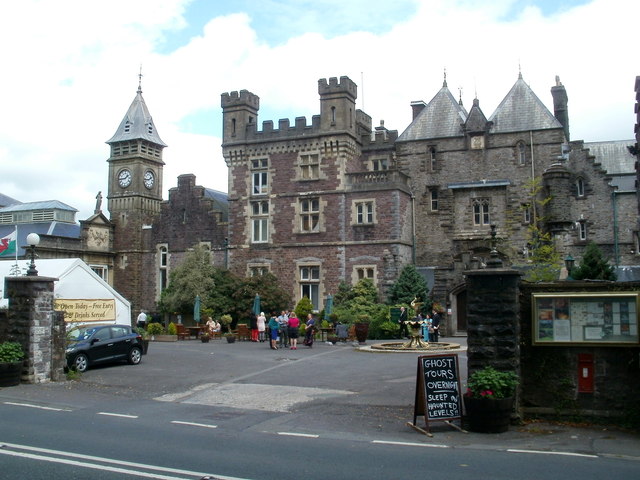
Few buildings in Wales carry three lives as distinct as this one. Craig-y-Nos Castle ghost tours are advertised today at a Scots baronial country house near Glyntawe in Powys, a place that began as a Victorian gentleman’s mansion, was rebuilt by one of the most famous opera singers in the world, and then spent sixty-four years as a hospital, much of it treating children with tuberculosis. The name means Rock of the Night.
Quick orientation: the house stands on parkland beside the River Tawe in the upper Swansea Valley, on the southeastern edge of the Black Mountain. It is a Grade II* listed building, its theatre carries a separate Grade I listing, and its landscaped grounds are now a country park managed by the Brecon Beacons National Park Authority and listed on the Cadw/ICOMOS Register of Parks and Gardens of Special Historic Interest in Wales.
Captain Powell’s House and the Morgans Who Followed
The main building went up between 1841 and 1843 for Captain Rhys Davies Powell, to designs by Thomas Henry Wyatt. The family’s story reads grimly in the record: Powell’s younger son, his wife and his younger daughter all died before he did. He died in 1862, his eldest son followed in 1864, and his surviving daughter Sarah inherited. When her husband died in 1875 the estate was sold.
After passing into the trust of the Chancery, it was bought in 1876 by Morgan Morgan of Abercrave for £6,000. Two generations of Morgans, the captain and his family alongside his son of the same name and his own household, lived jointly in the castle for several years. They cleared a large plantation of eighty-year-old fir trees standing between the castle and the quarries above, said to be home to a local population of red squirrels.
What Adelina Patti Built at Craig-y-Nos
In 1878 the soprano Adelina Patti bought the castle and its surrounding parkland for £3,500 to develop as her own private estate. She spent the rest of her life there, leaving only to sing in the premier opera houses of Europe and to tour the United States. After her second marriage, to the French tenor Ernesto Nicolini, she began a major building programme: the north and south wings, the clock tower, the conservatory, the winter garden and the theatre. Her last public appearance came in October 1914, when she sang for the Red Cross and filled the Albert Hall.
The estate was extraordinarily well connected for a house at the head of a Welsh valley. Patti part funded the Neath and Brecon Railway’s Craig-y-nos station, built a private road down to it and had a lavishly furnished private waiting room installed. In return the railway company provided her with her own carriage, which she could have attached to any train to take her anywhere in the United Kingdom she wished. By the start of the twentieth century she had one of the first motor cars in Wales, and is reported to have raced a local doctor from Swansea to Abercrave for a small wager.
Craig-y-nos was probably the first private house in Wales to be wired for electricity. An Otto engine in the grounds produced a 110 V DC supply, distributed by two bare copper wires laid in adjacent grooves carved into a plank of wood with a second plank placed over the top. It powered Swan lamps throughout the castle and a Welte Concert Orchestrion in the French billiards room, worked by a perforated paper roll. The rediscovery and investigation of the system is credited to Mr J. A. Lea, the last hospital secretary.
Inside the Adelina Patti Theatre
The theatre is the reason the building matters architecturally. Patti briefed the Swansea architects Bucknall and Jennings, with input from Sir Henry Irving, to give her a miniature version of La Scala in Milan, and the result borrows features from Wagner’s Bayreuth Festspielhaus and the Theatre Royal, Drury Lane. The auditorium measures 12 m long, 7.9 m wide and 7.3 m high, and was originally decorated in pale blue, cream and gold panels. Ten Corinthian columns support the ceiling, with the gilded names of composers including Mozart, Verdi and Rossini set between them, each surmounted by Patti’s monogram. The back drop shows Patti riding in a chariot as Semiramide.
Its cleverest feature is a mechanical auditorium floor that can be raised level for use as a ballroom or sloped towards the stage for performances. It seats 150, with a gallery at the back where the domestic staff sat so they could enjoy the performances, and an orchestra pit holding up to twenty-four musicians. The organ, presented to Patti in the United States after one of her tours, was dismantled in the 1920s when the buildings became a hospital.
The opening event, on 12 July 1891, split its guest list between those invited to stay and those invited only for the performance. House guests included the Spanish Ambassador, Baron and Baroness Julius De Reuter and Lord and Lady Swansea, along with journalists from The Daily Telegraph, Le Figaro and the Boston Herald. Sir Henry Irving was to have given the opening address but could not attend, so the actor William Terris deputised. Scheduled for 20:00, the performance began at 20:30 after a light tea. Patti sang the prelude to act one of La traviata and, after the interval, the Garden Scene from Faust. A buffet supper followed in the conservatory, at which 450 bottles of champagne were consumed. The stage today is probably the only surviving example of original nineteenth century backstage equipment anywhere.
The Children of Craig-y-Nos
Patti died in 1919. In March 1921 the castle and grounds were sold for £11,000 to the Welsh National Memorial Trust, founded to combat tuberculosis in Wales. Reconstructed as a sanatorium and named the Adelina Patti Hospital at the request of her widower, it admitted its first patients in August 1922. In 1947 the children at Craig-y-nos were among the first in the UK to be given streptomycin, the first effective TB medicine. From 1959 it served as a hospital for the elderly, and it closed on 31 March 1986 once the remaining patients had transferred to the new Ystradgynlais Community Hospital.
The human texture of that period is recorded in the book The Children of Craig-y-nos by Ann Shaw and Carole Reeves, and in a 2007 exhibition at the Welfare Hall in Ystradgynlais, supported by the Heritage Lottery Fund, the Sleeping Giant Foundation, the Wellcome Trust Centre and University College of London, which displayed relics and recorded recollections of former patients. One of them was the rugby player Clive Rowlands, admitted in 1947 at eight years old. Given a rugby ball as a gift, he accidentally kicked it through a glass door and was put in a straitjacket for a week.
Where the Ghost Stories Sit in the Record
Visitors should be clear about what is documented and what is not. The castle itself now advertises ghost tours as part of its programme, and the pairing of a long institutional hospital history with an intact Victorian theatre is exactly the combination that attracts paranormal interest. The published record for the building, however, deals in deeds, listings and medical history rather than in named apparitions, and no specific sighting, cold spot or figure on the stairs is verified here. If you want the atmosphere, it is genuinely there in the theatre and the old ward corridors. Treat any story you are told on the night as folklore offered by the house, not as documented fact.
Staying at Craig-y-Nos and Seeing the Theatre
Craig-y-Nos operates as a hotel and wedding venue with guest accommodation, and it takes dogs. The opera house is licensed for weddings, so access to it can depend on what else is booked that day. The ghost tours run alongside the events programme. The grounds, as a country park under the Brecon Beacons National Park Authority, are the easiest part of the estate to see without a booking.
Screen credits give another reason to look closely at the exterior: the castle appeared in the 2005 Doctor Who episode Tooth and Claw with David Tennant and Billie Piper, and the Torchwood crew later stayed here and filmed scenes for Countrycide.
Address: Craig-y-Nos, near Glyntawe, Powys, Wales
See Craig-y-Nos Castle for Yourself
Sources
- Adelina Patti: queen of hearts
- The Theatre at Craig-y-nos
- Wedding venue in Swansea: civil ceremony theatre
- Castle History – The Conservatory and Winter Gardens
- Adelina Patti
- Wikipedia: Craig-y-Nos Castle
Frequently Asked Questions
Where is Craig Y Nos Castle Powys located?
Craig Y Nos Castle Powys is located at Craig-y-Nos, near Glyntawe, Powys, Wales.
Can you visit Craig Y Nos Castle Powys?
Craig Y Nos Castle Powys is a place where you can stay overnight. Always follow posted rules and respect private property.
Reader sightings
Nobody has reported anything here yet. If you have been, you would be the first.
Report your own visit to Adelina Patti’s Opera House: Craig-y-Nos Castle Ghost Tours
How haunted is this place?
Be the first to rate
Leave a Reply