
Reviewed by Josh N · Updated August 25, 2026 · How we verify
Reported Phenomena
- Green Lady apparition
- Portent of fire
- Repeated visitor sightings
Reported by visitors & local legend. Stories, not verified claims.
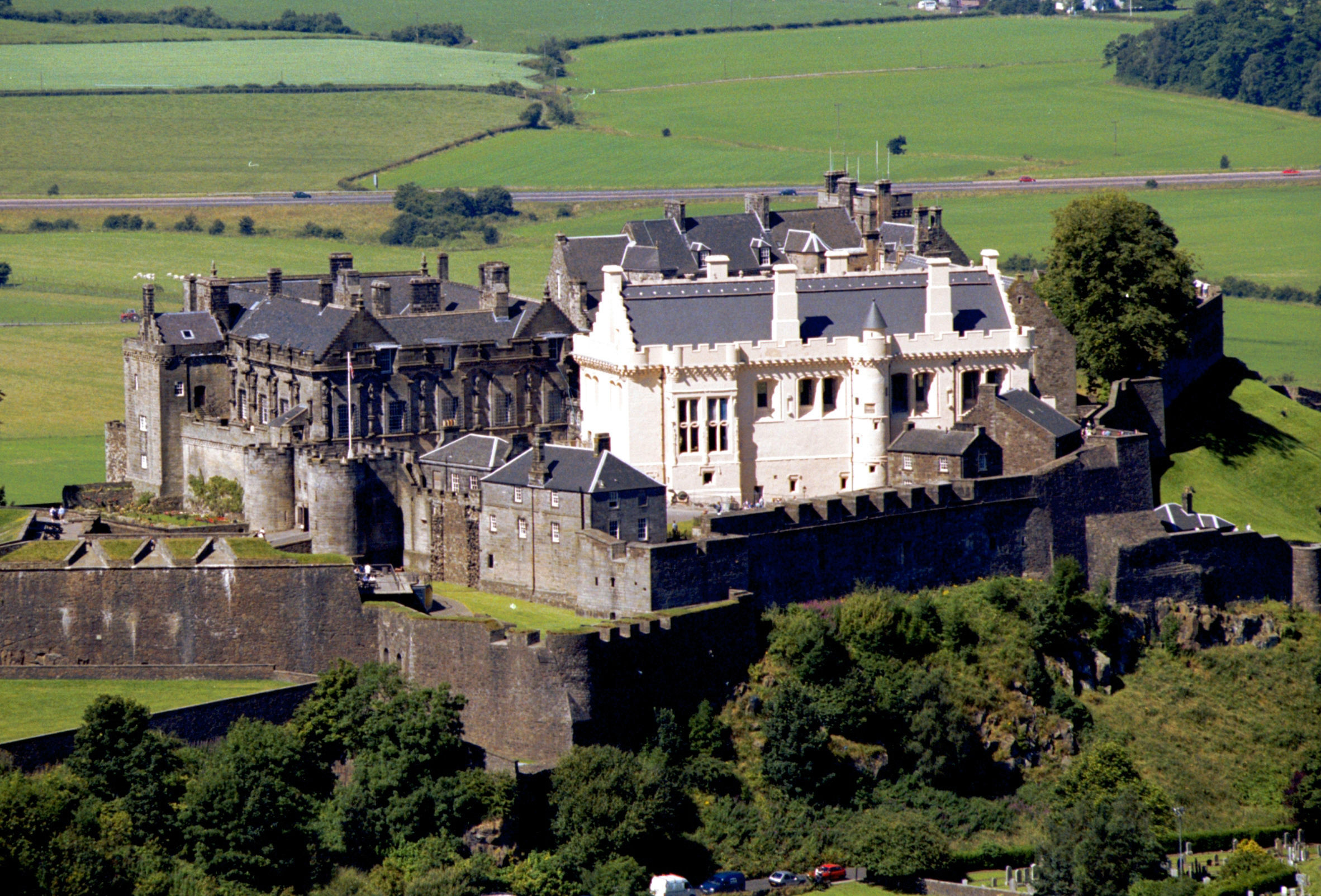
Of all the stories attached to the rock above the River Forth, the Green Lady of Stirling Castle is the one that has stuck. She is described as a maidservant who saved a queen, and her appearance is read as a warning rather than a greeting. That story sits on top of one of the largest and most historically and architecturally important castles in Scotland, a place that has been besieged at least eight times and where kings and queens were crowned, born and killed.
Quick orientation: the castle stands in Stirling, is a Scheduled Ancient Monument, and is managed by Historic Environment Scotland. It is open to the public year round, and the Association of Leading Visitor Attractions recorded 609,698 visitors in 2019.
Why Anyone Built Here At All
The castle sits atop an intrusive crag that forms part of the Stirling Sill, a quartz-dolerite formation around 350 million years old, later shaped by glaciation into a crag and tail. Steep cliffs on three sides gave it a strong defensive position, and its strategic value came from guarding what was, until the 1890s, the farthest downstream crossing of the River Forth.
Occupation of the rock itself is less certain than the legends suggest. A hill fort lies on Gowan Hill immediately to the east, and the rock may have been held by the Maeatae, or later by the Manaw Gododdin, but there is no archaeological evidence for occupation of Castle Hill before the late medieval period. The 16th-century historian Hector Boece claimed the Romans fortified Stirling and that Kenneth MacAlpin besieged a castle here in the 9th century; Boece is considered an unreliable historian. Another chronicler, William Worcester, linked the site to the court of King Arthur. The first firm record comes around 1110, when King Alexander I dedicated a chapel here. He died at Stirling in 1124.
Warwolf, Mowbray’s Bargain and the Wars of Independence
Edward I invaded Scotland in 1296 and found Stirling Castle abandoned and empty. The English were dislodged the following year after the victory of Andrew Moray and William Wallace at the Battle of Stirling Bridge, with the surviving commanders retreating into the castle and being starved into surrender. By 1303 the position had reversed, and Stirling was the last castle in Scottish hands. Edward’s army arrived in April 1304 with at least 17 siege engines. The Scots under William Oliphant surrendered on 20 July, but part of the garrison was ordered back inside because Edward had not yet used his newest machine, Warwolf, believed to be a large trebuchet, which destroyed the castle’s gatehouse.
The most consequential episode came a decade later. Sir Philip Mowbray, holding the castle for the English, proposed on 24 June 1313 that he would surrender if not relieved within a year. Edward Bruce accepted and withdrew, a bargain the historian Patrick Fraser Tytler later called “a truce involving conditions which ought on no account to have been accepted.” The relief army arrived the following summer, and on 23 June 1314 King Robert’s forces met the English at the Battle of Bannockburn, within sight of the castle walls. Edward II tried to take refuge in the castle; Mowbray kept his word and refused. Robert then ordered the castle slighted so the English could not reoccupy it.
The Palace the Stewarts Built
Almost all the present buildings went up between 1490 and 1600, under James IV, James V and James VI. James IV built the King’s Old Building, completed around 1497, and then the Great Hall, which was being plastered by 1503 and has been described as “the grandest secular building erected in Scotland in the late Middle Ages”. It measures 42 by 14.25 m. Its hammerbeam roof was removed in 1800 when the hall was subdivided into barracks, and the restoration works, only possible after the army left in 1965, were completed in 1999.
James V created the Royal Palace, the first Renaissance palace in the British Isles, begun in the 1530s and largely complete by the late 1540s. The Master of Works until his execution in 1540 was Sir James Hamilton of Finnart. The ceiling of the King’s Presence Chamber carried the carved oak roundels known as the Stirling Heads; they were taken down after a ceiling collapse in 1777, and of an estimated 56 original heads, 38 survive. A £12 million project restored six royal apartments to their 1540s appearance and reopened over the weekend of 5 and 6 June 2011.
Crowned, Baptised and Murdered on This Rock
Stirling’s royal record is unusually dense. In 1452 James II stabbed and killed William, 8th Earl of Douglas here, after Douglas refused to end a potentially treasonous alliance. Mary, Queen of Scots was brought to Stirling for safety in July 1543 and crowned in the chapel royal on 9 September 1543. She later nursed Henry Stuart, Lord Darnley, through an illness here in 1565, and the two were soon married. Their son James VI was baptised at the castle in December 1566, with fireworks, an assault on a mock castle and a masque by Bastian Pagez. Darnley was resident but did not attend.
The present Chapel Royal was built a generation later for another baptism: Prince Henry was born in the castle in 1594, and the chapel, probably the work of the Royal Master of Works William Schaw, was erected within a year for his christening on 30 August. When James VI succeeded to the English throne in 1603, the royal family left for London.
Two Centuries as a Garrison
Charles II lived at the castle in 1650 and was the last reigning monarch to stay there. General Monck laid siege on 6 August 1651, erecting gun platforms in the adjacent churchyard, and after the garrison mutinied Colonel William Conyngham surrendered on 14 August. Damage from that siege can still be seen on the church and the Great Hall. The last siege came in 1746: the Jacobites returned to Stirling in January, the town surrendered, but the governor William Blakeney refused to capitulate, and the Jacobites withdrew north on 1 February.
From 1800 the castle was owned by the War Office and run as a barracks. The Chapel Royal became a lecture theatre and dining hall, the King’s Old Building an infirmary, the Royal Palace the Officer’s Mess. Stirling remains the headquarters of the Argyll and Sutherland Highlanders, and the regimental museum, in the King’s Old Building, closed for refurbishment on 31 August 2018 and reopened in June 2021.
Who the Green Lady Is Said to Be
Numerous accounts of ghostlore exist in relation to Stirling Castle, and the Green Lady is by far the best known of them. According to various reports she has been sighted by a great many residents and visitors over the years. One widely circulated narrative holds that she was a maidservant who rescued Queen Mary from a perilous situation, and many interpret her appearance as a portent of impending danger, often in the form of a fire.
It is worth being plain about what that is. The Green Lady is folklore, repeated and reshaped over generations, not a documented event with names and dates attached. The castle has had real fires, including the burning of the north end of the King’s Old Building in 1855, which was rebuilt in a Baronial style by the architect and historian Robert William Billings, but nothing in the record connects a sighting to a blaze. What the tradition offers is a story about the building’s fear of fire, told through a servant who once saved a queen. Anyone hoping for evidence rather than atmosphere should set expectations accordingly.
Planning a Visit to Stirling Castle
The castle is open to the public year round under Historic Environment Scotland. Inside, the sequence to walk is the Outer Defences, largely built in their present form in the 18th century though the French Spur at the east end dates back to the regency of Mary of Guise in the 1550s, then the Forework gatehouse of about 1506, then the Inner Close with the Royal Palace to the south, the King’s Old Building to the west, the Chapel Royal to the north and the Great Hall to the east. One of the caponiers, the covered firing galleries fronting the ditches, survives and is reached from Guardhouse Square by a narrow staircase.
Below the west wall lies the King’s Knot, a 16th-century formal garden now visible only as earthworks, built on the site of a medieval jousting arena known as the Round Table. The early 19th-century Esplanade outside the castle served as a parade ground and now doubles as a car park and performance space; it has hosted open-air concerts by acts including R.E.M., Bob Dylan, Rod Stewart and Runrig, and the city’s Hogmanay celebrations. Film-spotters may recognise the exterior: because it resembles Colditz Castle in Saxony, the castle stood in for it in the 1970s television series Colditz.
Address: Stirling, Scotland
See Stirling Castle for Yourself
Sources
- The Lady of the Lake
- History of the Chapel Royal of Scotland
- The largest trebuchet ever built: Warwolf in the Siege of Stirling Castle
- A History of the Forsyth Family
- Historic Scotland / Kirkdale Archaeology
- Wikipedia: Stirling Castle
Frequently Asked Questions
Where is Stirling Castle Green Lady located?
Stirling Castle Green Lady is located at Stirling, Scotland.
Can you visit Stirling Castle Green Lady?
Stirling Castle Green Lady is open to the public. Always follow posted rules and respect private property.
Reader sightings
Nobody has reported anything here yet. If you have been, you would be the first.
Report your own visit to The Green Lady of Stirling Castle: A Warning of Fire
How haunted is this place?
Be the first to rate
Ghost Tours Nearby
 Private Tours of Braveheart Country and Stirling Castlefrom $1,077
 Private Stirling Dark Side Tourfrom $182
Affiliate links: BeyondHaunted may earn a commission, at no extra cost to you.
Leave a Reply