
Reviewed by Josh N · Updated August 25, 2026 · How we verify
Reported Phenomena
- Ghost of a prisoner
- Spirits of doomed lovers
- Haunted keep tower
Reported by visitors & local legend. Stories, not verified claims.
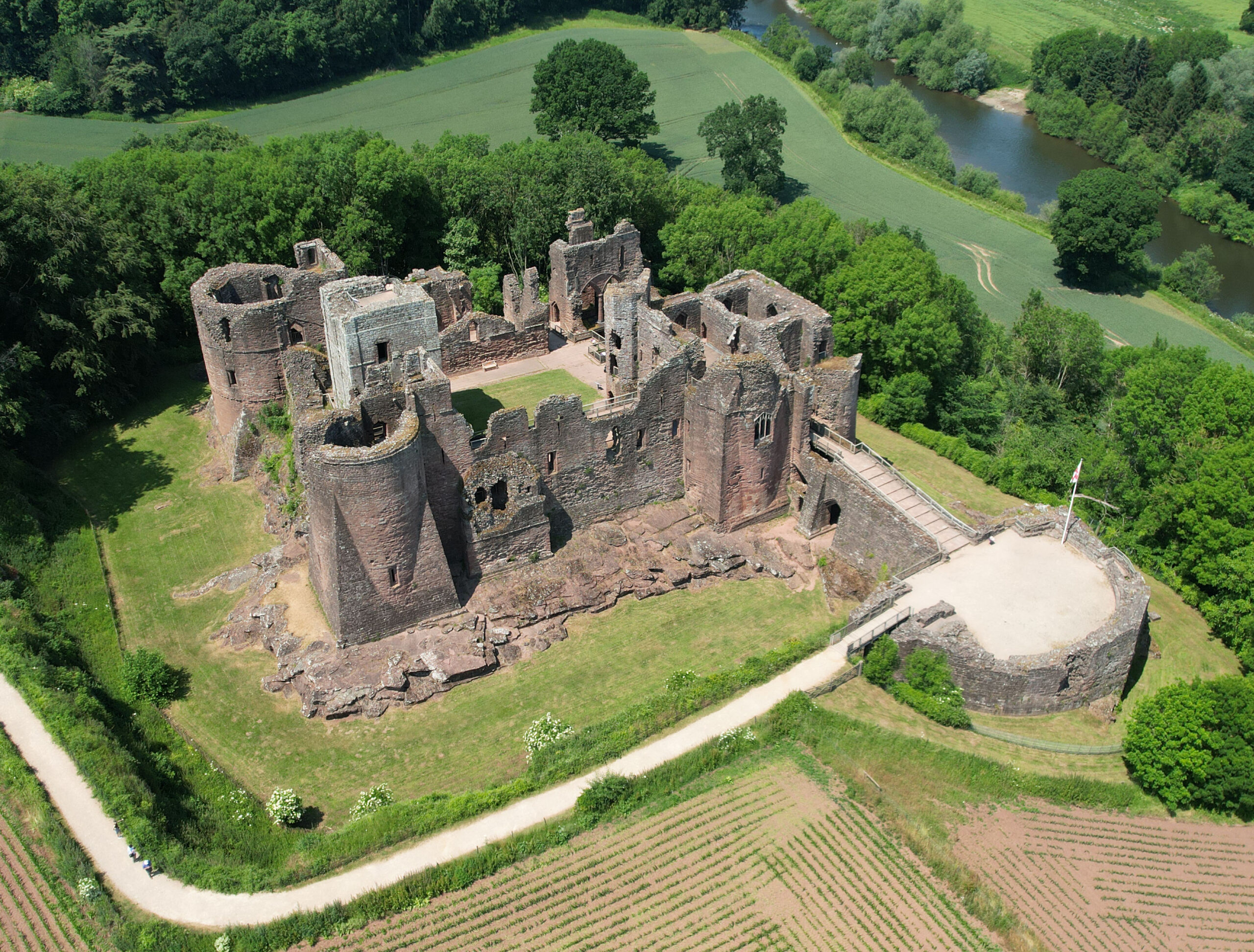
Two stories carry most of the talk about the Goodrich Castle ghosts, and both of them grew out of things that genuinely happened on this rock above the River Wye in Herefordshire: a prison built under a Norman keep, and a siege that ended with a corner of the castle collapsing into a mine shaft. The castle itself is a Norman medieval ruin standing north of the village of Goodrich, and it was praised by William Wordsworth as the “noblest ruin in Herefordshire”. The historian Adrian Pettifer rates it the “most splendid in the county, and one of the best examples of English military architecture”. Neither man mentioned a ghost.
Quick orientation: the site sits roughly 16 miles from Hereford and 4 miles from Ross-on-Wye, it is a Grade I listed building and a Scheduled Monument, and substantial remains are open to the public under English Heritage.
A Keep Too Small to Live In
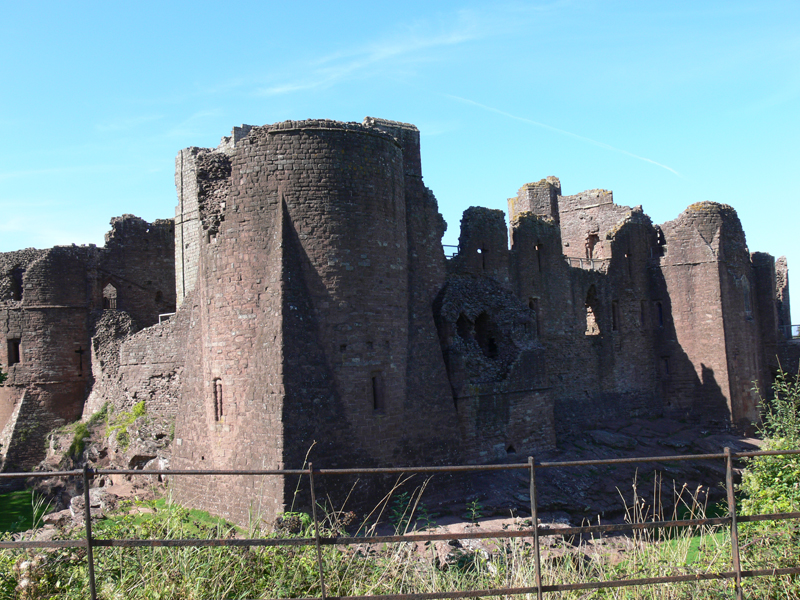
The oldest thing standing is a square early Norman keep of light grey sandstone, with Norman windows and pilaster buttresses. Its walls are thick, but the single chamber on each floor measures only 5.5 by 4.5 metres internally, which made it far more useful for defence than for daily life. The original doorway was on the first storey for safety and was later converted into a window, with the entrance brought down to the ground floor. An earth mound was once heaped against the base, and the masonry in the lowest courses is still noticeably rougher.
Everything around it is later and grander. William de Valence began building a much larger castle around the old keep from the 1280s onwards, demolishing the earlier curtain wall raised by William Marshal. The great hall, 20 by 9 metres, was set in the strongest position overlooking the Wye so that it could have large windows and a huge fireplace without weakening the defences. On the southern and eastern sides, ditches 27 metres long and 9 metres deep were cut into the rock. The chapel occupies the gatehouse’s eastward tower, and its west window is modern, commemorating the British scientists, engineers and servicemen involved in radar development who died between 1936 and 1976.
From Godric of Mappestone to the Talbots
The castle was probably built by Godric of Mappestone after the Norman Conquest, initially as an earth and wooden fortification. In 1203 King John transferred Goodrich and the surrounding manor to William Marshal, Earl of Pembroke, and Marshal had to defend it in earnest: in 1216 he left Henry III’s coronation feast in Gloucester to hurry back and reinforce the place. In time it became the seat of the powerful Talbot family, before falling out of favour as a residence in late Tudor times.
Elizabeth de Comyn, Held Prisoner in Her Own Castle
The grimmest documented episode at Goodrich involves no ghost at all. When Elizabeth de Comyn inherited the castle in the 1320s, Hugh Despenser the Younger kidnapped her in London and transported her to Herefordshire to be imprisoned in her own castle at Goodrich. Threatened with death, she was forced to sign the castle and other lands over to the Despensers in April 1325. She then married Richard Talbot, the 2nd Baron Talbot, who seized the castle back in 1326, and the couple regained legal title the following year. Talbot later received permission from Edward III to create a dungeon under the keep for holding prisoners, which is the practical root of the castle’s later reputation as a place of confinement.
Roaring Meg and the Siege of 1646
The Earl of Stamford garrisoned Goodrich for Parliament until December 1643, when Royalist pressure forced his withdrawal to Gloucester. A Royalist garrison under Sir Henry Lingen took over, and with 200 men and 90 horses Lingen raided Parliamentary forces across the region. No modern earthworks had been added, so the castle went into the war essentially in its medieval condition.
In 1646 the Parliamentary colonels John Birch and Robert Kyrle marched south from the Siege of Hereford. On 9 March 1646 Birch burned the weakly defended stables in a surprise night attack, driving off the Royalist horses. He returned in June, found the castle too strong for direct assault, and dug in with artillery. With the garrison still holding out, Birch had an enormous mortar called “Roaring Meg” cast in a local forge and turned it on the north-west tower while his sappers undermined the foundations. Lingen dug a counter-mine; Birch moved the mortar forward under cover of darkness, the tower collapsed and buried the counter-mine. Down to their last four barrels of gunpowder and thirty barrels of beer, the Royalists surrendered.
The following year the castle was slighted, which rendered it impossible to defend. The Countess of Kent, its new owner, received £1,000 in damages but chose not to rebuild.
The Chieftain in Macbeth’s Tower
The great keep carries the alternative name “Macbeth tower”, after stories of an Irish chieftain held prisoner there. In some versions he died while attempting to escape, and his ghost is said to still haunt the tower. This is folklore rather than record. What is documented is only the licence to build a dungeon beneath the keep, which is the kind of detail a legend can grow around very comfortably.
Alice Birch, Charles Clifford and the Flood
The other Goodrich legend belongs to the siege. Local stories tell that Colonel Birch’s niece, Alice Birch, fell in love with a Royalist named Charles Clifford, that the pair tried to flee before the final assault, and that they drowned in a flash flood while crossing the River Wye. In these tellings the two remain at the site as ghosts. Again, this survives as a tale attached to the castle rather than as an event in the siege accounts, and readers should treat it as such.
Wordsworth, Sixpence and the Picturesque Ruin
By the late eighteenth century the ruin had a second career as scenery. Wordsworth first visited in 1793, and an encounter with a little girl he met while exploring the ruins led him to write We are Seven in 1798. By the 1820s visitors could buy a guidebook on site, and Victorian tourists recorded being charged six-pence to wander round. Large-scale collapses of part of the north-west tower and curtain wall in 1919 pushed the then owner, Mrs Edmund Bosanquet, to grant the castle to the Commissioner of Works in 1920, and a programme of repairs stabilised what survives.
Visiting Goodrich Castle
Substantial remains stand and are open to the public, managed by English Heritage. Roaring Meg itself, preserved by Herefordshire Council, has been returned to the site along with civil war cannonballs recovered during excavations in the 1920s, so the weapon that broke the castle and the castle it broke can be seen in one visit. The neighbouring Victorian pile of Goodrich Court was demolished in 1949, which restored the open landscape the watercolourists came for. Expect steep rock-cut ditches, uneven floors and long drops, and keep to the routes English Heritage has opened.
Address: Goodrich, near Ross-on-Wye, Herefordshire
See Goodrich Castle for Yourself
Sources
- National Monuments Record, accessed 9 August 2010.
- Nga (official)
- ww1240 – Collection at Bartleby.com
- English Heritage
- The Wye Tour: Or, Gilpin on the Wye, with Historical and Archaeological…
- Wikipedia: Goodrich Castle
Frequently Asked Questions
Where is Goodrich Castle Macbeths Tower located?
Goodrich Castle Macbeths Tower is located at Goodrich, near Ross-on-Wye, Herefordshire.
Can you visit Goodrich Castle Macbeths Tower?
Goodrich Castle Macbeths Tower is open to the public. Always follow posted rules and respect private property.
Reader sightings
Nobody has reported anything here yet. If you have been, you would be the first.
Report your own visit to Macbeth’s Tower, Roaring Meg and Goodrich Castle Ghosts
How haunted is this place?
Be the first to rate
Leave a Reply