

Reviewed by Josh N · Updated September 30, 2026 · How we verify
Reported Phenomena
- Hole that empties itself
- Sense of being watched
- Curse
Reported by visitors & local legend. Stories, not verified claims.
Sketoe’s Hole is not a house, a hotel or a graveyard. It is a depression in the sand under a highway bridge north of Newton, Alabama, and for roughly 125 years people in Dale County insisted it could not be filled. The hole was dug in a hurry on December 3, 1864, beneath the feet of a Methodist minister named William “Bill” Sketoe Sr., because the men hanging him had misjudged his height. What happened to that hole afterward became one of the best known ghost stories in the state.
Sketoe’s Hole at a Glance
- Who: William Sketoe Sr., June 8, 1818 to December 3, 1864, a Methodist circuit rider living in Newton.
- What happened: He was lynched by the Newton Home Guard under Captain Joseph Breare.
- The hole: About thirty inches wide by eight inches deep, reported by locals to empty itself no matter how often it was filled.
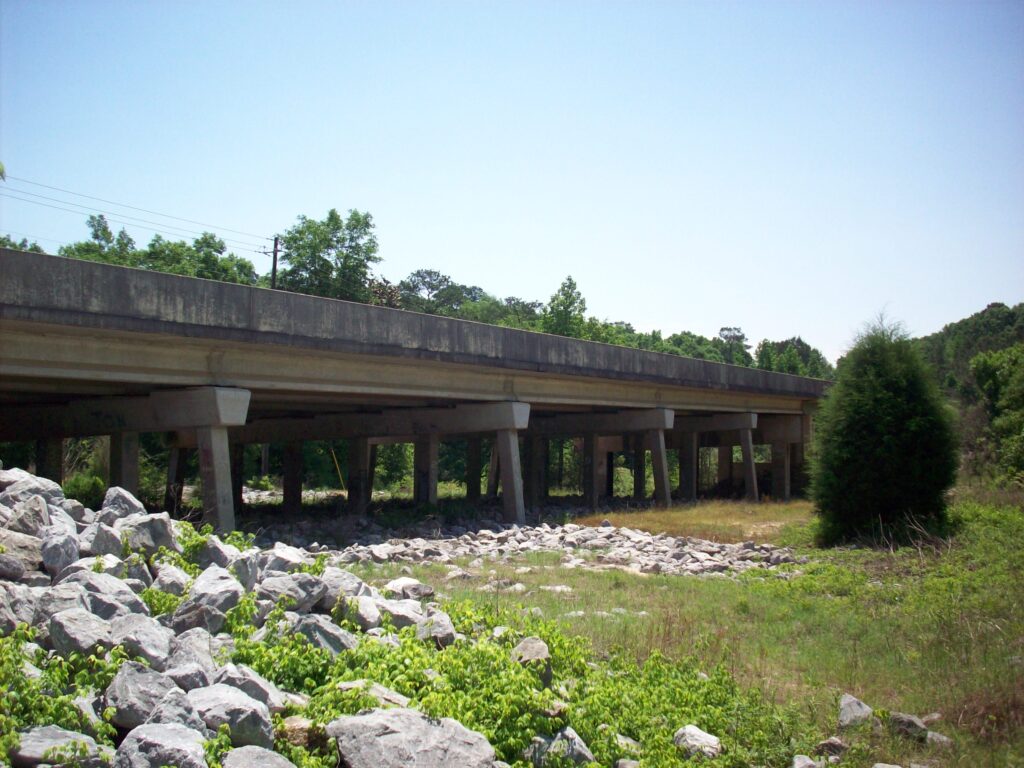
- Now: Covered by rip-rap since 1990 and lying beneath the highway bridge over the Choctawhatchee River. A monument to Sketoe stands nearby.
Bill Sketoe, Circuit Rider in the Wiregrass
Much of Sketoe’s life is hard to reconstruct with any certainty. What is documented is that he lived in Newton before the Civil War and that he was lynched there on December 3, 1864. Nearly everything else comes down through the version collected by Alabama author Kathryn Tucker Windham in 13 Alabama Ghosts and Jeffrey, published in 1969, which repeats the story as it had been told around Newton for generations.
By that account, Sketoe was born in Madrid, Spain, on June 8, 1818, and came to Dale County as a boy with his father. He was well liked, chose the ministry as his vocation, and while riding circuit in the Wiregrass he met and married Sarah Clemmons. Together they had eight children. The legend has him enlisting in the Southern Army and serving until the fall of 1864, when word reached him that his wife had fallen ill and he went home to care for her.
That last detail is where the record and the folklore part company. Government archives contain no record of Sketoe serving in any Confederate unit or local militia. The story that he produced papers showing he had hired a substitute also runs into a problem: the Confederacy repealed its substitution laws in early 1864, which makes the claim questionable at best.
Two Explanations for the Killing
One fact is not in dispute. Sketoe, for whatever reason, ran afoul of the Newton Home Guard commanded by Joseph Breare, and that is what got him killed.
Dale County during the last two years of the war was effectively lawless. The circuit court held no sessions, and the pine forests nearby sheltered deserters and Unionists who came out to terrorize the locals. Citizens organized Home Guard units in response. Breare, a Newton lawyer described by a partner’s son as “an Englishman” who had moved to the county in the 1850s, led one of them. He had been an Alabama delegate to the 1860 Democratic National Convention and a lieutenant in Company E, 15th Alabama Infantry, was captured at Gettysburg, was exchanged, and came home to take command of the Home Guard. His outfit was known locally as the “Buttermilk Rangers” because it also worked for the Confederate conscript department. Breare had already hanged two men for alleged treason before Sketoe.
The romantic version says Breare simply refused to believe Sketoe’s story and hanged him as a deserter. The historian David Williams, in Rich Man’s War: Caste, Class, and Confederate Defeat in the Lower Chattahoochee Valley, offers a harder reading: Sketoe was suspected of aiding John Ward, who led a band of deserters and pro-Union guerrillas. Ward had ambushed a Confederate ammunition transport in Dale County two months earlier and killed an officer, and one of Breare’s men had been shot in a skirmish with Ward near Ozark. Breare tried to hang three local men over the ammunition train attack and was stopped by another Confederate officer for lack of evidence. Sketoe was never charged, never tried, and no hard evidence of collusion was ever produced publicly. Breare apparently made him the third victim regardless.
The Afternoon of December 3, 1864
As the legend tells it, Sketoe was waylaid that afternoon while crossing the wooden bridge over the Choctawhatchee River north of Newton. Breare’s men dragged him into the woods, beat him, and forced him to crawl through the sand. They hauled him to a waiting buggy, threw a rope over the limb of a post oak and put it around his neck. A friend of Sketoe’s came upon the scene, failed to talk the Home Guard out of it, and ran to Newton for help. Breare asked the preacher whether he had any last words. Sketoe asked to pray, and then prayed for his killers rather than for himself, which so enraged the militiamen that Breare struck the buggy horse and left him hanging.
They had not accounted for his size. Sketoe was tall, and his weight bent the limb until his feet touched the ground. One of Breare’s men scooped out a hole beneath him so that he would strangle before help arrived. He was buried in nearby Mt. Carmel cemetery under an epitaph reading “gone, but not forgotten.” The city museum in Newton preserves a cloak said to have belonged to Sarah Sketoe.
Local histories add a coda that has done as much for the legend as the hole itself: every member of the lynching party is said to have died unnaturally. Breare, by those accounts, was struck by a limb from a post oak, the same kind of tree from which Sketoe was hanged. No figure for the size of the mob appears in the record, and the claim that the men were cursed to keep the hole clean forever is folklore, not history.
Thirty Inches Wide, Eight Inches Deep
The killing caused a stir in Newton, and then something stranger took hold. People began to notice that the hole dug under Sketoe’s feet never filled in. It kept its dimensions, roughly thirty inches across and eight inches deep, year after year. Trash, dirt and debris were shoveled in, and according to witnesses, locals returned, sometimes within hours, to find it empty again. Campers said they filled it with dirt and pitched their tents directly over the spot, only to wake the next morning and find it swept clean. Visitors to the site have also described a persistent sense of being watched, though that is a reported impression rather than anything on record.
Windham’s book carried the story well beyond Dale County, and for decades the hanging site drew tourists to Newton to look at a small hollow in the dirt.
Mary Fleming’s Plainer Explanation
Not everyone in Dale County accepted the supernatural reading. Mary Fleming, who lived in the county after the war and saw the hole many times, said the explanation was simple: Sketoe’s friends, one of them named Wash Reynolds, quietly kept it cleaned out while telling everyone that some unseen force was responsible. Reynolds denied it flatly, saying he knew no more about the hole than anybody else. The dispute has never been settled, which is about what you would expect of a story whose central evidence was a shallow depression in riverbank sand.
Visiting the Sketoe Monument in Newton
The hole itself is gone. A new highway bridge went up over the hanging site in 1979, leaving the cavity beneath the span. In 1990, flooding forced crews to bring in rip-rap to shore up the river bank, and the hole disappeared under tons of rock. What remains is the location, under the highway bridge where Alabama Highway 134 crosses the Choctawhatchee, and a monument erected in 2006 by Sketoe family members together with Newton officials near the site of his death. The marker gives a brief version of Windham’s account.
The spot stays popular with visitors and with paranormal researchers, which means the draw now is the story and the setting rather than the phenomenon. Treat it as what it is: the place where a man was murdered without charge or trial. Stick to public ground, respect private property and do not trespass, and mind the river bank and the traffic overhead.
Sources
- Yahoo | Mail, Weather, Search, Politics, News, Finance, Sports & Videos
- archiver.rootsweb.ancestry.com
- Wikipedia: Bill Sketoe
Frequently Asked Questions
Can you visit Sketoes Hole?
Sketoes Hole is open to the public. Always follow posted rules and respect private property.
Reader sightings
Nobody has reported anything here yet. If you have been, you would be the first.
Report your own visit to Sketoe’s Hole: The Newton Pit That Wouldn’t Stay Filled
How haunted is this place?
Be the first to rate

Leave a Reply