
Reviewed by Josh N · Updated July 28, 2026 · How we verify
Reported Phenomena
- Rocking chair moving
- Objects moving unexplained
- Unseen touches
- Disembodied whispering voice
Reported by visitors & local legend. Stories, not verified claims.
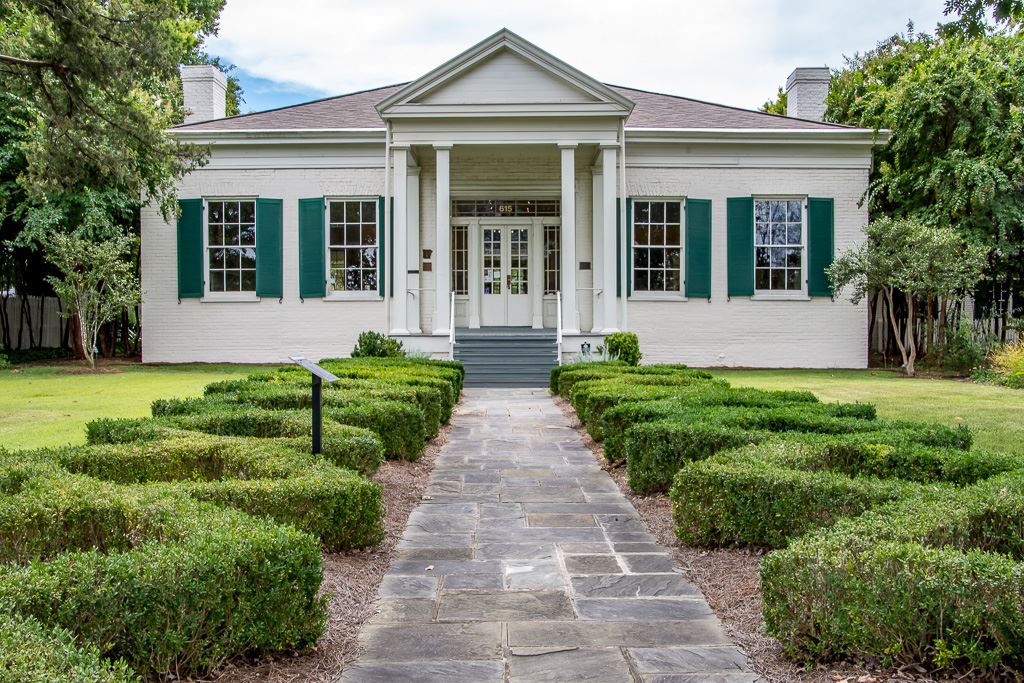
Little Rock lost most of its antebellum architecture to fire, flood, and the wrecking ball, which makes Curran Hall an unusual survivor: a single story Greek Revival house from 1842 that still stands on East Capitol Street and now greets visitors arriving in Arkansas as the city’s information center. It is also one of the more persistently talked about buildings in local ghost lore, credited with a rocking chair that moves on its own and a voice that gives its name as Mary. The documented history is the stranger half of the story.
Ebenezer Walters and the House Built in 1842
The house, formally recorded as the Walters-Curran-Bell House, was built in 1842 for Colonel Ebenezer Walters. It is a modest form done well: one story, symmetrical, with Doric pilasters framing the entrance in the restrained Greek Revival manner that was fashionable in the territorial and early statehood South. Two auxiliary buildings were put up at roughly the same time as the main house. They did not stay where they were built. In 1891 both were moved and attached to the rear of the house, which is why the footprint reads as larger and more rambling than the front elevation suggests.
Ghost tour tradition holds that Walters built the house for his wife, that she died shortly before it was finished, and that he lived on alone in it in mourning. That account belongs to the folklore rather than to the architectural record, and readers should treat it as such. What the record does establish is a chain of prominent occupants. Before the Civil War the house was home to George Watkins, a justice of the Arkansas Supreme Court.
Jacob Frolich, the Trap Doors, and a Murder Indictment
The most remarkable chapter of Curran Hall’s history has nothing supernatural in it at all. After the war the house was bought by Jacob Frolich, who would later serve as Arkansas Secretary of State in the post-Reconstruction government. Before he reached that office, Frolich was an opponent of the Reconstruction administration and expected reprisals. He responded by turning his home into something closer to a redoubt, fitting Curran Hall with trap doors and bringing his livestock inside the house at night so it could not be taken.
Frolich was subsequently indicted for the murder of a man reputed to be an informant for the Reconstruction government. He fled to Canada. He later came back to Arkansas, stood trial, and was acquitted. Whatever one makes of the ghost stories, the house spent part of the 1870s as the fortified home of a man under indictment for killing a political informer, and that is a matter of record.
From Antebellum Landmark to Little Rock’s Visitor Center
Over its long working life the building passed out of purely residential use and served a variety of purposes. Its significance as one of the few remaining antebellum landmarks in Little Rock earned it a place on the National Register of Historic Places in 1976. In 1996 it was acquired by the City of Little Rock and the Little Rock Advertising and Promotion Commission, renovated, and reopened in 2002 as a visitor information center. Interior alterations have been comparatively light, which is part of the appeal for architecture-minded visitors and, according to the people who tell its ghost stories, part of the reason the place feels unsettled.
The Rocking Chair, the Unseen Hands, and the Voice Called Mary
Nothing about Curran Hall’s hauntings is verified, and the accounts come almost entirely from staff and visitors rather than from any documented incident. What gets repeated most often:
- The back porch rocking chair reported moving with no one in it and no wind to explain it.
- Small objects said to shift position or turn up somewhere other than where they were left.
- Physical contact, usually described as a light brush or touch from someone who is not there.
- A whispering female voice that has, in several retellings, identified itself as Mary.
Local paranormal enthusiasts connect the name to the wife Walters is said to have lost before the house was finished, but that connection depends on a legend that the historical record does not confirm. The house also passed through the hands of a judge, an accused killer turned Secretary of State, and a string of later occupants, so there is no shortage of alternative candidates if one insists on assigning the voice an owner. The honest position is that the stories are consistent and long-running, and that nothing more than that has been established.
Calling at Curran Hall on East Capitol Street
Because Curran Hall functions as Little Rock’s visitor information center, this is one of the easier haunted buildings in the state to walk into. It is open to the public during operating hours, staffed by people whose job is to answer questions about the city, and free to enter. Check current hours through the Little Rock Convention and Visitors Bureau before making a trip, since a working visitor center keeps office hours rather than tour-season ones.
Expect a short visit rather than a full attraction. The house is small, the interior is largely original, and the reward is the building itself: the Doric entry, the 1891 additions grafted onto the back, and the knowledge of what Jacob Frolich once kept behind those walls. Staff are used to questions about the ghost stories, but this is a city office in a historic house, not a paranormal venue, so treat it accordingly.
See Curran Hall for Yourself
Sources
Frequently Asked Questions
Where is Curran Hall located?
Curran Hall is located at 1842 that still stands on East Capitol Street.
Can you visit Curran Hall?
Curran Hall is open to the public. Always follow posted rules and respect private property.
Reader sightings
Nobody has reported anything here yet. If you have been, you would be the first.
Report your own visit to Trap Doors and the Voice Called Mary at Curran Hall
How haunted is this place?
Be the first to rate
Leave a Reply