
Reviewed by Josh N · Updated August 27, 2026 · How we verify
Reported Phenomena
- Disembodied voices
- Basement whispers
- Staircase apparition
- Woman in period dress
- Self-operating elevator
Reported by visitors & local legend. Stories, not verified claims.
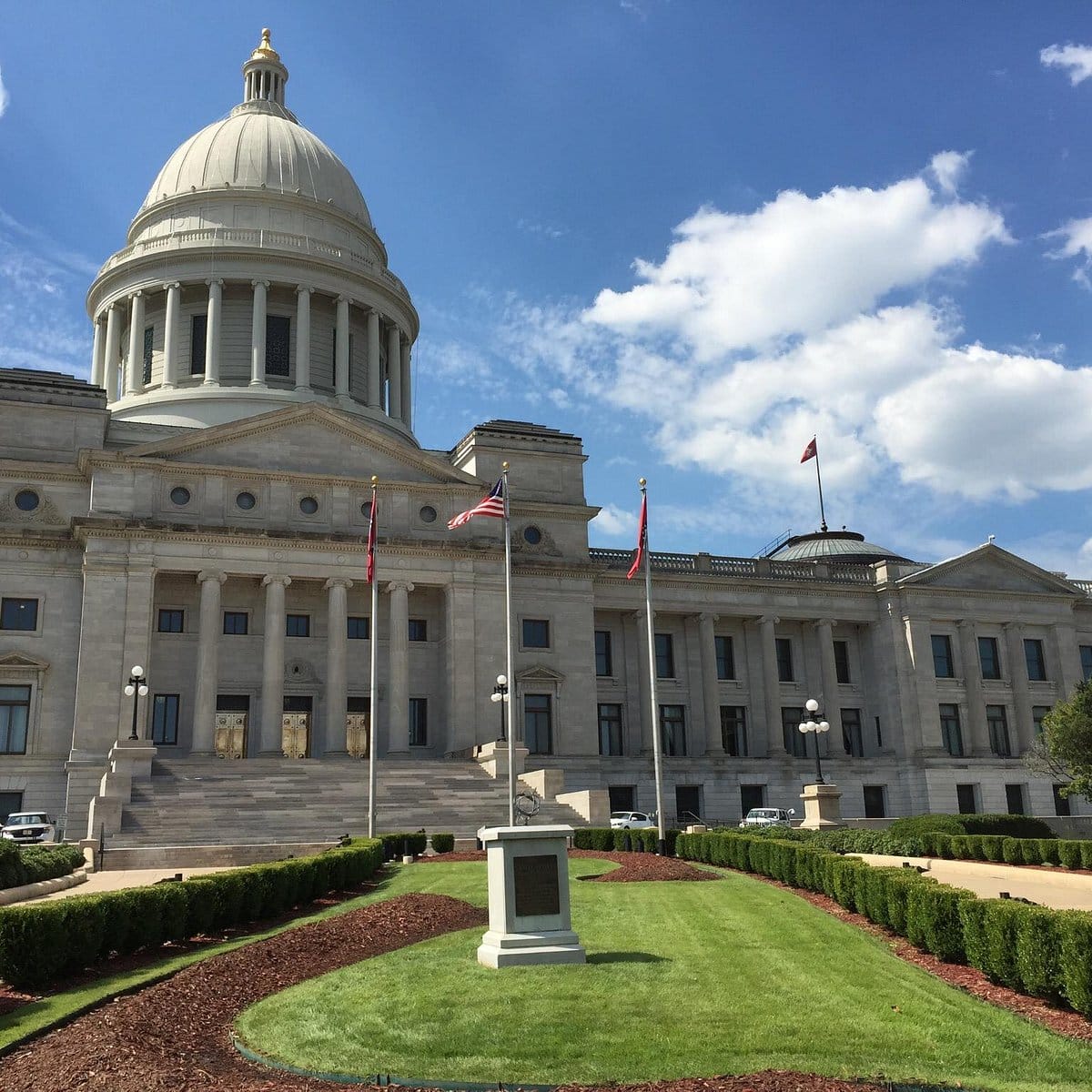
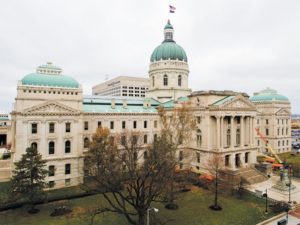
Gold leaf on the dome, bronze doors bought from Tiffany, and prisoners in the mortar: the haunted Arkansas State Capitol in Little Rock, Arkansas carries a founding story stranger than most of the ghost stories told about it. The building that houses the Arkansas General Assembly went up on the site of the state penitentiary, and convicts helped raise the walls of the government that had locked them up. That single fact does more to explain the Capitol’s reputation than any of the tales that followed it.
What Sits Atop Capitol Hill
- Home of the Arkansas General Assembly and the seat of Arkansas state government, at the eastern end of the Capitol Mall.
- Built between 1899 and 1915, a construction period of 16 years.
- Raised on the site of the state penitentiary, with prisoner labor.
- Limestone exterior quarried at Batesville, Arkansas; dome finished in 24 karat gold leaf.
- Grounds hold more than a dozen monuments, including the “Little Rock Nine” Civil Rights Memorial.
Two Architects, Sixteen Years, and a Building That Does Not Line Up
The Capitol exists partly because of a set of drawings for somewhere else. In 1899 the St. Louis architect George R. Mann called on Governor Daniel W. Jones carrying his winning 1896 competition design for the Montana State Capitol, a building that had not yet been constructed in Helena. The drawings were hung on the walls of the old Capitol to stir up enthusiasm, and they worked: they smoothed the passage of the appropriation bills and made Mann’s name in Arkansas. That same year a seven-member commission chose him as architect.
One commissioner objected. George W. Donaghey wanted a national design competition instead and was outvoted. When Donaghey was elected governor in 1908 he forced Mann off the job and brought in Cass Gilbert to finish the work.
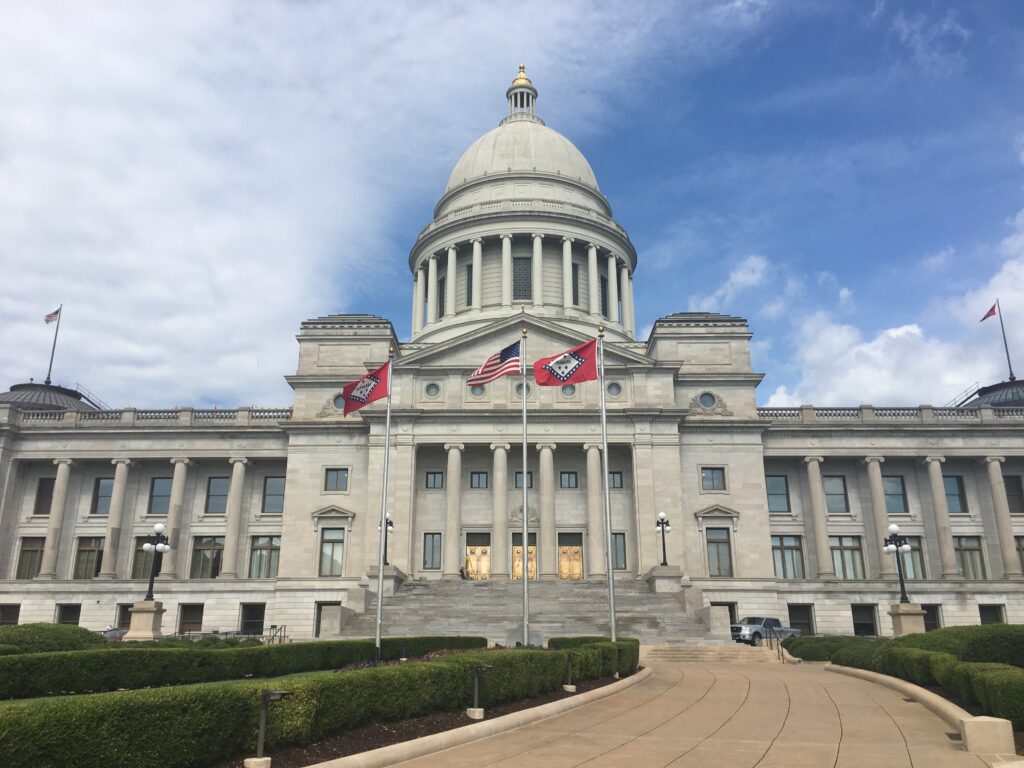
Donaghey left his own mark on the site in a way no one intended. Laying out the foundations, he centered the building on the centerline of Fifth Street, now Capitol Avenue, then squared it north and south using the still-standing penitentiary walls as his guide. He did not account for the fact that Fifth Street, like other so-called east-west streets in downtown Little Rock, runs parallel to the Arkansas River at a slight angle. The result is a monumental building set end to end north and south that refuses to sit square with the downtown grid, and a formal entrance walk that has to bend in a slight S-curve between the foot of Capitol Avenue and the front steps.
The prison walls, in other words, are not just under the Capitol in the figurative sense. They were the straightedge the Capitol was built against.
The Penitentiary Under the Marble
The Capitol was built on the site of the state penitentiary, and the men serving time there helped build it. During construction they lived in a dormitory that was simply left standing on the Capitol grounds while the new statehouse rose around them. Government had previously been conducted at the Old State House downtown.
What was spent on the replacement is worth noting alongside that arrangement. The original stipulation was that the whole building should not exceed $1 million. Final construction cost reached $2.2 million, the equivalent of roughly $320 million in 2014 dollars. The exterior limestone came from Batesville, the interior used Yule marble, and the cupola was covered in 24 karat gold leaf. The bronze front doors, sometimes described as the birthright of Arkansans, stand 10 feet tall and four inches thick and were bought from Tiffany and Company in New York for $10,000.
Voices in the Basement and the Woman on the Stairs
Everything in this section is reported experience and local legend rather than documented event. No coroner’s record, incident report or investigation supports any of it, and the historical record of the building does not mention it.
The most persistent story concerns the ground itself. Workers are said to have turned up wooden coffins while digging on the old penitentiary site, an unsurprising thing to find where a prison once stood but not a detail confirmed in the building’s construction history. From that story grows the wider claim that inmates who died on the property never left it.
The reported phenomena themselves are modest and consistent, which is often the case in working government buildings where staff spend long hours alone:
- Disembodied voices and whispering in the basement, described by both employees and visitors, with no identifiable source.
- A woman in period clothing seen descending the grand staircase. Accounts do not agree on who she might have been, and no name has ever been attached to her with any evidence.
- An elevator that is said to travel between floors with no one aboard and no call registered.
The Elevator and the Story of Ira Gurley
The elevator legend is the one visitors most often ask about. The story holds that Representative Ira Gurley died in an accident involving the lift and that the car still moves on its own account. Treat it as folklore: it is repeated widely in ghost tours and paranormal write-ups, but it is not corroborated by the documented history of the building, and old elevators in century-old public buildings behave oddly for reasons that have nothing to do with the dead. If the story matters to you, look for the primary record before you repeat it.
A Dome That Plays Washington on Camera
The Capitol’s monumental dome has long made it a convenient stand-in for the United States Capitol in Washington, D.C. The NBC miniseries Under Siege, directed by Roger Young and aired in February 1986, depicted the bombing of the nation’s capitol building; pyrotechnics used in the production left surface stains on the Arkansas dome that lingered for several years and caused real controversy in the state. The grounds and interiors appear in the 1990 action film Stone Cold with Brian Bosworth, in Daddy and Them (1999), written and directed by Arkansas native Billy Bob Thornton, and in God’s Not Dead 2 (2016) and its 2018 sequel.
Visiting the Arkansas State Capitol
This is a working seat of government before it is anything else, so plan around the General Assembly rather than around the ghost stories. Details on public access, tours and building hours come from the Arkansas Secretary of State, who administers the building.
The grounds reward an unhurried walk in their own right. Monuments and memorials there include the Arkansas Fallen Firefighters Memorial, the Arkansas Medal of Honor Memorial, the Bauxite and Granite Boulders, the Confederate Soldiers Monument, the Confederate War Prisoners Memorial, the Law Enforcement Officers Memorial, a Liberty Bell replica, the “Little Rock Nine” Civil Rights Memorial, the Memorial Fountain, the Monument to Confederate Women, the Vietnam Veterans Memorial, and the much-debated Ten Commandments Monument.
Two things to look for while you are there, both free and both real: the bend in the entrance walk, which is the visible consequence of a governor lining up a statehouse against prison walls, and the Tiffany bronze doors at the top of the steps. Whether or not anything walks the staircase inside, the building’s actual history is the stranger story.
Exploring haunted places can be rewarding, but stay respectful in a working public building, follow staff instructions, and never trespass.
See Arkansas State Capitol for Yourself
Sources
- Encyclopedia of Arkansas
- Filmmakers find state welcoming
- Watch the fiery trailer for the faith-based film 'God's Not Dead: A Light in Darkness'
- Cass Gilbert Society
- Arkansas Geological Survey – Arkansas.gov (Ar (official))
- Wikipedia: Arkansas State Capitol
Address: 500 Woodlane Street
Frequently Asked Questions
Where is Arkansas State Capitol located?
Arkansas State Capitol is located at 500 Woodlane Street.
Can you visit Arkansas State Capitol?
Arkansas State Capitol is open to the public. Always follow posted rules and respect private property.
Reader sightings
Nobody has reported anything here yet. If you have been, you would be the first.
Report your own visit to Built by Convicts: The Haunted Arkansas State Capitol
How haunted is this place?
Be the first to rate
Leave a Reply