
Reviewed by Josh N · Updated July 28, 2026 · How we verify
Reported Phenomena
- Unexplained lights
- Floating orbs
- Shadowy figures
- Disembodied whispers
- Phantom footsteps
Reported by visitors & local legend. Stories, not verified claims.
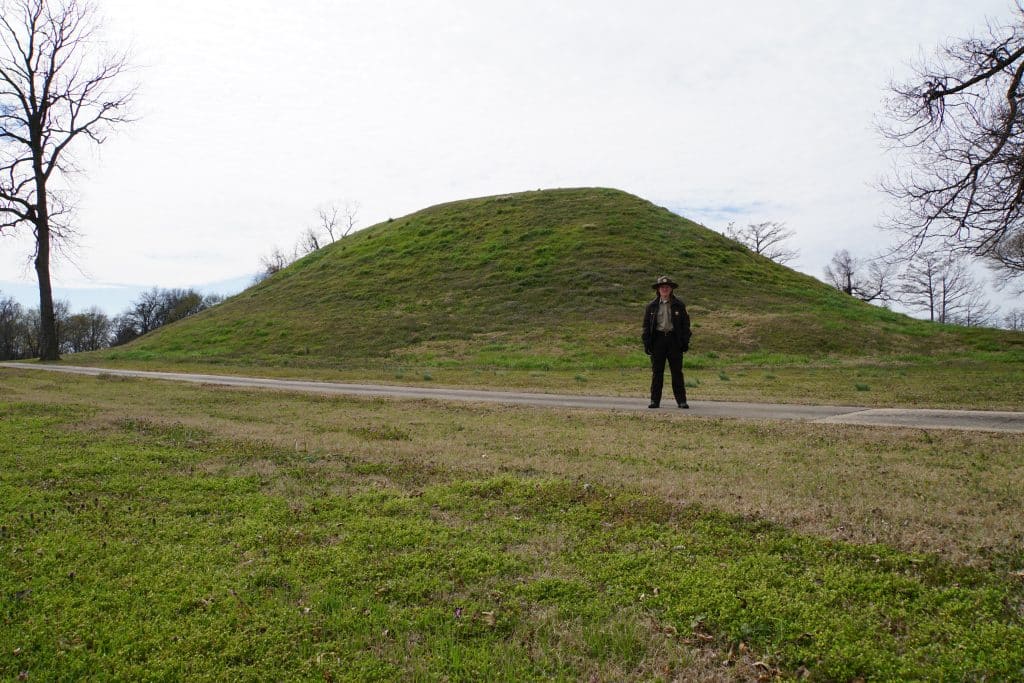
Toltec Mounds Arkansas is the name most visitors still use for an 18-mound complex on the banks of an oxbow lake southeast of Little Rock, even though the park was officially renamed Plum Bayou Mounds Archeological State Park in November 2022. The site holds the tallest surviving prehistoric mounds in the state, it is a National Historic Landmark, and it has picked up a secondary reputation as a place where people report unexplained lights, shadowy figures, and voices after dark. Those reports are visitor accounts and local lore, not documented events, and nothing in the archaeological record supports or explains them.
Quick Facts
- Current name: Plum Bayou Mounds Archeological State Park, renamed November 2022
- Also known as: Toltec Mounds Archeological State Park, Toltec Mounds site, Knapp Mounds, site designation 3 LN 42
- Location: Scott, Arkansas, on the banks of an oxbow lake of the Arkansas River now called Mound Pond
- Built by: People of the Plum Bayou culture, Late Woodland period
- Occupied: 7th through 11th century
- Size: Eighteen mounds inside a curving earthen embankment roughly one mile long
- Tallest mounds: Two originally stood 38 and 49 feet high
- Designations: National Historic Landmark, 1978, and Arkansas State Archeological Landmark, 2025
- Status: Active Arkansas state park and a protected ancestral site, not a ghost tour attraction
The History of the Site
The mounds were built and used by people of the Plum Bayou culture, a group whose way of life was distinct from other contemporary Native American communities in the Mississippi Valley. Plum Bayou sites are found across the White River and Arkansas River floodplains of central and eastern Arkansas, and as far west as the eastern Ozark Mountains. This location is the largest known site of that culture.
Most Plum Bayou people lived in permanent villages and hamlets spread through the surrounding countryside. They built sturdy houses, farmed, gathered wild plants, fished, and hunted. The mound center itself carried only a small resident population, made up primarily of the community’s political and religious leaders and their families. It functioned as a religious and social hub for everyone living in the region, occupied from the 7th to the 11th century.
How the culture related to its neighbors, including the Coles Creek culture to the south and the Fourche Maline culture to the southwest, is still under investigation by archaeologists. The center was eventually left behind. Other Native Americans lived on the site in the 15th century, but they did not build the mounds.
Where the Name Toltec Came From
The link to the Toltec of Mexico was a 19th-century mistake. Some early writers believed the Toltec people had lived in North America and built the earthworks found across the continent. The name stuck to this site for well over a century.
Mary Knapp co-owned the land from 1849 to 1905, which is why the site is also recorded as Knapp Mounds. She and her first husband bought the property in 1849, and it passed to her after his death. She and her second husband made further land purchases nearby. Knapp had a genuine interest in archaeology and became acquainted with Dr. William Barry, who shared her interest in Native American artifacts and customs. Her correspondence with Barry about the “Toltec Mounds” was passed along to Joseph Henry, secretary of the Smithsonian Institution. Knapp went on to write to Henry directly and to send artifacts she had collected at the site to the Smithsonian.
That contact helped bring archaeologist Edward Palmer of the Smithsonian’s Bureau of American Ethnology to the site in 1883. Palmer’s work, along with later investigations, established that the indigenous ancestors of regional Native Americans built these mounds and every other mound in what is now the United States. They belonged to mound building cultures that flourished from the Late Archaic period into the Protohistoric period, raising earthworks for religious, political, and ceremonial purposes tied to their cosmology.
The name Plum Bayou was originally borrowed from a nearby waterway and applied to the culture. The park was officially renamed in November 2022 after consultation with the Quapaw Nation and the Arkansas Archaeological Survey.
What Survives on the Ground
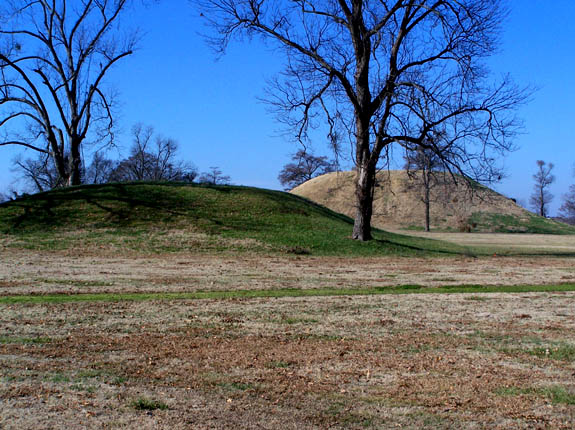
The site once had an earthen embankment and ditch 8 to 10 feet high and 5,298 feet long enclosing three sides of the complex. The fourth side was the lake. Eighteen mounds stood inside that curving one-mile embankment, and two of them originally rose 38 and 49 feet.
The mounds were placed along the edges of two open plazas used for political, religious, and social gatherings that drew people from the surrounding countryside. At least two mounds were used for feasting, judging by discarded food remains, with deer a clear favorite. Most were flat-topped platform mounds with buildings on them.
The detail that has done the most to fuel the site’s “Arkansas Stonehenge” nickname is the layout itself: mound placement appears to have been planned using alignments with important solar positions and standardized units of measurement. That is an archaeological finding about deliberate design, not evidence of anything supernatural.
Reported Phenomena
There is no evidence that the site is haunted, and the documented history records no disaster, battle, or tragedy here that folklore could attach itself to. What exists is a set of reported experiences repeated by visitors and paranormal enthusiasts over the years:
- Unexplained lights and orbs said to drift above the mounds at night, sometimes reported in photographs
- Apparitions and shadowy figures described as moving across the grounds
- Faint whispers, footsteps, and echoes with no identified source
These are reported experiences rather than verified events. The interpretation most often attached to them, that the voices belong to the people who built the mounds, is storytelling layered onto a sacred ancestral place. It is worth keeping in mind that the ground here is flat open floodplain beside a lake, terrain where distant vehicle lights, water reflections, insects, and wildlife noise all read strangely after sundown.
Visiting
This is an active Arkansas state park protecting a National Historic Landmark and an Arkansas State Archeological Landmark, and since 2025 it carries both designations. It is also an ancestral site renamed in consultation with the Quapaw Nation, and visitors should treat it as such: stay on designated trails, leave artifacts where they are, and do not climb or dig into the mounds.
There are no documented ghost tours here and no established public access after dark, which means most of the night-time light and shadow reports come from outside normal park operation. Check the park’s official information for current hours, guided tour availability, and trail conditions before making the drive. The genuine reason to come is the scale and precision of what the Plum Bayou people built: the tallest prehistoric mounds left standing in Arkansas, arranged around plazas by people who were tracking the sun.
Address: 490 Toltec Mounds Road, Scott, AR 72142
See Toltec Mounds for Yourself
Sources
- Nps (official)
- National Park Service
- Uark (official site)
- encyclopediaofarkansas.net
- Wikipedia: Plum Bayou Mounds Archeological State Park
Frequently Asked Questions
Where is Toltec Mounds located?
Toltec Mounds is located at 490 Toltec Mounds Road, Scott, AR 72142.
Can you visit Toltec Mounds?
Toltec Mounds is open to the public. Always follow posted rules and respect private property.
Reader sightings
Nobody has reported anything here yet. If you have been, you would be the first.
Report your own visit to Toltec Mounds Arkansas: History and Reported Hauntings
How haunted is this place?
Be the first to rate


Leave a Reply