
Reviewed by Josh N · Updated August 27, 2026 · How we verify
Reported Phenomena
- Spectral figures
Reported by visitors & local legend. Stories, not verified claims.
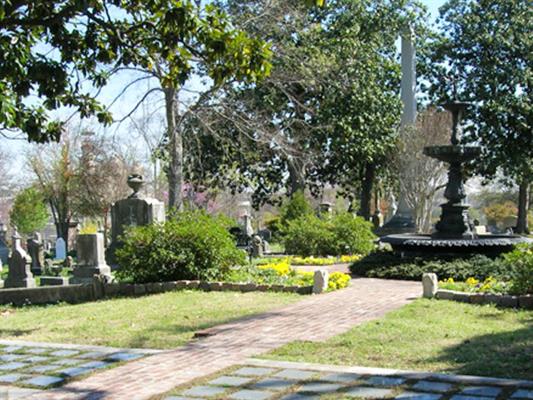
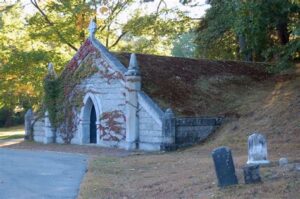
Ten Arkansas governors, seven United States senators and twenty-one mayors of Little Rock are buried within a single square block in the Quapaw Quarter, which is why Mount Holly Cemetery has been nicknamed “The Westminster Abbey of Arkansas.” It sits in downtown Little Rock, Arkansas, listed on the National Register of Historic Places since 1970, and it draws two very different sorts of visitor: people tracing the state’s political and literary lineage, and people who have heard that old burial grounds do not stay quiet after dark. The first group is far better served by the documentary record than the second, and this article says so plainly.
Mount Holly at a Glance
- Where: the Quapaw Quarter area of downtown Little Rock, Arkansas
- Status: historic cemetery, listed on the National Register of Historic Places in 1970
- Nickname: “The Westminster Abbey of Arkansas”
- Known for: the burials of ten former Arkansas governors, seven U.S. senators, 14 Arkansas Supreme Court justices, 21 Little Rock mayors, Confederate generals and a long roll of Arkansas writers
- Annual event: “Tales of the Crypt,” a candlelit October performance staged by high school drama students
The Roll Call Under the Stones
The reason Mount Holly earned its ecclesiastical nickname is arithmetic. Alongside the ten governors and seven senators lie 14 justices of the Arkansas Supreme Court, 21 Little Rock mayors, several Confederate generals and a run of the state’s literary figures. Dr. Matthew Cunningham, the first mayor of Little Rock and its first physician, is here. So is William E. Woodruff, the first Treasurer of Arkansas and the founder of the Arkansas Gazette, and John N. Heiskell, who edited that same paper and served briefly as a U.S. senator in 1913.
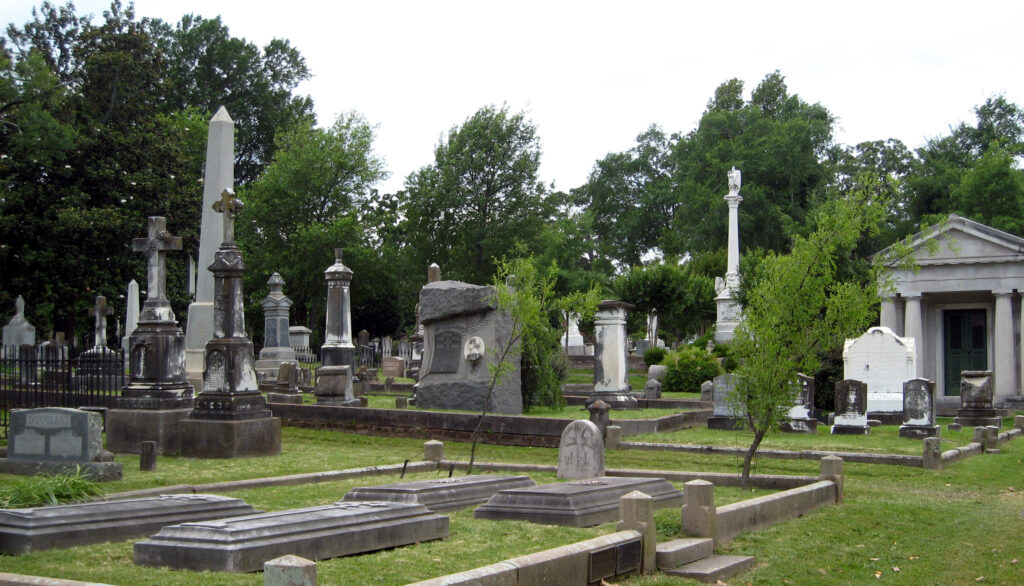
The political names run deep into the nineteenth century and forward into living memory: George Izard, second Governor of Arkansas Territory; William S. Fulton, the last territorial governor and later a senator; Augustus H. Garland, who was in turn a Confederate senator, governor, U.S. senator and Attorney General of the United States; Jeff Davis, governor from 1901 and then senator until his death in 1913. More recently, David Pryor, who served as congressman, governor and senator, and Jim Guy Tucker, the 43rd Governor of Arkansas, were buried here.
The literary and artistic side is just as dense. John Gould Fletcher, the Pulitzer Prize winning poet, lies with his wife Charlie May Simon, a noted children’s book author. Sandford C. Faulkner, remembered as the original “Arkansas Traveller,” is buried at Mount Holly, as is George R. Mann, the architect of the Arkansas State Capitol, and the artist Edward Washburn.
David O. Dodd and the Confederate Section
Of all the graves at Mount Holly, the one that attracts the most visitors is that of David O. Dodd, who lived from 1846 to 1864 and is remembered as the boy martyr of the Confederacy. He is buried among a considerable Confederate presence: Major Generals Thomas James Churchill, who later became the 13th Governor of Arkansas, and James Fleming Fagan; Brigadier General Albert Rust; and Allison Nelson, a Confederate brigadier who had also served as the ninth Mayor of Atlanta. If any part of the cemetery accumulates stories by sheer weight of association, it is this one.
The Modest Gravestones
Not everyone at Mount Holly held office. Several enslaved people are buried in the cemetery, their graves marked by modest gravestones. It is worth walking to find them. A burial ground assembled almost entirely out of governors and generals tells only part of the story of nineteenth century Little Rock, and these stones quietly correct the record.
“Tales of the Crypt” and the Candles in October
Every October, drama students from Parkview Arts and Science Magnet High School are each assigned a person buried at Mount Holly to research. They write short monologues or dialogues, dress in period costume, and perform at the graveside of the person they studied while audiences are led from grave to grave by guides carrying candles.
The event is called “Tales of the Crypt,” and the timing near Halloween is coincidental in spirit if not in calendar. Organisers are explicit that it is intended as history rather than as a scare. That distinction matters here, because the candlelit imagery is almost certainly the source of a good deal of the cemetery’s spooky reputation. What visitors are watching is a teenager in a frock coat reciting researched biography, not a ghost tour.
What the Record Actually Supports
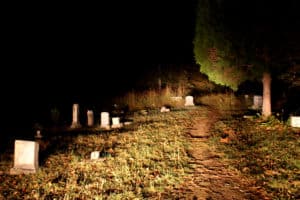
There is no shortage of atmosphere at Mount Holly Cemetery, but atmosphere is not evidence. The documented history of the site contains no verified paranormal incident, no famous apparition with a name attached, and no body of investigator findings worth reporting as such. Anyone who tells you a specific ghost story about a specific Mount Holly grave is passing on local lore, and it should be treated as lore rather than as record.
The one genuinely disturbing event in the cemetery’s recent history was human. During the overnight hours of April 20, 2016, Mount Holly was heavily vandalised. Numerous headstones were toppled and smashed, including the well known statues of a mourner standing beside statues of two little girls. Those figures were among the most photographed monuments in the cemetery, and their destruction did more real damage to the place than any legend ever has.
Walking Mount Holly Cemetery
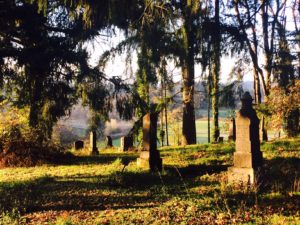
This is an active historic cemetery in the middle of a residential and historic district, not an abandoned lot. Daylight visiting is the sensible approach: the interest here is genuinely in the stones, the sculpture and the density of Arkansas history packed into a small footprint, and none of that reads well by torchlight. Go respectfully, stay on paths where they exist, do not lean on or rub monuments, and remember the 2016 vandalism when deciding how to behave. If you want the guided experience, the October “Tales of the Crypt” performances are the obvious way in, with the caveat that you are attending a history programme rather than a ghost hunt.
See Mount Holly Cemetery for Yourself
Sources
- Vandals strike Mt. Holly Cemetery, severely damage several monuments and statues
- NPGallery Asset Detail (National Park Service)
- Mount Holly Cemetery – Encyclopedia of Arkansas
- Loc (official)
- Mount Holly Cemetery, History in the Heart of Little Rock
- Wikipedia: Mount Holly Cemetery
Address: 1200 S. Broadway Street
Frequently Asked Questions
Where is Mount Holly Cemetery located?
Mount Holly Cemetery is located at 1200 S. Broadway Street.
Can you visit Mount Holly Cemetery?
Mount Holly Cemetery is open to the public. Always follow posted rules and respect private property.
Reader sightings
Nobody has reported anything here yet. If you have been, you would be the first.
Report your own visit to Westminster Abbey of Arkansas: Mount Holly Cemetery, Little Rock
How haunted is this place?
Be the first to rate
Leave a Reply