
Reviewed by Josh N · Updated August 25, 2026 · How we verify
Reported Phenomena
- Tobacco smoke smells
- Muffled voices
- Lights turning
- Choking sensations
- Spectral young woman
Reported by visitors & local legend. Stories, not verified claims.
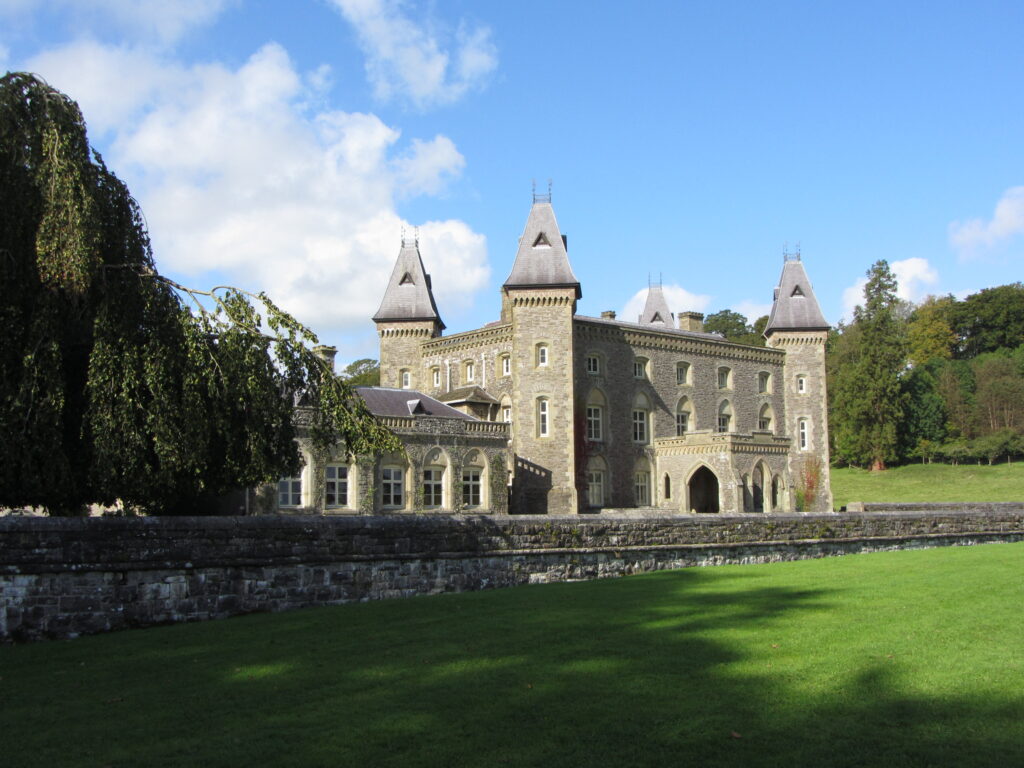
Just west of the market town of Llandeilo in Carmarthenshire, haunted Newton House sits inside Dinefwr Park, a stretch of Welsh parkland that has been occupied for at least two millennia. The National Trust, which owns and maintains part of the property, describes the house as “thought to be one of the most haunted houses in Britain”, and Wales Online lists it among the most notable ghostly houses in Wales. What the visitor actually meets is more modest and rather more interesting than that billing suggests: a grey stone, three-storey castellated block with four corner turrets and sloping slate roofs, a grand central porch, and two showrooms open to the public.
Two Millennia of Occupation at Dinefwr
The ground here has been in use since long before any Rice family owned it. A polished stone axe of Neolithic date was unearthed on the site in 1976, and an Iron Age farm stood on the property. The Romans built a pair of forts here, one partly overlying the other, and traces of Roman roads and tracks survive, some possibly part of the Carmarthen to Llandovery road. A Roman milestone and a coin hoard were found near Dinefwr Castle, with amphorae fragments and Samian ware excavated near Dinefwr Farm.
The castle itself was built in the 12th century by Rhys ap Gruffydd, Prince of Wales. Henry VIII seized the castle and grounds in 1531, and the estate owners, who changed their surname to Rice, had to buy their own property back from the Crown. Mary I is documented to have restored some of the land, but the family did not fully regain their holdings until the reign of Charles I. They were later elevated to the peerage of Great Britain as Baron Dynevor.
Edward Rice’s 1660 House and the Gothic Refacing
An earlier Newton House stood at some distance from the castle during the medieval period, and was modified in 1595 and again in 1603. Edward Rice ordered a Jacobean replacement on the site of that earlier mansion in 1659; it was completed the following year. Turrets and battlements were added between 1760 and 1780, giving the place a deliberately romantic silhouette.
Around 1856 came the change that most defines the building’s present appearance: significant work in the Venetian Gothic style, with a tower added and alterations by R. K. Penson of Oswestry, along with a limestone refacing. The National Trust puts it plainly: “Most of what you see of the grand building today dates back to the 1850s, when it was given a fashionable Gothic facelift, with stone cladding and four impressive turrets”. Inside, the late 17th-century ceilings are the real prize. The authors of Carmarthenshire and Ceredigion call them “the finest single architectural legacy among the country houses of the region”, panelled with thick moulded beams, wreaths in the panels and winged cherubs’ heads in the corners. A billiard room followed in 1896, and in 1914 a strongroom with walls 46 cm thick and heavy steel fire-proof doors was built so the Dynevors could keep documents and valuables. Newton House is Grade II* listed, as are its summer house and the inner and outer courtyard ranges.
The Empty Grave of September 1843
The house had a walk-on part in the Rebecca Riots. In September 1843 the occupant, Colonel George Rice-Trevor, 4th Baron Dynevor, was woken one night and found an empty grave dug in the grounds, a warning that he would be buried in it by 10 October. This is documented history rather than legend, and it is worth separating from the ghost stories: nobody claims the grave was supernatural, only that it was a death threat delivered with a spade.
Squatters, Missing Beams and the National Trust Rescue
The 20th century treated the estate badly. Walter Rice, 7th Baron Dynevor, died in 1956, and his son Charles Rhys, 8th Baron Dynevor, died just six years later. Most of the estate and a number of family assets had to be sold to pay duties. Richard Rhys, 9th Baron Dynevor, sold the property in 1974, after which it fell into disrepair and was occupied by squatters and thieves who stripped out beams and furniture. The National Trust acquired the deer park in 1987 and the house three years later, restoring it while Cadw took on Dinefwr Castle. The Wildlife Trust West Wales had already acquired the nearby woodland in 1979.
Walter the Butler and the Servants’ Basement
The servants’ basement is described as one of the centres of reported activity, and the figure most often named is Walter the Butler, a former employee of the house. People say they smell his tobacco smoke drifting through the room. Muffled voices are reported, and lights said to switch on and off of their own accord. None of this is verified; it is what visitors and staff report, repeated often enough over the years to have become the house’s signature story.
Why Visitors Stop Halfway Up the Cantilever Staircase
The other recurring account concerns the cantilever staircase, where visitors have reported feeling as though they are being choked. The explanation attached to the sensation is the strangling of Lady Elinor Cavendish, cousin of the lady of Newton House, in the 1720s, by a lover she had rejected. Treat that as the traditional narrative rather than an established fact: the sensation is what people report, the murder is the story told to account for it.
Television Crews at Newton House
Television journalists began investigating the alleged hauntings in the 1980s. On one occasion crew members are said to have fallen ill one after the other while filming. During one investigation the spectre of a young woman was reported gliding across a room and vanishing through a cupboard door. The house later featured in the 11th and 15th series of Most Haunted.
Visiting Newton House, the Deer Park and the White Park Cattle
Two showrooms are open to the public. Besides the tearoom, the exhibition in the basement and on the ground floor carries displays on the Rhys family, the history of the estate and the Second World War, presented as though the year is 1912. Among the paintings are William Powell Frith’s Mary, Queen of Scots Bidding Farewell to France (1561) and Godfrey Kneller’s 1718 portrait of William Talbot, Bishop of Salisbury.
For many visitors the park outweighs the interior. The deer park was landscaped from 1775, when George Rice and his wife Cecil hired Capability Brown to take charge of the scheme, with a winding path and deciduous trees planted to frame both house and castle. Brown’s beech clumps survive. The park holds notable herds of rare White Park cattle and fallow deer, and a small Moorish-style garden behind the house with a central fountain has been restored. The park is registered at Grade I on the Cadw/ICOMOS Register of Parks and Gardens of Special Historic Interest in Wales. Writing in 1862, Benjamin Clarje thought it showed “perhaps a richer display of varied landscape than any spot of similar size in the kingdom”. The surrounding woodland is mainly oak and wych elm, with cherry, holly, spindle, dog violet and the parasitic toothwort in the understorey, and lichen communities that include the rare lungwort.
Address: Newton House, Dinefwr Park, Llandeilo, Carmarthenshire
See Newton House for Yourself
Sources
- Newton House
- Tywi Timeline
- Newton House
- Newton House
- Plas Dinefwr, including Sw.screen Wall, Dynevor Park, Llandeilo
- Wikipedia: Newton House, Llandeilo
Frequently Asked Questions
Where is Newton House Dinefwr Park located?
Newton House Dinefwr Park is located at Newton House, Dinefwr Park, Llandeilo, Carmarthenshire.
Can you visit Newton House Dinefwr Park?
Newton House Dinefwr Park is open to the public. Always follow posted rules and respect private property.
Reader sightings
Nobody has reported anything here yet. If you have been, you would be the first.
Report your own visit to Walter the Butler’s Tobacco Smoke: Haunted Newton House
How haunted is this place?
Be the first to rate
Nearby Haunted Locations
- 1Wales’s Earliest Photograph and Haunted Margam CastleWales24mi
- 2Britain’s Oldest Stone CastleWales62mi
- 3Macbeth’s Tower, Roaring Meg and Goodrich Castle GhostsEngland64mi
- 4The Durdham Down Gibbet and the Ghost That Emptied a Widow’s RoomsEngland68mi
- 5Tarred, Caged and Rumoured to WalkEngland68mi
- 6The Gibbet on Gallows Acre LaneEngland68mi
Leave a Reply