
Reviewed by Josh N · Updated August 29, 2026 · How we verify
Reported Phenomena
- Spectral lady
- Haunted fields
- Corpse in the peat
Reported by visitors & local legend. Stories, not verified claims.
Four miles northeast of Kilwinning, where the Lochlibo Road runs across the flat bog country of North Ayrshire, sits a hamlet whose Gaelic name means field of the well. The Auchentiber ghost belongs to no house, no inn and no hotel corridor: she is said to walk the fields, a servant girl who set out one night in the 1820s to keep a tryst and never got there.
Auchentiber at a Glance
Auchentiber is a hamlet in the Parish of Kilwinning, four miles (six kilometres) northeast of Kilwinning, standing on the Lugton Water, which runs on into the River Garnock. Some new housing has gone up, but the place remains very much a hamlet, and the main part of it now sits on a cul de sac rather than a through route. The old landmarks are mostly gone or changed: the school built near Bloak Road bridge closed in 1954 and survives as a private house, and the smithy marked on the 1860 OS map was still standing in 2007 before its roof collapsed the following year.
The Leddy o’Clumbeith, as Dr Duguid Told It
The story was recorded by Dr Duguid around 1840, describing events in the 1820s. A servant girl from the farm of Clonbeith was making her way to the Blair Tavern to keep a tryst when she fell into a mine shaft, horse and all, and was killed. That is the plain version. A darker one runs alongside it: others say her lad killed her and then jumped into the shaft after her. Either way, the ending is the same in the telling, and her ghost is said to haunt the fields around Auchentiber.
What the story does not have is a name, a date, an inquest or a burial record. It is folklore collected a generation or two after the fact, and it should be read as that rather than as a documented death. The area does have older records of ordinary violence, for what that is worth: in 1507 a nominal fine of five merks was inflicted on Cuthbert Robisoune, a farmer in Auchentiber, for an assault on a neighbour and on the man’s son, whom he had cast into the fire.
The Problem With the Blair Tavern
Anyone chasing the legend on the ground will look for the tavern she was walking to, and here the chronology snags. The Blair is a prominent group of buildings, marked on the 1860 OS map and possibly older, with the date 1834 in Roman numerals above the entrance door. But it was not opened as a public house until the late 20th century. In the 1960s it was the Blair Garage. It was renovated in 2008 to 2009 and is now known simply as the Blair.
In the 1820s the drinking house here was the Cleikum Inn, marked on the 1860 OS map on the right hand side of the road near Bentfauld farm, with a lay-by now occupying the site. Jamieson records the local nicknames for the inns along these roads, Auchentiber’s being the Cleek ‘Em Inn, matched by the Trap ‘Em Inn at Burnhouse, the Lug ‘Em Inn at Lugton and the Turn ‘Em Out at Torranyard. The likeliest reading is that a later teller swapped in the name of the pub that existed in their own lifetime. It is a small thing, but it is the kind of detail that shows a legend being quietly updated as it travels.
Shafts, Claypits and Limekilns in a Flat Landscape
The setting at least makes the accident plausible. This was worked ground. Near Waukmill the 1860 OS map shows whinstone, limestone and sandstone quarries and a limekiln, with more freestone and limestone quarries and limekilns on the lane down to East Auchenmade, and another whinstone quarry and limekiln on the road up to Wardlaw. A brickworks stood at the Auchenmade claypit close to South Auchenmade farm, served by a railway siding. Peat cutting has gone on here too, especially beside the road towards Kilwinning. A rider crossing this country in the dark, off the made road, had genuine holes to fall into.
The Bonnie Lady Found in the Peat at Clonbeith
Duguid left a second Auchentiber story, and it is stranger than the first. Around the 1840s, near Clonbeith on the way to Megswells, he met Pate Glunch cutting peats. Pate, normally a still, dour man, was animated, and took the doctor to see a long dead corpse lying in a hole in the peat. She was around 18 to 20 years of age, with rosy cheeks, a sweet smile playing around her lips and blonde hair. Her identity was unknown, though a rumour linked her to the family of the Montgreenan estate.
Nothing in the record confirms it, and the details as told read like a bog body seen through 19th century sentiment. The mosses here have given up other things: in the 1840s peat cutting at Auchentiber uncovered a straight row of wooden stakes beneath peat then between 10 and 12 feet thick, and the collector Alexander Reid of Bonshaw owned garden seats made of bog-oak from Auchentiber Moss.
Field of the Well
The name promises water and the ground delivers it. The Bloak Well was found around 1800 to 1826 because pigeons from Lainshaw House and neighbouring parishes flocked there to drink. Mr Cunningham of Lainshaw built a handsome house over it in 1833 and appointed a keeper, the mineral water being valued for healing properties attributed to it, and the well itself ended up in the middle of the kitchen.
What Anyone Actually Reports Here
Very little, and honesty is better than padding. There is no haunted room to book, no investigation nights, no catalogue of modern sightings. The reported phenomenon is a single traditional one: a female figure associated with the fields around the hamlet, tied to a death that has never been documented. Treat it as a 19th century tale still attached to a landscape rather than as an ongoing series of encounters.
Walking Auchentiber and Its Mosses
The hamlet is open ground and can simply be driven or walked to, with the Blair as the obvious anchor point. The real draw for many visitors is the surrounding bogs. Auchentiber, Bloak, Kennox, Cockinhead and their neighbours are raised bogs, a very rare habitat in lowland Scotland, with around 90 per cent of such sites drained or degraded beyond restoration. Cockinhead is unusually well preserved and is a Site of Special Scientific Interest protected by Scottish Natural Heritage.
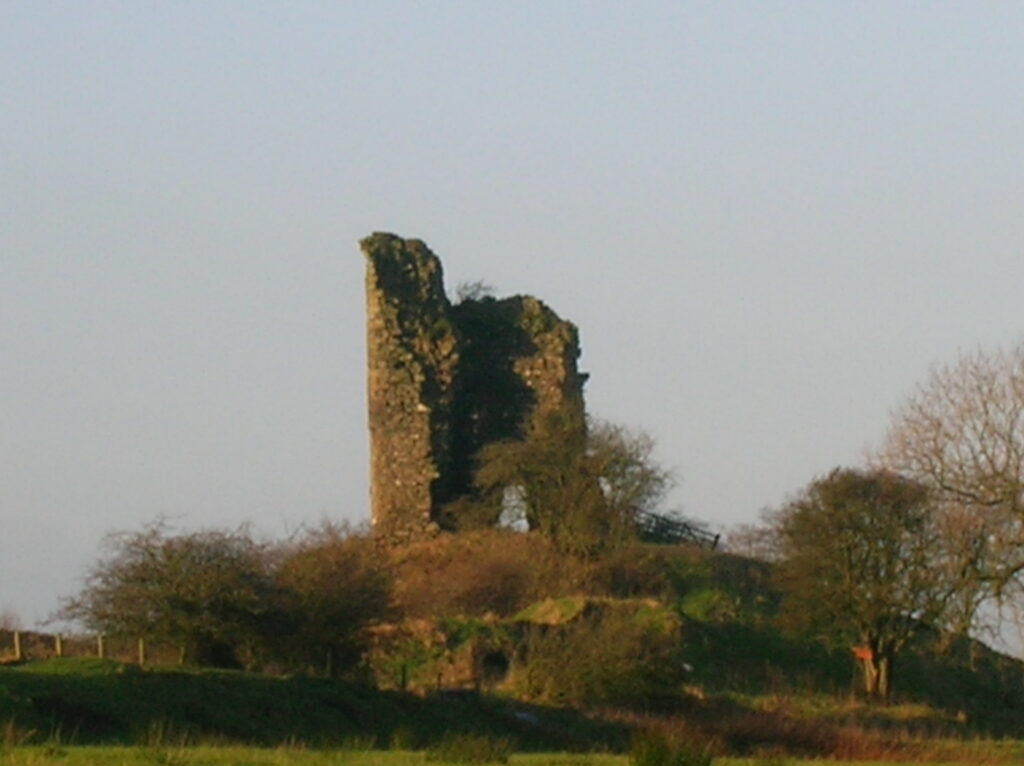
Go carefully. Moorgrips, the drainage ditches cut across the moss, are frequent, and the walker had better beware, which is precisely the hazard the Leddy’s story turns on. Auchentiber sat on an old toll road, with the nearest milestone at the crossroads and tolls at Torranyard and Lugton before road tolls were abolished in 1878. Auchenmade railway station, once part of the Lanarkshire and Ayrshire Railway, opened on 3 September 1888 and closed permanently on 4 July 1932, so there is no train. For a bed, the old Montgreenan estate is now a hotel about a mile and a quarter away towards Torranyard, where the ruin of Auchenharvie Castle stands out across the flat ground.
Address: Auchentiber, North Ayrshire, Scotland
Sources
- Raised Bogs
- The Trial of the Feudalists at Ayr in 1507
- Am Faclair Beag, Tiobair
- Dictionaries of the Scots Language:: DSL Online version 3.0
- Changes to Old Maps website – Landmark Information Group
- Wikipedia: Auchentiber
Frequently Asked Questions
Where is Leddy O Clumbeith Auchentiber Ghost located?
Leddy O Clumbeith Auchentiber Ghost is located at Auchentiber, North Ayrshire, Scotland.
Can you visit Leddy O Clumbeith Auchentiber Ghost?
Leddy O Clumbeith Auchentiber Ghost is open to the public. Always follow posted rules and respect private property.
Reader sightings
Nobody has reported anything here yet. If you have been, you would be the first.
Report your own visit to A Mine Shaft, a Tryst and the Auchentiber Ghost
How haunted is this place?
Be the first to rate
Leave a Reply