Reviewed by Josh N · Updated August 26, 2026 · How we verify
Reported Phenomena
- Grey Lady sightings
- Green Man apparition
- White Lady apparition
- Crying child ghost
- Phantom knight in armour
- Ghostly nun sightings
Reported by visitors & local legend. Stories, not verified claims.
Fourteen is the number usually attached to the Bramshill House ghosts, a figure credited to a police officer who worked at the training college housed here, though another officer at the same college did not take the suggestions seriously. That single detail says a good deal about the place: a Jacobean prodigy house in northeast Hampshire, England, with a folklore inventory as carefully catalogued as its coats of arms, and almost none of it verifiable.
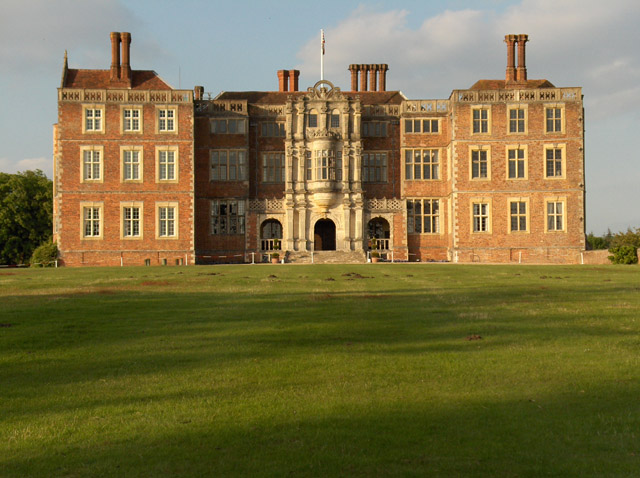
Quick orientation. Bramshill House stands at the approximate centre of a triangle formed by Reading, Basingstoke and Farnborough, roughly 47 miles by road south-west of central London. It lies north-east of Hartley Wintney, east of Hazeley off the B3349, and south-east of Bramshill village on the B3011. The house has been a Grade I listed building since 8 July 1952, and the surrounding registered historic park, Grade II* listed in 1984, was upgraded to Grade I in September 2017.
What Lord Zouche Built, and What Foxley Left Behind
There was a house here long before the one visitors photograph. In 1347 Thomas Foxley obtained a licence to build a manor house or small castle at Bramshill, set within a wooded park of some 2,500 acres. That building went up between 1351 and 1360, with thick walls, vaulted cellars and an internal courtyard, and fragments of it are still embedded in the present plan.
In March 1605 Edward la Zouche, 11th Baron Zouche, a favourite of James I, bought the property from Sir Stephen Thornhurst. He demolished a large part of what stood there and built the mansion recognised today, one of the largest and most important prodigy houses of the Jacobean period in England. The design is traditionally attributed to John Thorpe, though no records survive to confirm it; what the records do show is that the stone mason Richard Goodridge was working at Bramshill in 1617 and again in 1621. Nikolaus Pevsner called the southern facade “among the most fanciful pieces of Jacobean design in [England]”.
Inside, the Great Hall keeps its dais and a Jacobean stone screen four metres high, decorated with 92 shields. The Long Gallery runs the first floor of the northern range, 38.6 metres of richly decorated stucco ceiling. The house measures 56,974 square feet with 15 bedrooms, and the historians Anthony Blunt and James Lees-Milne counted it among the “glories of English architecture”.
Fire Under Charles I, and Three Centuries of Copes
The building was partly destroyed by fire a few years after completion, during the reign of Charles I. On 25 June 1640 Lord Antrim sold Bramshill for £9,500 to Sir Robert Henley. Sir John Cope bought it in 1699, and his descendants occupied the premises until 1935, shortening the south wings, converting most of the chapel into a drawing room and carrying out the bulk of the interior work that survives.
One near miss is worth noting. After his victory over Napoleon, the Duke of Wellington was offered his choice of house by Parliament. He came and looked at Bramshill, then in 1817 chose Stratfield Saye instead.
Crossbows, Fox Hounds and First-Class Cricket on the Lawn
The estate has been a sporting venue since the 16th century, and its most notorious accident happened outdoors. On 24 July 1621, while hunting in the park, George Abbot, Archbishop of Canterbury, accidentally shot and killed one of the gamekeepers with his crossbow. An inquiry cleared him of murder.
The cricket ground first hosted a first-class match in 1823, when an early Hampshire side beat an England XI by five wickets. Three further first-class matches followed in 1825 and 1826. The grounds themselves run to 262 acres and include an 18-acre lake north of the house, which matters here because so much of the ghost lore attaches to the water.
Maternity Home, Romanian Exiles, Police College
The 20th century put an unusually varied cast through the rooms. Ronald Nall-Cain, 2nd Baron Brocket, bought the house from the Cope family in 1935 and was its last private owner. During the Second World War the Red Cross used it as a maternity home, after which the exiled King Michael and Queen Anne of Romania lived here for several years. It became the National Police College in 1960, and from 2005 two buildings on the site housed the European Police College, which moved to Budapest in 2014.
Maintenance costs eventually told. In July 2013 the Home Office put the house and estate on the market for £25 million, and it was sold to the heritage property developers City & Country in August 2014. In 2018 it was offered again, on a reduced estate of about 90 acres, with a guide price of £10 million.
The Fourteen: Who Is Said to Walk Here
Bramshill has been cited as one of the most haunted houses in England, and the roll call is specific. The Grey Lady, whose husband is said in one version to have been a religious dissenter beheaded in the 17th century, is alleged to haunt the terrace, the library and the chapel. Accounts of her disagree: the author Penny Legg describes golden hair, a tear-stained face and the scent of lily of the valley, while the journalist P. Lal gives her reddish-brown hair and a grey sleeveless robe. Her husband is reported around the stables and the chapel drawing room.
The Green Man, dressed as the name suggests, is said to appear near the lake, as is the ghost of a gardener who drowned there. He is identified as a Cope who either drowned in the lake in 1806 or, in Legg’s version, threw himself off a cliff near Brighton. A young child is said to haunt the library and the Fleur de Lys room, heard crying and reaching for visitors’ hands; folklore makes the Grey Lady the child’s mother. A lady dressed in the style of Queen Anne and a knight in armour are reported in the chapel drawing room, while the chapel itself is said to be frequented by a woman in 17th-century dress and by a nun. A young man in 1920s tennis clothes, supposedly a Cope who fell from a train, is placed in the reception area, and a small boy said to have fallen from the roof in the 18th century on the terrace.
None of this rests on documented investigation. It is a body of stories collected over decades of residents, staff and writers, and it should be read as such.
The Mistletoe Bough and the Chest in the Entrance Hall
The best known tale is not unique to Bramshill. The historian William Page cited the house as a possible setting for the Legend of the Mistletoe Bough, a story attached to several English country mansions: a bride hides in a wooden chest during a game of hide and seek on her wedding night and cannot get out. In the Bramshill telling it happens at Christmas, and her skeleton is found fifty years later, still in her wedding dress with a sprig of mistletoe in her hand. A chest is displayed in the entrance hall.
The bride is sometimes named as John Cope’s daughter Anne, who married Hugh Bethell of Yorkshire, and sometimes as Genevre Orsini, married in 1727, whose ghost is said to have travelled from Italy with the chest. Sir William Cope, writing his Victorian monograph on the house, preferred the Orsini version and added a deflating footnote: the chest on show is not the original. The genuine article had been proved large enough by “a woman of comely proportions” who lay down in it to test the point, and was then taken away by Sir Denzil Cope’s widow in 1812.
The bride is called the White Lady and is said by Legg to haunt the Fleur de Lys room. Legg also records that Michael I of Romania asked to be moved to another room during his stay, to avoid the young woman in white said to pass through his bedroom each night. An old man with a grey beard, whom Legg takes for the White Lady’s father or husband, is reported staring through windows and at the chest itself.
Seeing Bramshill House Today
This is not an open attraction. Bramshill passed from the Home Office to a private heritage developer in 2014, and the sources record no public opening, no tour programme and no ghost nights. The lanes approaching the mansion, Mansion Drive, Reading Drive South and Pheasantry Drive, serve the estate, and Lower Pool Road within the grounds is private. Anyone drawn by the house should treat it as private property and view it from public roads only.
Several structures on the estate carry their own listings, including the Grade I early 17th-century triple-arched gateway on the Reading route north-east of the house, the Grade I bridge of two arches crossing the Broad Water on the main south-west avenue, and the Grade II lodges forming its gateway. They are the parts of Bramshill most likely to be glimpsed by a visitor who is not invited in.
Address: Bramshill, Hook, northeast Hampshire
See Bramshill House for Yourself
Sources
- Ordnance Survey 1:50 000 Landranger Series of Great Britain
- Biographies: John Foxley (d. 1325)
- Jacobean Country Houses for Sale
- College (Permanent Site)
- Brighter Future for Police College
- Wikipedia: Bramshill House
Frequently Asked Questions
Where is Bramshill House Jacobean Mansion located?
Bramshill House Jacobean Mansion is located at Bramshill, Hook, northeast Hampshire.
Can you visit Bramshill House Jacobean Mansion?
Bramshill House Jacobean Mansion is on private property and best viewed from a distance. Always follow posted rules and respect private property.
Reader sightings
Nobody has reported anything here yet. If you have been, you would be the first.
Report your own visit to A Bride in a Chest: Bramshill House Ghosts in Hampshire
How haunted is this place?
Be the first to rate
Leave a Reply