
Reviewed by Josh N · Updated August 25, 2026 · How we verify
Reported Phenomena
- Spectral processions
- Ghostly Cistercian monks
- Guarded treasure tunnel
- Prophetic death dream
Reported by visitors & local legend. Stories, not verified claims.
Most of the Netley Abbey ghosts arrived long after the monks left. The stories attached to this roofless Cistercian shell near Southampton, in Hampshire, were largely written by eighteenth century poets and satirists who found the ivy-covered ruin irresistible, and one of them cheerfully admitted inventing his. That does not make the place less worth walking. It simply means the ghost lore and the documented history run on separate tracks, and it is worth knowing which is which before you go.
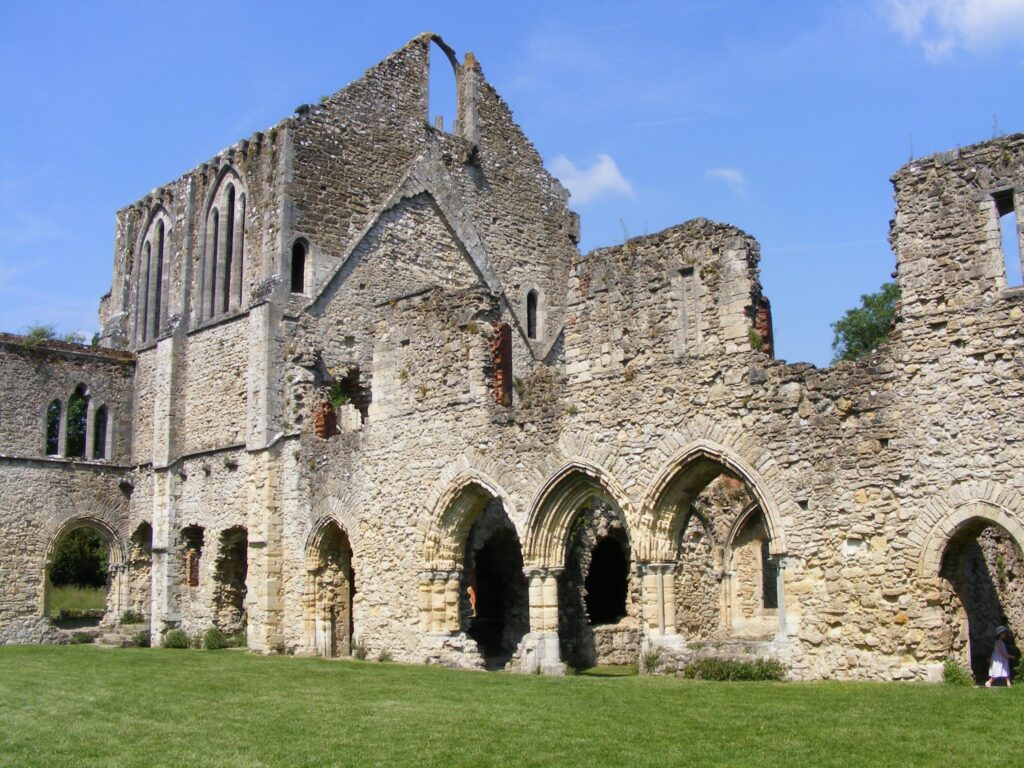
The bare facts: Netley Abbey is a ruined late medieval monastery in the village of Netley near Southampton, founded in 1239 as a house for monks of the austere Cistercian order. It is now a Scheduled Ancient Monument cared for by English Heritage, and the surviving remains constitute the most complete surviving Cistercian monastery in southern England. The ruins sit in wooded parkland west of the village.
A Bishop’s Memorial That Outlived Its Founder
Netley was the idea of Peter des Roches, who was Bishop of Winchester from 1205 until his death in 1238. He began buying land for the endowment around 1236 but died before the work was finished, leaving his executors to complete the foundation. According to the Chronicle of Waverley Abbey, the first monks arrived to settle the site on 25 July 1239, coming from neighbouring Beaulieu Abbey across Southampton Water.
The half-finished endowment left the new house financially exposed, and real progress on the buildings seems to have waited on royal interest. Henry III eventually assumed the role of patron in 1251, and the results are still visible: a large church some 72 metres long, built in the French-influenced Gothic style pioneered by the king’s masons at Westminster Abbey. A foundation stone at the base of the south-east pier of the crossing carries the inscription “H. DI. GRA REX ANGE”. The church took decades and was probably finished between 1290 and 1320.
Genteel Poverty and Free Beds for Sailors
Taxation returns of 1291 show a clear annual revenue of £81, a comfortable income, but bad management soon left the house close to bankruptcy. In 1328 the government appointed an administrator, John of Mere, to sort out the crisis, and estates were sold to pay debts. The monks blamed their troubles on the cost of feeding and housing travellers by sea and the king’s sailors who landed at the abbey. Whatever the accounting, the reputation stuck: the monks were best known to their neighbours for the generous hospitality they offered to travellers on land and sea.
Seven Monks and the Surrender of 1536
In 1535 the abbey’s income was assessed in the Valor Ecclesiasticus at £160 gross, £100 net, which brought it under the First Suppression Act. The king’s commissioners found Netley inhabited by seven monks, all of them priests, describing it as “A hedde house of Monkes of thordre of Cisteaux, beinge of large buyldinge and situate upon the Ryvage of the Sees.” Alongside the monks lived 29 servants and officials, plus two Franciscan friars of the strict Observant part of that order who had been placed in the abbot’s custody by the king.
Abbot Thomas Stevens and his seven monks were forced to surrender the house to the Crown in the summer of 1536. Stevens crossed the water to Beaulieu, was appointed its abbot the same year, and after that house fell too he ended his days as treasurer of Salisbury Cathedral, dying in 1550. Surviving reports suggest the abbey had a peaceful and scandal-free domestic life, which is inconvenient for anyone hoping the hauntings have a medieval crime behind them.
Sir William Paulet’s House Inside the Church
On 3 August 1536 Henry VIII granted the buildings and some of the estates to Sir William Paulet, his Lord Treasurer and later Marquess of Winchester. Paulet turned a monastery into a palace. The nave became his great hall, kitchens and service buildings, the transepts and crossing became luxurious apartments, and the presbytery was kept as the mansion’s chapel. The monks’ dormitory became the long gallery and the latrine block was carved into grand chambers. Theophilus Hastings, 7th Earl of Huntingdon, was still living in the house at the close of the seventeenth century.
Walter Taylor’s Dream and the Falling Tracery
This is the best attested of Netley’s legends, and the one with a corpse behind it. Around 1700 the abbey came into the hands of Sir Berkeley Lucy, who decided in 1704 to demolish the by then unfashionable house and sell the materials. He contracted a Southampton builder, Mr Walter Taylor, to take down the former church. During the demolition Taylor was killed by the fall of tracery from the west window, and the scheme stopped there.
The legend, recounted by the eighteenth century antiquary Browne Walters, is that Taylor had been warned. In the account, “Taylor dreamed that, as he was pulling down a particular window, one of the stones forming the arch fell upon him, and killed him.” He was troubled enough to consult a friend, said to have been the father of the well-known Dr Isaac Watts, who advised him to have nothing to do with the job. Taylor pressed on. The arch that came down was not the window of the dream, but it “fell upon his head and fractured his skull”, and the injury was aggravated “through the unskilfulness of the surgeon”. He died. The death is on record; the premonition is the part that only the story carries.
Blind Peter, Slown and the Order to Block It Up
A second local legend holds that at the Dissolution the abbey treasure was hidden down a secret tunnel, with a lone monk left behind to guard it. A treasure hunter named Slown is said to have found and entered an underground passage, then reappeared moments later screaming “In the name of God, block it up,” before dropping dead.
Netley does have real subterranean work to feed a tale like this. The reredorter drained into an underground stream running in a vaulted passage beneath the building, and the precinct was defended by a high bank and moat, part of which still survives east of the abbey. Excavation of the chapter house also turned up scattered human remains and evidence of graves beneath the medieval floor level, the abbots’ traditional burial place. None of that amounts to a guarded treasure vault, but it explains why visitors keep looking for one.
The Walled-Up Nun Who Never Existed
The most repeated Netley horror story is also the most firmly disproved. The tale of a nun walled up in a small room appears in Richard Harris Barham’s The Ingoldsby Legends, published between 1837 and 1845, in which the monks immure an erring nun and are duly punished by God. It was a creation of the author with no basis in fact or genuine folklore, as Barham himself admits in his notes, attributing the yarn to one James Harrison, “a youthful but intelligent cab driver of Southampton, who ‘well remembers to have heard his grandmother say that Somebody told her so.’” If you hear the walled-up nun told as history at Netley, that is its entire pedigree.
Where the Spectral Processions Came From
Netley’s ghostly atmosphere was manufactured, quite openly, by the Romantics. Horace Walpole visited with the poet Thomas Gray and in 1755 declared the place “In short, not the ruins of Netley, but of Paradise”. George Keate published The Ruins of Netley Abbey, A poem in 1764, pleading for the remains to be preserved. William Sotheby’s Ode, Netley Abbey, Midnight of 1790 took the gothic route and peopled the ruins with spectral processions and ghostly Cistercians, which is the direct literary ancestor of every hooded figure since reported here. Richard Warner followed in 1795 with the two-volume potboiler Netley Abbey, a Gothic Story, and William Pearce’s Netley Abbey, an Operatic Farce reached Covent Garden in 1794 with a stage mock-up of the moonlit ruins.
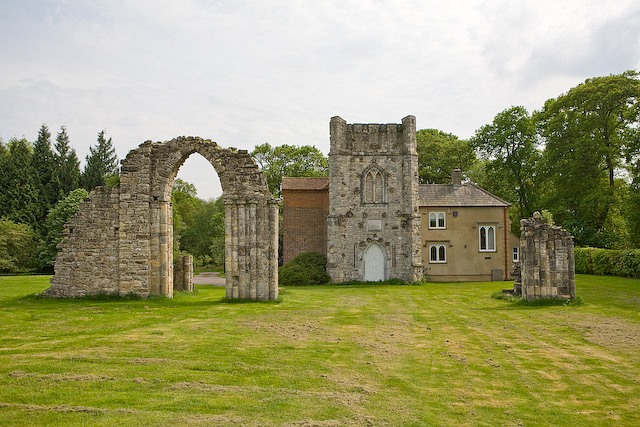
The tourists came with the verse. Jane Austen was among the nineteenth century visitors, John Constable painted the west end of the church in 1833, and in the 1760s Thomas Dummer had already carted the north transept off to Cranbury Park near Winchester, where it stands as a garden folly. Excavations directed by Charles Pink and the Reverend Edmund Kell took place in 1860, and in the same period the owners stripped out many Tudor additions to make the site feel more medieval, destroying much of the evidence for the mansion phase in the process.
Visiting Netley Abbey, and the 2018 Closure
The abbey passed into state care in 1922, given by its then owner Tankerville Chamberlayne, one time Member of Parliament for Southampton. English Heritage maintains it, and in most places the walls stand close to their original height. The sacristy and library, the south transept chapels, the treasury, the reredorter undercroft and the lower floor of the abbot’s house still have their vaults intact. Medieval heraldic polychrome tiles found on the site are displayed in the sacristy, and Henry III’s foundation stone remains in the church. In summer the ruins have hosted open-air theatre, and a flashmob wedding took place here on 25 June 2011.
One important caveat for anyone planning a trip: Netley Abbey was closed to the public in June 2018 on safety grounds, after scaffolding erected in the nave for conservation work was found to “fall far short” of expected standards. Check the current position with English Heritage before travelling rather than assuming the gate will be open.
Address: Netley, near Southampton, Hampshire
See Netley Abbey for Yourself
Sources
- A companion in a visit to Netley abbey [by J. Bullar]. To which is annexed, Netley abbey; an elegy: by G. Keate
- Scheduled Monuments in Southampton
- History of Cranbury Park, Hampshire
- Netley Abbey Investigation History
- The Romance of Netley
- Wikipedia: Netley Abbey
Frequently Asked Questions
Where is Netley Abbey Cistercian Ruins located?
Netley Abbey Cistercian Ruins is located at Netley, near Southampton, Hampshire.
Can you visit Netley Abbey Cistercian Ruins?
Netley Abbey Cistercian Ruins is open to the public. Always follow posted rules and respect private property.
Reader sightings
Nobody has reported anything here yet. If you have been, you would be the first.
Report your own visit to A Builder’s Fatal Dream and the Netley Abbey Ghosts
How haunted is this place?
Be the first to rate
Leave a Reply