
Reviewed by Josh N · Updated August 10, 2026 · How we verify
Reported Phenomena
- Cherokee apparitions
- Disembodied singing
- Felt energy from stone
- Sense of being watched
Reported by visitors & local legend. Stories, not verified claims.
The Paint Rock pictographs sit on a bluff where North Carolina runs out and Tennessee begins, above a bend in the French Broad River in Madison County. The figures painted on the stone are old enough that nobody alive can say for certain what they mean, and the stories attached to the place have grown in the gaps. Locals and travellers have long reported apparitions in the woods below the cliff, along with singing heard where no singer can be found. Those accounts are folklore and personal experience, not documented events, and this guide keeps them separate from what the record actually shows.
The Cliff That Gave the Community Its Name
Paint Rock is an unincorporated community in Madison County, and it takes its name from the mountain of the same name that stands nearby on the North Carolina and Tennessee state line. The settlement lies along the south bank of the French Broad River, a river that has functioned as a road through these mountains for as long as people have needed to get through them. The Norfolk Southern S-Line runs through the community, which is part of the Asheville Metropolitan Statistical Area.
That geography explains most of the site’s history. A gorge cut through high ground is a natural corridor, and the painted cliff face marks a point where that corridor narrows. By the nineteenth century, Paint Rock had become a well known waypoint for travellers, and troops were stationed there to guard what was then a crucial mountain passage.
Red, Ochre and Cerulean on 107 Feet of Stone
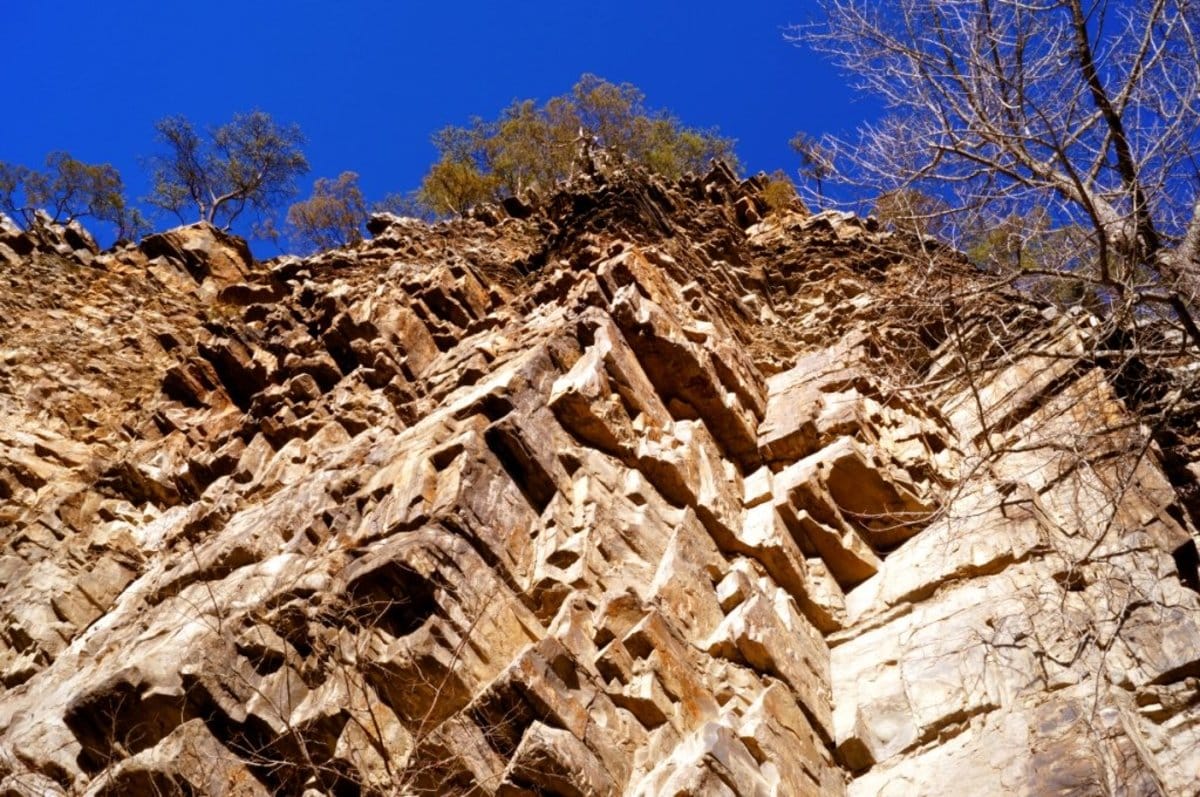
The paintings are worked in red, ochre and a blue that reads as cerulean, pigments drawn from local material rather than trade goods. They appear on cliffs rising roughly 107 feet above the French Broad River gorge, and they are widely counted among the finest surviving prehistoric rock art in North America. The commonly cited age for the work is around 5,000 years. The Cherokee regard the site as sacred.
What survives today has taken a beating. Five millennia of rain, freeze and thaw, along with smoke from generations of campfires lit beneath the overhang, have dulled and blurred much of the surface. Visitors expecting a gallery of crisp figures should adjust their expectations; the pigment is faint in places and easiest to read in raking light.
Michaux, Strother and the Earliest Written Descriptions
Two early records anchor the pictographs in the documentary history of the region. The boundary surveyor John Strother noted the artwork in 1790, while the French botanist Andre Michaux described it in 1796. Both accounts refer to painted figures of animals and natural scenes on the rock face. These are among the reasons the site can be treated as historically verified rather than merely traditional: outsiders with no stake in the legend wrote it down before the tourist era began.
The Cherokee Man and Woman Said to Walk the Woods
The ghost stories attached to Paint Rock centre on two figures, a Cherokee man and a Cherokee woman, described as moving through the woods near the base of the cliff. Sightings have been reported by both residents and passing visitors over many years. There is no incident, death or documented tragedy in the record that these accounts are pinned to, which is worth stating plainly: the apparitions are a persistent local tradition rather than the aftermath of any event that can be dated.
The second recurring report is auditory. People claim to have heard a woman singing in the forest, faint and unaccompanied, with no source found when they went looking. Others describe something less dramatic and harder to test, a sense of old and active energy coming off the stone itself, felt most strongly by those close enough to lay a hand on it. Whether that is the rock or the reputation is a question the site does not answer.
Reported phenomena at Paint Rock, in short:
- Apparitions of a Cherokee man and woman in the surrounding woods
- A woman’s singing heard from the trees with no visible source
- A felt charge or vibration reported by people touching the cliff face
- A general sense of being watched along the riverbank
Getting to Paint Rock, Hot Springs
The community sits near Hot Springs and is reached by Paint Rock Road, designated SR 1300, which connects to US 25 and US 70. It is a rural drive along the river, and the cliff is the obvious landmark once you arrive. Parking is informal and the road is narrow in stretches, so a weekday visit is easier than a summer weekend.
Treat the rock art as what it is: an irreplaceable, sacred and extremely fragile surface. Do not touch the painted areas, do not chalk or wet them to raise contrast, and do not climb the face. Adjoining land in the area is privately held, so stay on the public road and river access rather than crossing fences. Anyone visiting after dark for the ghost stories should factor in unlit rural roads, a cold river and a live rail line through the community.
See Paint Rock for Yourself
Sources
- Geographic Names Information System (Nationalmap (official))
- GeoHack – Paint Rock, North Carolina
- Wikipedia: Paint Rock, North Carolina
Frequently Asked Questions
Can you visit Paint Rock?
Paint Rock is open to the public. Always follow posted rules and respect private property.
Reader sightings
Nobody has reported anything here yet. If you have been, you would be the first.
Report your own visit to Paint Rock Pictographs and the Singing in the Woods
How haunted is this place?
Be the first to rate
Nearby Haunted Locations
- 1Grove Park InnNorth Carolina29mi
- 2Biltmore Estate GhostsNorth Carolina32mi
- 3Rowena and the Black DogTennessee45mi
- 4Phantom Carriages and Pink Marble at the Haunted Ramsey HouseTennessee46mi
- 5The 1922 Telescope That Explained the Brown Mountain LightsNorth Carolina56mi
- 6Shadows in the BalconyTennessee58mi
Leave a Reply