
Reviewed by Josh N · Updated August 18, 2026 · How we verify
Reported Phenomena
- Cavalryman apparition
- Parade ground sightings
- Missile museum disturbances
- Dormitory activity
Reported by visitors & local legend. Stories, not verified claims.
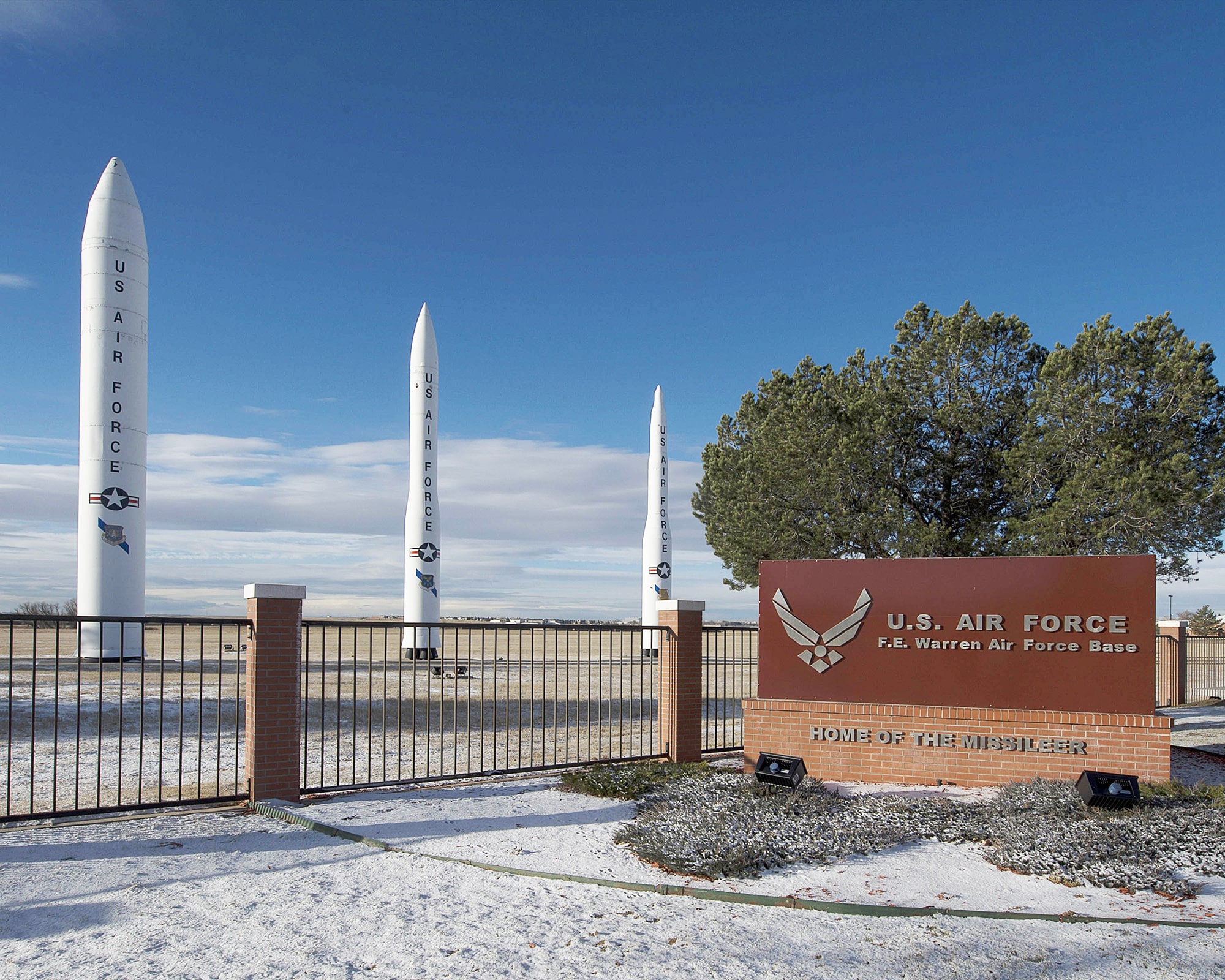
Three miles west of Cheyenne, on high plains that were treeless when the first tents went up, F.E. Warren Air Force Base has been in continuous military use longer than any other installation in the United States Air Force. It is a working nuclear missile base in southeast Wyoming, home to 150 Minuteman III intercontinental ballistic missiles, and it is also a nineteenth century cavalry post that never stopped being one: more than 220 red brick buildings raised between 1885 and 1930 are still standing and still in use. That combination, Victorian barracks wrapped around a Cold War mission, is the setting for the ghost stories base personnel have passed around for decades.
The Warren AFB File at a Glance
- Established as Fort D. A. Russell by the United States Army in 1867, weeks after the Union Pacific Railroad set up its mountain region headquarters at Crow Creek Crossing on 4 July 1867
- Renamed Fort Francis E. Warren on 1 January 1930, and Francis E. Warren Air Force Base on 7 October 1949
- Home of the 90th Missile Wing and of Twentieth Air Force, which commands all US Air Force ICBMs
- Total area of about 5 square miles, with a resident population recorded at the 2010 census
- Active installation with controlled access, no public wandering
A Diamond of Wooden Huts: Fort D. A. Russell, 1867
The base exists because of the Railroad Act of 1862. President Abraham Lincoln and Congress, planning the transcontinental line, wrote in a military installation on the eastern slope of the Rockies in Wyoming Territory to protect Union Pacific workers. When the railroad established its mountain region headquarters at Crow Creek Crossing, later Cheyenne, on 4 July 1867, the cavalry moved out three miles west and founded Fort D. A. Russell. The city and the fort began in the same summer and have grown alongside each other since.
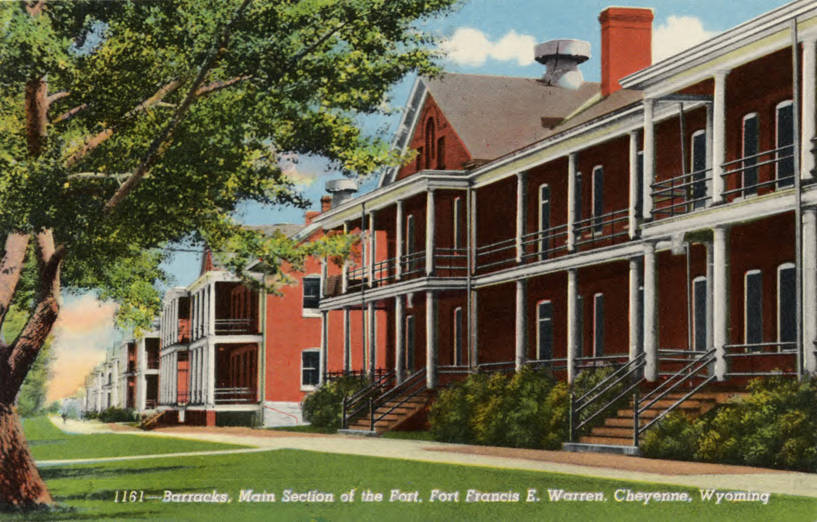
Detachments of the 30th Infantry formed the first garrison under Colonel John D. Stevenson. They lived in tents briefly, then moved into wood-frame quarters over the winter of 1867 to 1868. The buildings were laid out as a diamond rather than a rectangle, 800 feet by 1,040 feet with the opening facing east, a deliberate attempt to break the winds that came across the bare high plains. The entrance to that original fort stood next to what is now Chapel 1. Troops from the post rode out in 1876 for the Great Sioux Wars, the same campaign in which George Armstrong Custer’s forces were destroyed.
Twenty Thousand Horses and the Brick Rebuild
Fort Russell was made permanent in 1884 on the strength of its location, and in 1885 the War Department ordered it rebuilt for eight infantry companies. The Army put up 27 red brick buildings for $100,000, replacing the frame structures, and planted thousands of trees on ground that had none. Many of those early brick buildings were stables, and at the fort’s peak they housed close to 20,000 horses and mules. Between 1885 and 1930 more than 220 brick buildings went up. Most survive, their exteriors preserved and their interiors modernised.
The garrison list reads like a roll call of the Army’s turn of the century. Four black regiments formed by Congress in 1866, the 9th and 10th Cavalry and the 24th Infantry, all served here; only the 25th Infantry did not. In 1898 the Spanish-American War pushed the 8th Infantry out of Fort D. A. Russell for Cuba, and the Wyoming National Guard mustered in at the post before shipping to the Philippines, where it was the first battalion to reach the walls of Manila. Troops returning from the Philippine-American War in 1901 brought back a Queen Mary Tudor cannon forged in 1557 and two of the three Balangiga bells, which insurgents had rung as the signal for an ambush on American soldiers. The bells went back to the Philippines in 2018. The seven-foot cannon still stands near the base flagpole.
Quarters No. 2, the post commander’s house in 1885, was reassigned in 1903 to the family of Captain John “Black Jack” Pershing, who had married Senator Francis E. Warren’s daughter. Billy Mitchell, Mark Clark, Benjamin O. Davis Sr. and Walter Reed all spent time here. So, later, did Sammy Davis Jr., and the singer Chris LeDoux grew up on the base.
The Last Cavalry Left in 1927
This matters for the ghost stories. The final cavalry units rode off the installation in 1927, closing 60 years of mounted history at Fort Russell. President Hoover’s proclamation renamed the post Fort Francis E. Warren in 1930, honouring Wyoming’s territorial and first state governor, who had been awarded the Medal of Honor at 19 during the Civil War and served 37 years as a US senator, dying in office in November 1929 at the age of 85.
The Second World War turned Fort Warren into a Quartermaster Corps training centre for up to 20,000 men. More than 280 wooden buildings went up without insulation or interior walls to hold them, and in a Wyoming winter that meant shaking snow off a blanket before walking to an unheated communal shower. A prisoner of war camp was built at the same time. Jurisdiction passed to Air Training Command on 1 June 1947 and to the newly created United States Air Force in September 1947.
From Atlas Coffins to Minuteman III
On 1 February 1958 the base transferred to Strategic Air Command, and Warren became the first fully operational ICBM base in the Air Force. The first Atlas D missile deployed away from Vandenberg went to the 564th Strategic Missile Squadron on 15 September 1959, and the first Atlas D complex was declared operational on 9 August 1960 in the presence of General Power. Later sites held Atlas E missiles lying on their sides in shallow “coffin” launchers. The Atlas era ended in March 1965. Minuteman I followed from 1963, Minuteman III from the 1970s, and 50 Peacekeeper missiles after President Reagan’s statement to Congress on 22 November 1982. The last Peacekeepers came off alert by 16 September 2005 and the 400th Missile Squadron was inactivated on 19 September 2005. Today the 90th Missile Wing keeps 150 Minuteman III missiles on constant alert across a 9,600 square mile complex spanning three states.
Some of the supporting equipment has aged conspicuously. Former missileers alerted 60 Minutes, which aired a segment on Warren AFB on 27 April 2014 featuring analogue phone lines and computer systems still running on floppy discs. The base has also been a Superfund site on the National Priorities List since 21 February 1990, because of trichloroethylene contamination in soil and groundwater; one Army Corps project manager estimated in 2014 that removing the chemicals from the groundwater would likely be a 100 to 200 year effort.
What People Say Walks the Parade Ground
None of the documented history of the post records a haunting. What exists is base folklore, told among personnel and repeated by paranormal enthusiasts, and it should be read as anecdote rather than record.
The most persistent story is of a cavalryman, seen or sensed on the parade grounds, still walking a patrol that ended when the last horse units left in 1927. Accounts of him are vague on detail and consistent only in the uniform. Odd occurrences are also reported around the missile museum, and the dormitories carry their own crop of stories, the usual currency of any institution where young people live in old buildings and work night shifts. People who repeat these tales tend to link them to the fort’s frontier and Spanish-American War years, which is an interpretation rather than evidence.
It is worth being blunt: no verified incident, no documented death, and no named witness underpins any of it. What Warren does have is 220 buildings a century and a half old, occupied continuously by a rotating population with a taste for a good story, and a mission that keeps a lot of people awake at three in the morning.
Getting Onto F.E. Warren: Access and Reality
This is an operational nuclear installation, not a heritage site. Access is controlled, the 90th Security Forces Group provides continuous security across the base and the missile field, and there is no casual visiting. Anyone hoping to see the historic brick quarters or the 1557 cannon by the flagpole needs to arrange access through the base rather than turn up at the gate.
The old missile sites offer nothing either. The abandoned Atlas launchers northwest of Cheyenne are in private ownership behind no trespassing signs, with cracked roads and vegetation growing through the surface, and the Peacekeeper launch facilities have been imploded and graded. Unlike most Air Force bases, Warren has no paved runway; the only conventional airfield it ever had was a single dirt strip, made briefly famous when the First World War ace Eddie Rickenbacker crashed there and survived.
See Francis E Warren Air Force Base for Yourself
Sources
- KFEW Francis E Warren Air Force Base Heliport
- Home
- Warren AFB, CDP Decennial Census P1 (Census (official))
- First ICBM base hums
- F.E. Warren Air Force Base (Epa (official))
- Wikipedia: Francis E. Warren Air Force Base
Frequently Asked Questions
Can you visit Francis E Warren Air Force Base?
Francis E Warren Air Force Base is on private property and best viewed from a distance. Always follow posted rules and respect private property.
Reader sightings
Nobody has reported anything here yet. If you have been, you would be the first.
Report your own visit to Cavalry Ghosts at F.E. Warren Air Force Base, Cheyenne
How haunted is this place?
Be the first to rate
Ghost Tours Nearby

Affiliate links: BeyondHaunted may earn a commission, at no extra cost to you.
Leave a Reply