
Reviewed by Josh N · Updated July 28, 2026 · How we verify
Reported Phenomena
- Woman's wailing
- Disembodied crying
- Screams near water
- Figure on the bank
Reported by visitors & local legend. Stories, not verified claims.
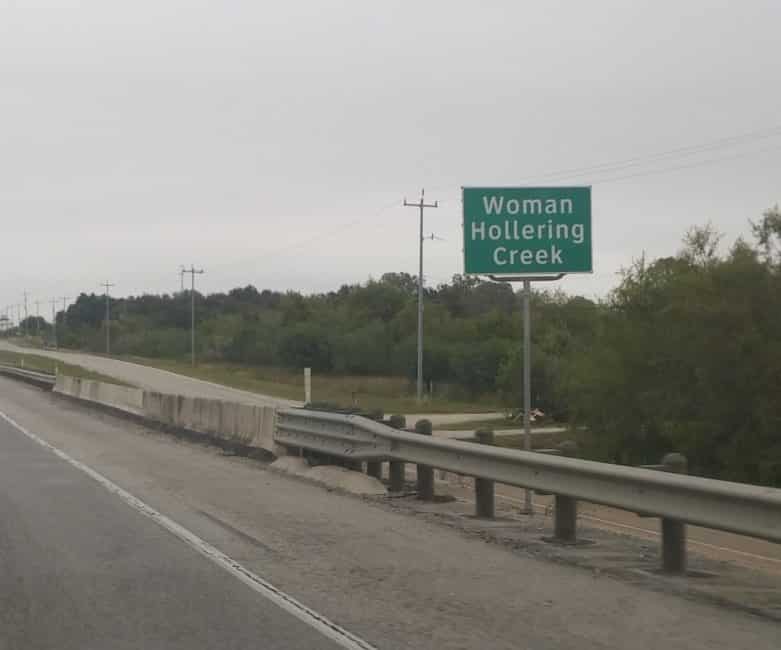
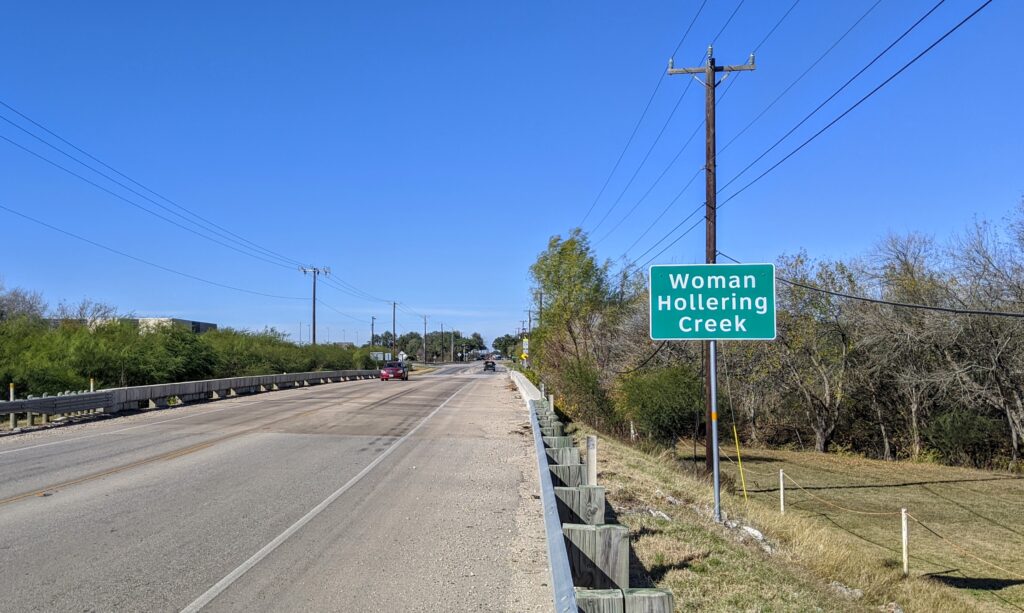
Drive Interstate 10 east out of San Antonio toward Seguin and you will cross Woman Hollering Creek without noticing it: a modest ribbon of water under a highway bridge, signed and gone in a second. The name is the whole attraction. Of all the waterways in Texas, this one carries its ghost story in plain English on the map, and the story it carries is the oldest and most widely told ghost story in the Spanish-speaking Americas.
A Small Creek With a Long Address
Hydrologically, Woman Hollering Creek is a minor player. It runs in Bexar County and feeds Martinez Creek, which feeds Cibolo Creek, which in turn empties into the San Antonio River. It appears on some maps and in some records under the alternative name Womans Hollow Creek, which may be a corruption, a mishearing, or a surveyor’s shortcut. The creek has also been recorded as Arroyo de la Llorona, and the English name is most likely a loose and slightly clumsy translation of that Spanish original: La Llorona, the weeping woman. “Hollering” is what happens when a folk name crosses a language barrier and loses its grief along the way.
The land around the creek was occupied long before either name existed. Coahuiltecan and Apache peoples ranged through this part of central Texas ahead of Spanish and later Anglo settlement, and the creek was already on the map by the early nineteenth century. There is no documented incident, no coroner’s record, no named woman attached to the crossing. What survives is the name and the story that explains it.
The Weeping Woman and Her Many Variations
The core legend is straightforward and brutal. A woman who has recently given birth drowns her newborn in the water, either because the child’s father does not want it or because he has left her for another woman. She screams in anguish at what she has done. After her own death her spirit remains at the place of the drowning, wailing in misery, unable to leave.
That is the version most closely tied to the creek’s name, and it is only one of dozens. La Llorona has many variations across Mexico and the American Southwest, and local retellings in the San Antonio and Seguin area have added their own flourishes. One says the name came from something entirely ordinary: a woman calling loudly for her children at dusk. Another has a woman screaming for help while being attacked near the water. A third describes a mother driven mad by abandonment or unbearable loss who takes her children into the creek with her. All of them end in the same place, with a spirit that mourns along the bank after dark.
It is worth being clear about what this is. Nothing in the record confirms that any of these events happened at this crossing. The legend is older than the creek’s English name and travels freely from one body of water to the next. What makes this site unusual is not evidence but permanence: the story got written onto a map and stayed there.
What People Say They Hear at the Water
Accounts from visitors are consistent and narrow. The overwhelming majority involve sound rather than sight: a woman crying, moaning, or calling out from somewhere near the water, usually at night, usually with no visible source. Some describe the noise as distant, some as unnervingly close. Sightings of a figure on the bank are reported but far less often.
The plain explanations are not exotic. Screech owls, coyotes, waterbirds and wind moving through brush along a creek bed all produce cries that sound uncomfortably human, and a person who arrives at a place called Woman Hollering Creek expecting to hear a woman hollering is primed to interpret whatever they hear that way. What has kept the reputation alive is repetition across generations rather than any single documented encounter.
The Creek in Print and Song
The name has outgrown the water. Sandra Cisneros used it for her 1991 short story collection Woman Hollering Creek and Other Stories, which put the crossing in front of a national readership and tied it firmly to the Mexican American experience of this stretch of Texas. The Electric Boy Rangers recorded a song called “River Called Woman Hollering.” For many people, the creek is now better known as a title than as a place.
Seeing Woman Hollering Creek for Yourself
Set expectations low and you will not be disappointed. The creek crosses Interstate 10 between San Antonio and Seguin, and the highway signage is the most photographed thing about it. There is no park, no visitor centre, no trail system and no interpretive marker. Much of the surrounding land is private, and the shoulder of an interstate is a genuinely dangerous place to stop, so treat the crossing as something you observe rather than something you explore. Anyone hoping to reach the bank should look for legal public access points on the local roads that cross the creek away from the freeway, and should not cross fences or enter posted land.
Go for the name, the strangeness of finding a ghost story printed on a state highway map, and the short detour into Seguin or back into San Antonio. Whatever cries out from the brush at dusk is up to you to interpret.
See Woman Hollering Creek for Yourself
Sources
Frequently Asked Questions
Can you visit Woman Hollering Creek?
Woman Hollering Creek is open to the public. Always follow posted rules and respect private property.
Reader sightings
Nobody has reported anything here yet. If you have been, you would be the first.
Report your own visit to Woman Hollering Creek: A La Llorona Legend Off I-10
How haunted is this place?
Be the first to rate
Ghost Tours Nearby
 San Antonio Haunted Ghost Bus Tourfrom $60
 San Antonio Haunted Pub Crawl – Ghosts, Drinks & Historic Barsfrom $35
 San Antonio Haunted History Ghost Tourfrom $32
Affiliate links: BeyondHaunted may earn a commission, at no extra cost to you.




Leave a Reply