
Reviewed by Josh N · Updated July 28, 2026 · How we verify
Reported Phenomena
- Chairs that push visitors
- Moving suit of armor
- Disembodied screams and moans
- Reportedly haunted antiques
- Feeling of being watched
Reported by visitors & local legend. Stories, not verified claims.
Two Gothic chairs in the ballroom at Belcourt Castle are roped off, and the reason usually given by guides is not conservation. Visitors are told that one of them once threw a guest onto the floor. That single story, repeated on tour after tour, has done more for the building’s reputation than sixty rooms of French Renaissance carving ever did. The house itself, built on Bellevue Avenue in Newport, Rhode Island, is a genuine Gilded Age oddity long before anyone brings up ghosts: a 50,000 square foot summer villa with stables and carriage bays occupying its entire ground floor.
- Built: construction began 1891, completed 1894
- Architect: Richard Morris Hunt, for Oliver Hazard Perry Belmont
- Scale: roughly 60 rooms, 50,000 square feet, built at a cost of $3.2 million in 1894
- Intended use: six to eight weeks of occupancy a year
- Now: privately owned, renamed Belcourt of Newport, open by guided tour
A Hunting Lodge for a Man Who Preferred His Horses
Oliver Belmont was thirty-three when Hunt began work in 1891. He had recently divorced Sara Swan Whiting and denied paternity of their daughter, Natica, and he wanted a summer house built precisely to his own specifications. Hunt, who had already given Newport The Breakers and Marble House, was reportedly hesitant about some of the client’s demands but fell back on the principle that it was Belmont’s money he was spending.
The result was modelled on the Louis XIII hunting lodge at Versailles and then loaded with borrowings from German, English and Italian design. The plan is a large quadrangle: two-story wings running back from a three-story main block, wrapped around an 80 by 40 foot courtyard finished with Norman half timbering. A mansard roof is pierced by oval copper dormers. A wrought iron balcony stretches seventy feet along the second floor of the north front, where the two enormous carriage entrances were placed.
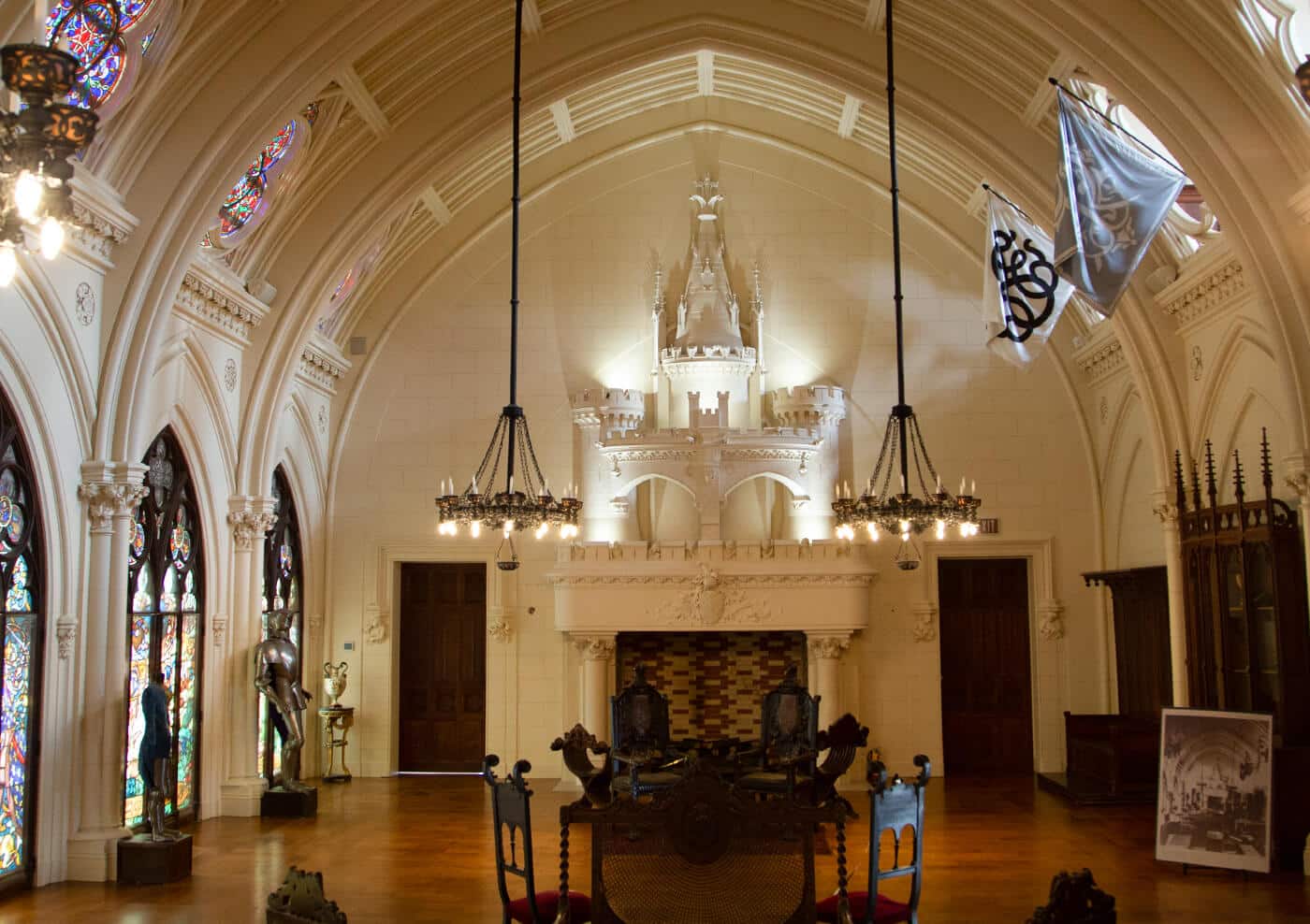
The eccentricity was on the inside. The whole ground floor went to Belmont’s carriages and his prized horses. Belmont’s father, August Belmont Sr., had the Belmont Stakes named for him, and Oliver was known for his skill driving a four-in-hand. Upstairs sat a master bedroom painted with scenes from the life of a nobleman and a bathroom containing what is said to have been Newport’s first standing shower. West of the carriage floor was the Francis I style Grand Hall, its Gothic rooms lit by huge stained glass windows and stamped with the Belmont coat of arms. The original blood red damask on those walls was replaced long ago with the same fabric in gold. A Grand Staircase, now a replica of the stairs at the Cluny Museum in Paris, links the lower hall to its twin above.
Belmont had open contempt for the newer money throwing up show palaces between Bellevue Avenue and the ocean, so he made his guests arrive by a modest entrance off Ledge Road, the small street running parallel to Bellevue. Thirty servants kept the place running, on aggregate wages of roughly $100 a week, about 40 percent of the national average wage at the time.
He very nearly missed his own house. Belcourt was scheduled to open on July 4, 1894, but Belmont was hospitalized in New York City after a mugging and the villa stayed shut for the season. A full year passed before he saw the finished building.
What Alva Belmont Changed
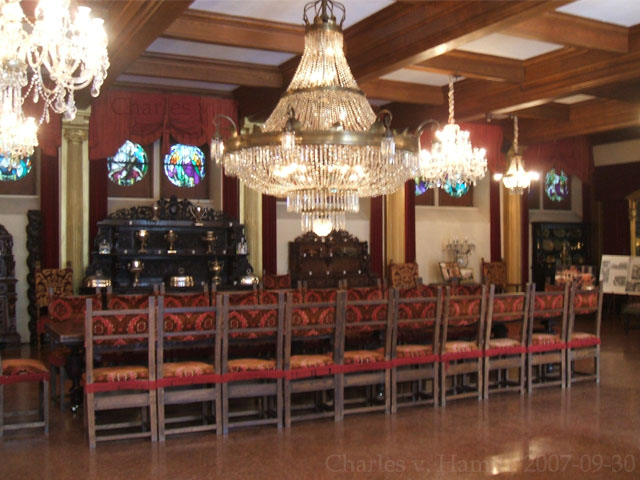
On January 11, 1896, Belmont married his neighbor Alva Vanderbilt, formerly the wife of William Kissam Vanderbilt. She arrived with strong opinions. Alva turned the carriage room into a banquet hall, converted a study into a boudoir and imported eighteenth century French paneling to do it. The house went from eccentric to hybrid. In 1899 its grounds hosted the first automobile parade held in the United States, which is a neat measure of how fast the world was moving away from a mansion designed around horses.
From $3.2 Million to a Thousand Dollars
Oliver Belmont died in 1908. Alva died in France on January 26, 1933, and Belcourt passed to Perry Belmont, the eldest Belmont child and Alva’s brother-in-law, who was eighty years old. With Newport a naval base and a plausible target, Perry moved most of the contents out to his other estates during the war years, and select pieces of Alva’s were auctioned off, reportedly because he had little affection for her memory.
In 1940 he unloaded the house entirely. George Waterman bought it for $1,000 on the condition that he restore it as closely as possible to Hunt’s original plans, intending to run an antique automobile museum inside. He repaired the third floor roof and removed an addition that overlooked the courtyard, then learned that zoning would not permit the museum. Waterman sold to Edward Dunn in 1943. Dunn held the property for eleven years and never lived in it, renting the stables to the military for equipment repair while other Newport mansions were being demolished or institutionalized.
Louis and Elaine Lorillard bought it in 1954 for $22,500 and imagined it as the permanent home of the Newport Jazz Festival. The Bellevue Avenue lawns could hold more than 10,000 people and the stucco and masonry made a decent acoustic backdrop, so the courtyard hosted concerts and the vast interior rooms became workshops and lodging. The neighbors objected, and the plan died. By November 1956 the Lorillards were selling a mostly abandoned building that had been largely uninhabited for two decades.
The Tinneys, the Chandelier, and Fifty-Six Years of Collecting
The Tinney family of Cumberland, Rhode Island, paid $25,000 for it in 1956. They renamed it Belcourt Castle, and they are the reason the place is famous for hauntings rather than for horses.
Harold Tinney, his wife Ruth, their son Donald and Ruth’s aunt Nellie Fuller, a descendant of the Mayflower passenger Edward Fuller, moved in and began filling sixty rooms with antiques and reproductions gathered from all over the world: Persian rugs, French royal furnishings, Oriental art, and a large number of religious objects. Donald built a coronation coach. A 1701 copy of Hyacinthe Rigaud’s portrait of Louis XIV, once hung in the Green Room of the Tuileries, came in. The centerpiece was an Imperial Russian-style chandelier carrying 13,000 rock crystal prisms and 105 lights, suspended a few feet above the rose marble mosaic floor of Alva’s banquet hall.
The alterations kept coming. The Organ Loft ceiling was raised eleven feet to take a 26-rank tracker organ. An old kitchen became a coach hall between 1966 and 1970. The open loggia became a French salon in 1969. In 1975 the northwest reception room was rebuilt as a chapel using German Renaissance stained glass. In the early 1980s the family erected gate piers on Bellevue Avenue and hung gates acquired from the Taylor estate in Portsmouth, altering the overthrow so that the entrance stands taller than any other estate gate in Newport.
In 1960 Donald Tinney married Harle Hanson, who had come to Belcourt to work as a tour guide. She would outlive the rest of them and was the only surviving family member when the castle was sold in 2012.
Not every strange event here is a ghost story. In 1983 thieves attempted a million-dollar theft of the collection. Police recovered many of the pieces, but a fourteen-pound silver reliquary holding a third century relic was never returned.
The Chairs, the Armor, and the Objects Themselves
Belcourt’s paranormal reputation is unusual in one respect: the stories attach less to the Belmonts than to the things the Tinneys brought home. The claim, made by the family and repeated by guides, is that some of the imported antiques carried something with them.
The most repeated account concerns a set of Gothic style chairs in the Grand Ballroom. A visitor is said to have been pushed out of one of them by an unseen force, after which the chairs were roped off. No contemporary record of that incident is available, and the story circulates in the form guides tell it, which is worth remembering.
Other reports include:
- A suit of armor said to shift position on its own
- Faint screams and moaning heard in the halls, sometimes linked to the armor
- Individual antiques described by the Tinneys as active or occupied
- A general sense of being watched in the upper galleries, where Hunt framed long vistas from room to room
All of it is anecdotal. Harold, Ruth, Donald and Harle Tinney lived here for decades and told these stories themselves, on tours, to paying visitors. That does not make the experiences false, but it does mean the record is a family’s testimony rather than documented investigation. A sixty-room house that stood mostly empty from the 1930s to the mid 1950s, then filled up overnight with reliquaries, church glass and armor, is also a house that generates atmosphere without any help from the dead.
Seeing Belcourt of Newport for Yourself
Jewelry entrepreneur Carolyn Rafaelian bought the property in 2012 and has been restoring it, returning the name to Belcourt of Newport. It is private property, and access is by guided tour only. Tours have been offered on Fridays and weekends and run roughly fifty minutes, though schedules at privately owned Newport houses change with the season and with restoration work, so confirm before you drive out.
Go for the building first. The courtyard, the carriage entrances on the north façade and the Gothic hall with its stained glass are the argument for the visit, and the lawn sculpture in bronze, terra cotta, marble and stone can be appreciated on the way in. The gates on Bellevue Avenue are hard to miss: the Tinneys made sure of that. Whether a chair moves is not something any tour can promise.
See Belcourt Castle for Yourself
Sources
Frequently Asked Questions
Can you visit Belcourt Castle?
Belcourt Castle is accessible by guided tour only. Always follow posted rules and respect private property.
Reader sightings
Nobody has reported anything here yet. If you have been, you would be the first.
Report your own visit to Belcourt Castle: The Roped-Off Chairs of Newport’s Gilded Age
How haunted is this place?
Be the first to rate
Ghost Tours Nearby
 Haunted History Walking Tour of Providencefrom $30
 Providence Ghost Tours: Phantoms, Poltergeists, & Pestilencefrom $26
 Haunted Boat Tours in Providencefrom $45
Affiliate links: BeyondHaunted may earn a commission, at no extra cost to you.
Leave a Reply