Reviewed by Josh N · Updated July 29, 2026 · How we verify
Reported Phenomena
- Mystery ghost lights
- Moving orbs of light
- Color-changing lights
- Splitting and merging lights
- Unexplained desert glow
Reported by visitors & local legend. Stories, not verified claims.
Nine miles east of Marfa, on the south shoulder of U.S. Highway 90, there is a roadside pullout where people park at dusk and stare southwest into the dark. They are looking for the Marfa Lights, spots of brightness that appear over Mitchell Flat in far west Texas, hold still, drift, split apart, and go out. The sightings go back to 1883. So does the argument about what they are.
This is one of the few famous American mysteries that has actually been measured. Physics students, spectroscopy teams and long-term monitoring stations have all pointed their equipment at Mitchell Flat, and most of what they caught turned out to be traffic. Not quite all of it, which is why people keep coming.
Quick Orientation for Light Watchers
- Where: Mitchell Flat, southwest of the Marfa Lights Viewing Center on U.S. 90, east of Marfa, Texas.
- First record: 1883, by a cowhand named Robert Reed Ellison.
- What people report: orbs of light that change intensity and color, usually yellow-orange, sometimes green, blue or red.
- How often: monitoring has logged an average of 9.5 lights on 5.25 nights per year.
- Leading explanation: automobile headlights on U.S. 67, distorted by desert air.
Robert Reed Ellison and the Campfire That Left No Ashes
The first historical record of the lights dates to 1883, when a young cowhand named Robert Reed Ellison was driving cattle through Paisano Pass and saw a flickering light. He wondered whether he was looking at an Apache campfire. When he mentioned it, other settlers told him they saw the lights often, and that when they went out to investigate they found no ashes and no other trace of a camp. Joe and Anne Humphreys reported seeing the lights next, in 1885.
For decades the story stayed local, passed around Presidio County rather than printed. The first published account did not appear until the July 1957 issue of Coronet magazine. In 1976, Elton Miles gathered stories reaching back into the nineteenth century in Tales of the Big Bend, and included a photograph of the lights taken by a local rancher. That combination, oral tradition plus a magazine feature plus a picture, is roughly how the Marfa Lights became a destination rather than a rumor.
Folklore around Marfa has attached the usual explanations to the glow, including the ghosts of long-dead Spanish expeditions. Those are stories, not records. Nothing in the documentary history of the lights ties them to any specific death or disappearance.
What Observers Actually See Over Mitchell Flat
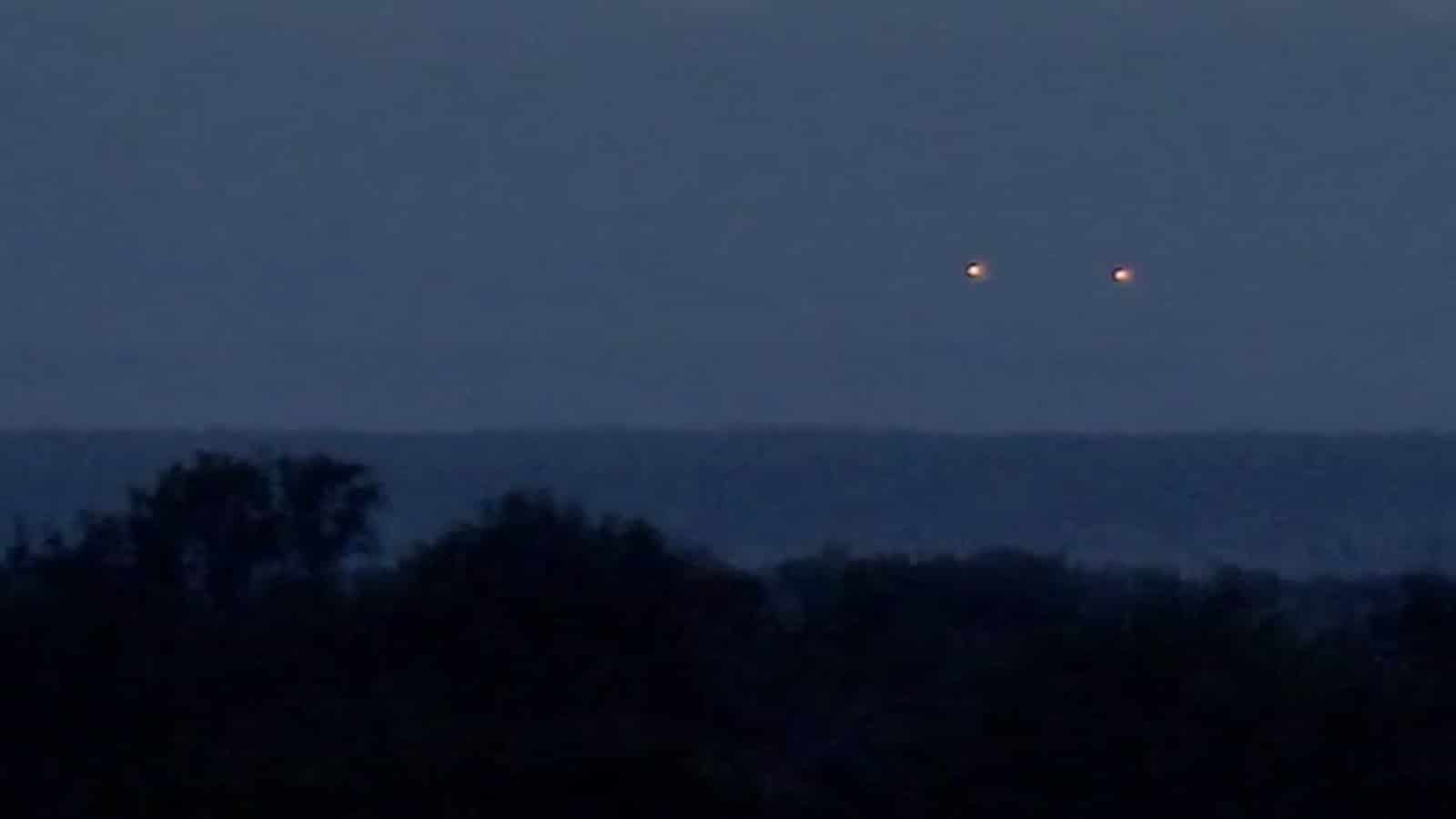
James Bunnell, who has spent years watching from the view park east of Marfa, describes the lights as orbs that change in intensity and color, sometimes moving and sometimes stationary, sometimes splitting or merging. He records them as usually yellow-orange, with occasional green, blue and red. Crucially, he notes they typically appear above the desert vegetation but below the mesas that form the horizon, which is what makes them read as objects sitting out on the flat rather than as anything in the sky.
Robert and Judy Wagers went further and defined the frame. What they call “Classic Marfa Lights” appear south-southwest of the Marfa Lights Viewing Center, inside a wedge whose left edge lines up with the Big Bend Telephone Company tower and whose right edge is Chinati Peak, both as seen from the viewing center. Judith Brueske has recommended the widened shoulder on Highway 90 about nine miles east of Marfa as the best vantage point. She also describes the practical problem every visitor faces: the lights show up as distant spots of brightness that have to be told apart from ranch lights and from headlights on Highway 67, and the main way to distinguish them is their aberrant movement.
Bunnell lists 34 sightings between 1945 and 2008. Monitoring stations went in starting in 2003, and from that data he has identified an average of 9.5 lights on 5.25 nights per year, while suspecting the stations may be catching only half of what occurs over Mitchell Flat. Whatever else that tells you, it tells you the lights are not a nightly show.
Chase Cars, Spectroscopes, and Highway 67
In May 2004, a group from the Society of Physics Students at the University of Texas at Dallas spent four days working the problem with traffic volume monitoring equipment, video cameras, binoculars and chase cars. Their findings were blunt. U.S. Highway 67 is visible from the viewing location. The frequency of lights southwest of the park tracked the frequency of traffic on U.S. 67. The lights moved in straight lines matching the road. When the group parked a vehicle on 67 and flashed its headlights, observers at the view park saw what looked like a Marfa light, and a car passing that parked vehicle appeared as one light passing another. Every light they saw southwest of the park across four nights was reliably attributable to headlights running between Marfa and Presidio.
Four years later, scientists from Texas State University spent 20 nights in May 2008 aiming spectroscopy equipment from the viewing station. They recorded lights that, in their words, could have been mistaken for lights of unknown origin, but in each case the movement and the instrument data resolved into automobile headlights or small fires. Their conclusion was measured rather than triumphant: because lights with genuinely odd behavior, the ones car headlights cannot account for, are so rarely observed, more research is needed to say what those are. Taken together, observations across 2000 to 2008 pointed to headlights distorted by warm desert air.
The skeptic Brian Dunning adds a piece of local context that is hard to argue with. The view park sits on the site of Marfa Army Airfield, where tens of thousands of personnel were stationed between 1942 and 1947 training American and Allied pilots, and which then served for years as a regional airport with daily airline service. With the field and its satellites under constant sentry patrol, it is unlikely that a genuinely inexplicable nightly phenomenon would have gone unremarked. Dunning’s preferred explanation is a mirage produced by sharp temperature gradients between cold and warm layers of air. Marfa sits at 4,688 feet above sea level, where swings of 40 to 50 degrees Fahrenheit between the daily high and low are common, which is exactly the condition such a mirage needs.
The Lights in Songs, Sitcoms, and Novels
Marfa’s glow has traveled well beyond Presidio County. The lights turned up on Unsolved Mysteries, in the King of the Hill episode “Of Mice and Little Green Men,” and in an episode of the Disney Channel series So Weird. David Morrell’s 2009 novel The Shimmer was inspired by them. The Rolling Stones name the “lights of Marfa” in “No Spare Parts,” released with the 2011 reissue of Some Girls. Paul Cauthen wrote a love song called “Marfa Lights” for his 2016 album My Gospel, The Union Trade recorded a track of the same name in 2015, and Mark McGuire included “The Marfa Lights” on a 2009 album. In the 2019 Simpsons episode “Mad About the Toy,” the family visits Marfa and Lisa tries to explain the lights before Marge stops her, which may be the most honest treatment of the subject on television.
Visiting the Marfa Lights Viewing Center
The viewing area is free, public, and open air, a roadside park on the south side of U.S. 90 roughly nine miles east of town. The community has publicized it deliberately to encourage tourism, so expect company on weekends and holidays. Go after full dark, bring a coat regardless of the daytime temperature given how far Marfa’s nights drop, and give it time: at an average of a few nights a year producing anything unusual, patience matters more than equipment.
Orient yourself south-southwest, between the telephone company tower on your left and Chinati Peak on your right. Learn where Highway 67 runs before you start counting mysteries, because most of what moves out there in a straight line is a car headed for Presidio. The honest pitch for the trip is this: you are almost certainly going to watch a mirage of traffic across a high desert basin, and a small residue of what has been recorded from this spot still has no accepted explanation. That residue is why the parking area exists.
See The Marfa Lights for Yourself
Sources
- The mysterious ‘Ghost Lights’ of Marfa, Texas
- Scientists Can’t Fully Explain These Strange Floating Lights in Texas
- Spectroscopy applied to observations of terrestrial light sources of uncertain origin
- Marfa Lights
- Famous Ghost Stories: Legends and Lore
- Wikipedia: Marfa lights
Frequently Asked Questions
Can you visit The Marfa Lights?
The Marfa Lights is open to the public. Always follow posted rules and respect private property.
Reader sightings
Nobody has reported anything here yet. If you have been, you would be the first.
Report your own visit to Marfa Lights: What 20 Nights of Spectroscopy Found
How haunted is this place?
Be the first to rate
Leave a Reply