
Reviewed by Josh N · Updated September 19, 2026 · How we verify
Reported Phenomena
- Lady in Gray apparition
- Cemetery apparition sightings
- Spirit searching graves
Reported by visitors & local legend. Stories, not verified claims.
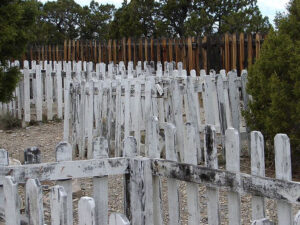
Two acres of headstones sit behind a stone wall on Sullivant Avenue in Columbus, hemmed in by houses built decades after the last prisoner left. This is all that survives of a Civil War camp that processed tens of thousands of men, and it is where the story of the Camp Chase Lady in Gray took hold. Ohio’s largest Confederate burial ground is a quiet place now, mowed and maintained, but the legend attached to it is one of the oldest continuously told ghost stories in the state.
From Camp Jackson to a Prison Holding 9,400 Men
Camp Chase was established in Columbus in May 1861, immediately after the start of the American Civil War, on land leased by the federal government. It replaced the much smaller Camp Jackson, set up by Ohio Governor William Dennison Jr. The camp took its name from a former Ohio governor, Salmon P. Chase, who was serving as Lincoln’s Secretary of the Treasury.
Its main entrance stood on the National Road, four miles west of downtown Columbus. The boundaries correspond to present-day Broad Street on the north, Hague Avenue on the east, Sullivant Avenue on the south, and Westgate Avenue on the west. What began as a training ground for Ohio volunteers became a parole camp, a muster outpost, and finally a prisoner-of-war compound. As many as 150,000 Union soldiers and 25,000 Confederate prisoners passed through its gates between 1861 and 1865. By February 1865, more than 9,400 men were held in the prison at once.
Not all of them were soldiers. Civilians from western Virginia and Kentucky suspected of supporting secession were confined here, among them the former three-term congressman Richard Henry Stanton. Confederates taken during Morgan’s Raid in 1863, including Colonel Basil W. Duke, were also sent to Camp Chase.
Smallpox, Short Rations, and the Winter That Filled the Cemetery
The conditions were bad for reasons that were mostly bureaucratic rather than deliberate. Prisoners were not intentionally starved, but the Union army fed its own soldiers first, which often left the men inside with little or no food. In 1863 the population peaked at roughly 8,000 at one time, and crowding that many people into a small compound produced a large outbreak of smallpox and other deadly diseases. Hundreds of prisoners died over the following winter. Conditions like these existed in prison camps on both sides, and the suffering eventually pushed the Union and the Confederacy into a prisoner exchange agreement under which around 10,000 soldiers were traded.
The camp closed in 1865. By September 1867 its dismantled buildings, usable materials, and 450 patients from the Tripler Military Hospital in Columbus had been transferred to the new National Asylum for Disabled Volunteer Soldiers in Dayton. What remained was the burial ground: 2,260 graves of Confederates who died in captivity at Camp Chase and at Camp Dennison near Cincinnati.
The Woman in Gray With the White Handkerchief
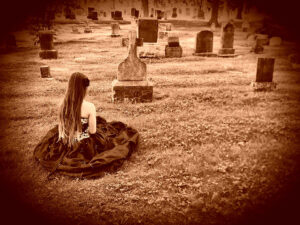
The legend is specific, which is unusual. The Lady in Gray is described as a young woman, late teens or early twenties, dressed entirely in gray and carrying a clean white handkerchief. She is said to be searching for a lost love whose grave she cannot find.
The account dates to just after the Civil War, when visitors to Camp Chase reported seeing a woman walking among the markers, trying to read the carved names. She was seen quite often for several years, then stopped appearing altogether. That is the whole of it. There is no documented name, no confirmed identity, and no contemporary record tying the figure to any particular prisoner in the ground. What exists is a persistent reported sighting from the postwar years that has been retold ever since, and modern visitors who describe seeing her are adding to a tradition rather than corroborating a fact.
The Memorial Arch and the Head That Was Never Recovered
In 1895 a former Union soldier, William H. Knauss, organized the first memorial service at the cemetery, and in 1906 he published a history of the camp. The Confederate Soldier Memorial was dedicated in 1902. From 1912 to 1994 the United Daughters of the Confederacy held annual commemorative services there; the Hilltop Historical Society now runs the event on the second Sunday in June.
On August 22, 2017, during a wider wave of removals and attacks on Confederate monuments, the soldier statue atop the memorial arch was pushed off and its head broke away. The vandals were never identified. They took the head but left the hat. The statue was repaired under the Dayton National Cemetery and re-installed in May 2019.
Finding Camp Chase in the Westgate Neighborhood
There is nothing left of the camp itself. The land became Westgate, a residential and commercial district built in the late 1920s and early 1930s, and a cornerstone from the camp now stands in front of the Westgate #623 Masonic Temple in the Hilltop section of west Columbus. Camp Chase is listed on the National Register of Historic Places.
The cemetery at 2900 Sullivant Avenue is the only part you can genuinely walk. It covers two acres and is managed, along with five national cemeteries, by the Dayton National Cemetery. An Ohio Bicentennial Commission historical marker was installed at the site in 1999. It is an active burial ground and a federal responsibility, so treat it accordingly: daylight hours, respect for the stones, and no expectation that anyone will meet you in gray at the gate.
Address: 2900 Sullivant Avenue, Columbus, Ohio
See Camp Chase for Yourself
Sources
- Camp Chase Confederate Cemetery–Civil War Era National Cemeteries: A Discover Our Shared Heritage Travel Itinerary
- Vandals decapitate Confederate soldier statue at Camp Chase cemetery
- NPGallery NRHP Archive Search (National Park Service)
- Library of Congress
- Wikipedia: Camp Chase
Frequently Asked Questions
Where is Camp Chase Confederate Cemetery Columbus located?
Camp Chase Confederate Cemetery Columbus is located at 2900 Sullivant Avenue, Columbus, Ohio.
Can you visit Camp Chase Confederate Cemetery Columbus?
Camp Chase Confederate Cemetery Columbus is open to the public. Always follow posted rules and respect private property.
Reader sightings
Nobody has reported anything here yet. If you have been, you would be the first.
Report your own visit to The Lady in Gray Still Walks Camp Chase Cemetery, Columbus
How haunted is this place?
Be the first to rate
Leave a Reply