
Reviewed by Josh N · Updated August 28, 2026 · How we verify
Reported Phenomena
- Spectral black cat
- Ghostly figures
- Poltergeist activity
- Ringing bells
Reported by visitors & local legend. Stories, not verified claims.
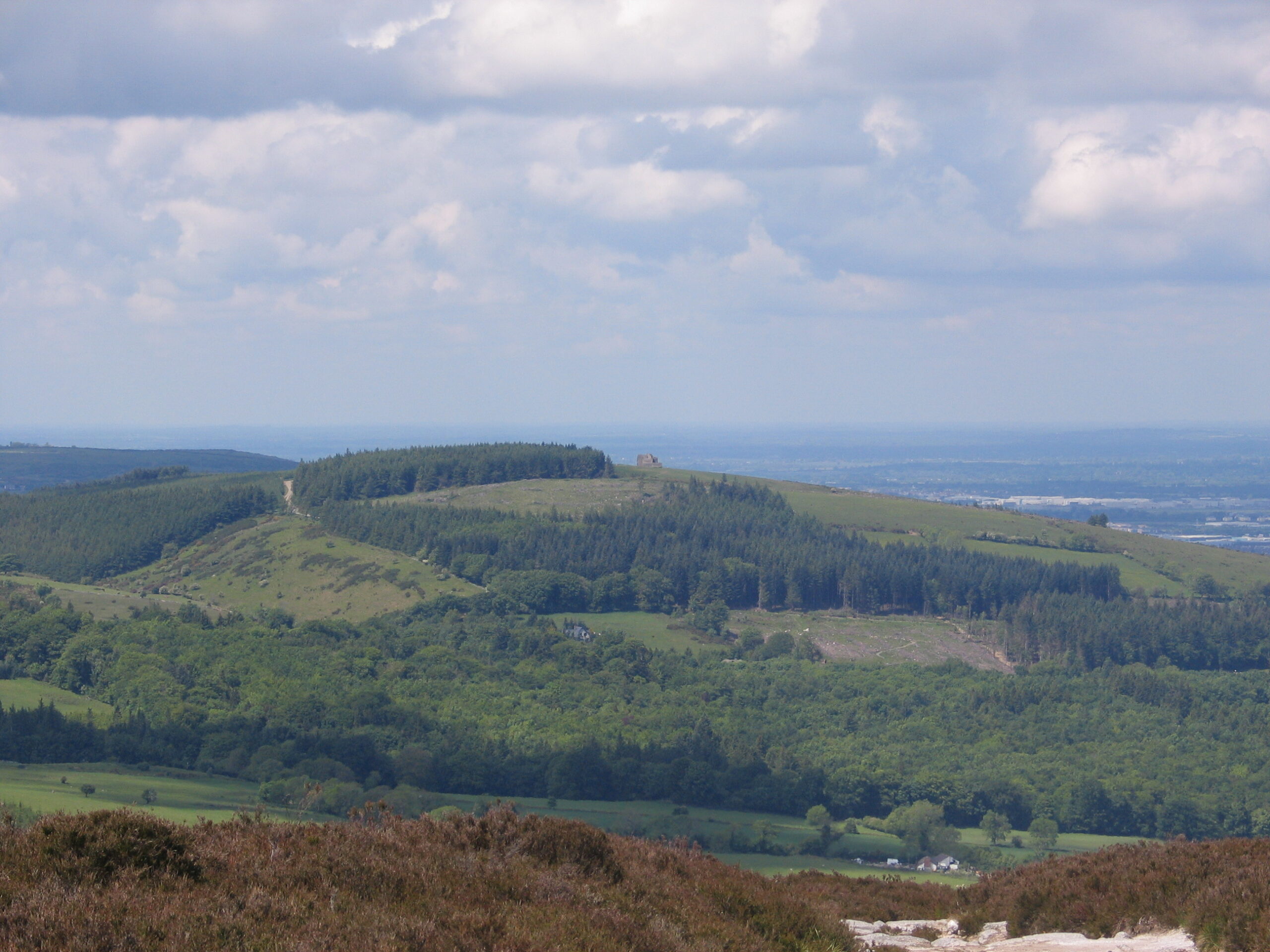
The roofless grey block on the summit ridge above Rathfarnham is the building most people mean when they say Hell Fire Club Dublin. It sits on Montpelier Hill in County Dublin, Ireland, at the northern edge of the Wicklow Mountains, looking straight down over the city. It was never a temple and never a clubhouse in any formal sense: it was a shooting lodge, raised around 1725, and almost everything sinister attached to it arrived later, in print and in talk.
The Hill in Brief: Height, Owner, Access
Montpelier Hill, also known as Slieve Gorra, stands 383 metres (1,257 ft) high. The hill and much of the surrounding land are owned by the state forestry company Coillte and are open to the public. The plantation on the slopes, Hell Fire Wood, is Sitka spruce, larch and beech. The English name comes from Mount Pelier House, a now-ruined Anglo-Irish country house on the northern slope.
The Passage Tomb Conolly Quarried
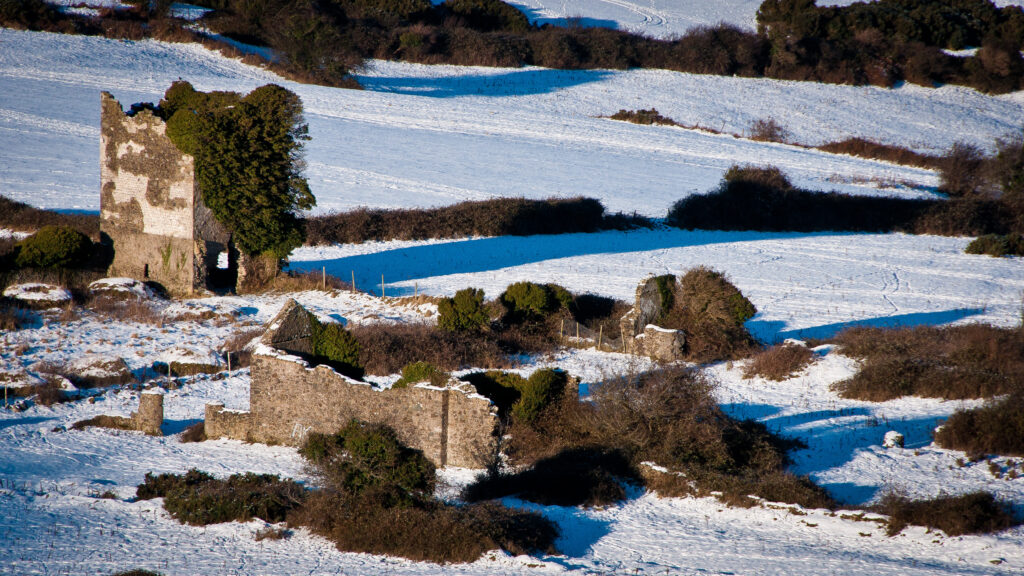
Two flattened prehistoric passage tombs sit on the summit, and around 1725 stones from them were used to build the lodge for the Anglo-Irish politician William Conolly. A nearby standing stone was taken for the lintel over the fireplace. When the antiquarian Austin Cooper climbed up in 1779 the cairn was still substantial, its kerb of large stones set edgeways forming a boundary about 18 inches high. Today all that remains is a circular mound 15 metres (49 feet) in diameter and up to 2 metres high, with a dip where the chamber stood. In October 2016 excavation found something far larger: a huge passage grave similar to that at Newgrange, probably 5,000 years old, beneath the ruins.
A Speaker’s Lodge and the Roof the Devil Took
Conolly was Speaker of the Irish House of Commons, and the lodge was Palladian in design, with a kitchen and servants’ quarters below and a hall and reception rooms above, set in a 1,000-acre deer park. Over the years it collected nicknames: “The Shooting Lodge”, “The Kennel”, “Conolly’s Folly”, ‘The Brass Castle’ and “The Haunted House”. Shortly after completion a great storm stripped the original slate roof, and local superstition held this was the Devil’s revenge for the disturbance of the cairn. Conolly replaced it with an arched stone roof built like a bridge. That roof is still there, having survived two centuries of abandonment and an occasion when it was set alight with tar barrels during Queen Victoria’s visit to Ireland in 1849. There is little evidence the lodge was ever much used. Conolly died in 1729.
Who Actually Sat at the Table
The Irish Hell Fire Club was founded around 1737 by Richard Parsons, 1st Earl of Rosse, and James Worsdale. A Worsdale painting held by the National Gallery of Ireland shows five members around a table, among them Henry, 4th Baron Barry of Santry, tried for murder and convicted in 1739, and Simon Luttrell, Lord Irnham. Most of the meetings happened in the city centre, at the Eagle Tavern on Cork Hill near Dublin Castle. Accounts claim the members drank scaltheen, whiskey mixed with hot butter, kept a chair vacant for the Devil and took a black cat as mascot. The lodge on the hill was let to the club at some stage by the Conolly family, which is neat, because Conolly had bought Montpelier Hill from Philip, Duke of Wharton, founder of the first Hell Fire Club in 1719.
The honest position is the one the author Michael Fewer takes: it is not clear to what extent, if any, the club used the building, and its remoteness is probably why almost no verifiable account of activity there survives.
The Cloven Hoof and Other Nineteenth-Century Imports
The stories are folklore, and several reached a wide audience through nineteenth-century publication in Robert Chambers’ Book of Days of 1864 and in The Gentleman’s Magazine. The best known tells of a stranger admitted on a stormy night who joined a card game; a player stooping for a dropped card saw a cloven hoof, and the visitor vanished in a ball of flame. That tale appears in texts from at least the 1930s and is close to a version attached to Loftus Hall in County Wexford. Another has a priest interrupting the sacrifice of a black cat and releasing a demon from the animal’s corpse. A third has Simon Luttrell trading his soul for the settling of his debts, then dodging the Devil when he came to collect. Others speak of black masses, animal sacrifice, and on one occasion the sacrifice of a dwarf.
Fire on the Hill, and the Move Down to the Stewards House
The lodge was damaged by fire at some point, and the accounts disagree on why. One says the club burned it when Conolly’s son refused to renew the lease. One says the members did it to give the place a hellish look. One says a footman spilled a drink on “Burn-Chapel” Whaley’s coat, Whaley poured brandy over him and set him alight, and the fire spread and killed members. After it, the club moved further down the hill to the Killakee Stewards House. Revived in 1771 as “The Holy Fathers”, the club ran another thirty years under Thomas “Buck” Whaley and disbanded when he died in 1800.
The Killakee Cat, 1968 to 1971
The Stewards House, built around 1765 by the Conollys, has its own reputation, chiefly for a large black cat, linked either to the exorcism story or to a cat said to have been doused in whiskey and set alight by club members before escaping across the mountains with its fur burning. The best documented episode ran between 1968 and 1970, when the Evening Herald and Evening Press reported on Margaret O’Brien and her husband Nicholas, a retired Garda superintendent, who were converting the house into an arts centre. Tradesmen left the job complaining of ghosts. Their friend the artist Tom McAssey and two workmen reported being confronted by a spectral figure and a black cat with glowing red eyes; McAssey painted the cat, and the portrait hung in the house for years. Locals were sceptical. Further apparitions were nonetheless reported, including an Indian gentleman and two nuns, along with ringing bells and poltergeist activity. An RTE crew filmed a documentary there in 1970, in which the clairvoyant Sheila St. Clair used automatic writing. In 1971 a plumber found a grave containing the skeleton of a small figure, most likely a child. The house was a restaurant in the 1990s, closed in 2001 and is now a private residence, so it cannot be visited.
Sleeping in the Arched Room
One first-hand night in the ruin is on record and it is notably unhaunted. Joseph Holt, a general of the Society of the United Irishmen, wrote in his memoirs of sheltering there on the run after the 1798 Rebellion: “I lay down in the arched room of that remarkable building. I felt confident of the protection of the Almighty that the name of enchantment and the idle stories that were told of the place had but a slight hold of my mind.”
Walking Up from the Hell Fire Wood Car Park
Access is from the Hell Fire Wood car park on the R115 between Rathfarnham and Glencullen, with around 4.5 kilometres (2.8 miles) of forest roads and tracks. The hill is also crossed by the Dublin Mountains Way, which runs between Shankill and Tallaght. Coillte maintains the ruin and has fitted concrete stairs and iron safety rails across the upper windows, so the shell can be entered, though the original entrance stair on the upper floor is long gone. Lord Massy’s Estate, the remains of the Killakee demesne with its nature trail and orienteering course, is on the other side of the road close to the car park.
The Visitor Centre and the Save the Hellfire Campaign
In March 2017 South Dublin County Council, Coillte and the Dublin Mountains Partnership announced a Dublin Mountains Project for the site, taking in parking, a cafe, a treetop walkway, improved trails and a visitor centre. Local residents and community groups objected, citing the fragile ecosystem, the risk to recently discovered megalithic artwork and traffic from a possible 300,000 visitors, and launched a campaign called “Save the Hellfire” to persuade An Bord Pleanala to refuse permission. Anyone planning a trip should check current arrangements before setting out.
Address: Montpelier Hill, off the R115 between Rathfarnham and Glencullen, County Dublin
See Montpelier Hill for Yourself
Sources
- Mountpelier
- 'Ancient passage tomb' found beneath Dublin's Hellfire Club
- The Hell Fire Club
- The Irish Hellfire Club: No Smoke Without Fire
- Council plans massive €19m visitors centre and tree top walkway at Hellfire Club
- Wikipedia: Montpelier Hill
Frequently Asked Questions
Where is Montpelier Hill Hell Fire Club located?
Montpelier Hill Hell Fire Club is located at Montpelier Hill, off the R115 between Rathfarnham and Glencullen, County Dublin.
Can you visit Montpelier Hill Hell Fire Club?
Montpelier Hill Hell Fire Club is open to the public. Always follow posted rules and respect private property.
Reader sightings
Nobody has reported anything here yet. If you have been, you would be the first.
Report your own visit to Cloven Hooves and a Black Cat: Montpelier Hill’s Ruin
How haunted is this place?
Be the first to rate
Ghost Tours Nearby
 Haunted Dublin Walking Tourfrom $27
 Dark Dublin Walking Tour: Torture, Murder and Mysteryfrom $27
 Gravedigger 2-Hour Ghost Bus Tour From Dublinfrom $34
Affiliate links: BeyondHaunted may earn a commission, at no extra cost to you.
Leave a Reply