
Reviewed by Josh N · Updated October 4, 2026 · How we verify
Reported Phenomena
- Reported resident spirits
- Spectral Newfoundland dog
- Back parlor presence
- Basement cell presences
Reported by visitors & local legend. Stories, not verified claims.
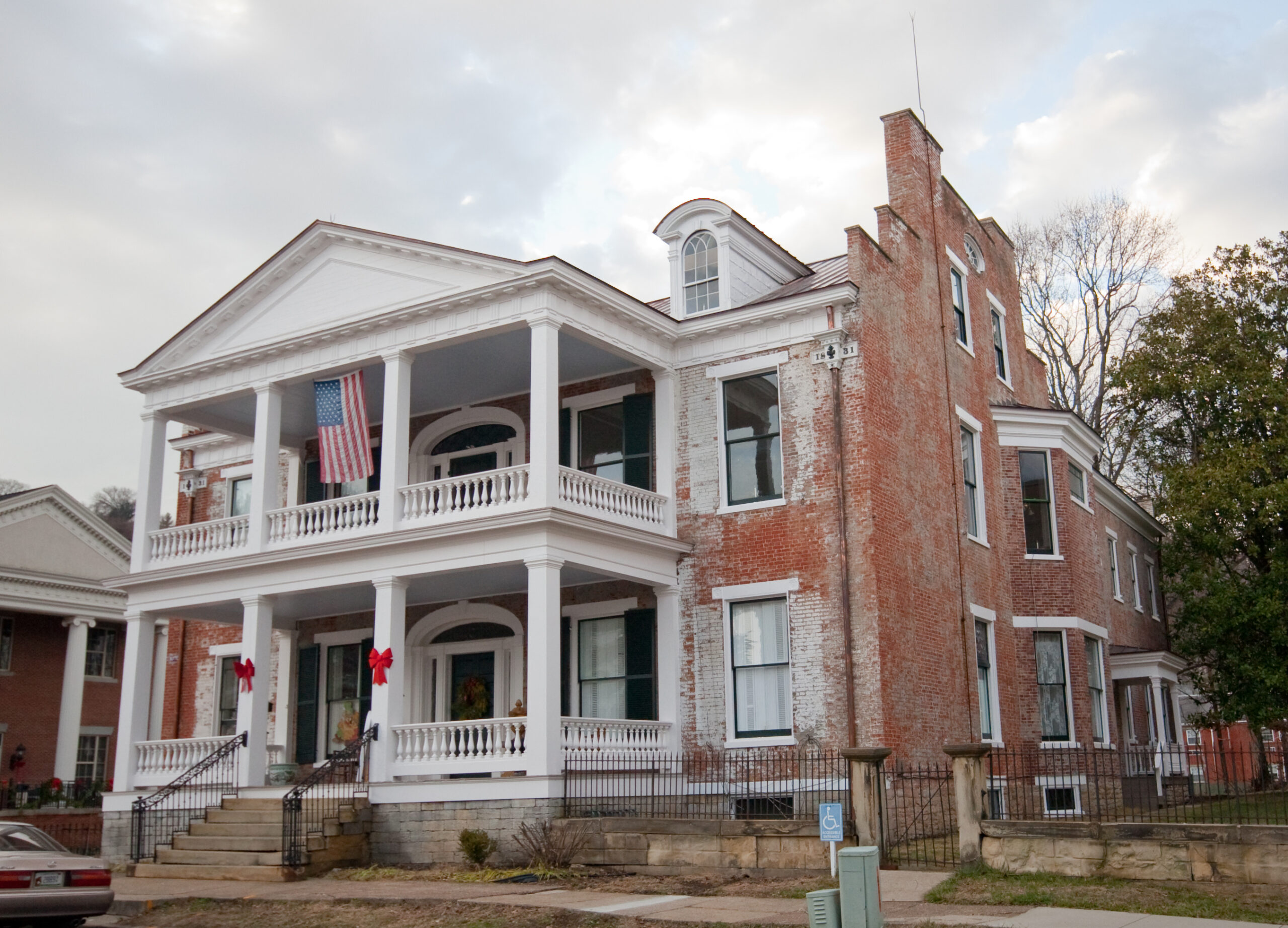
Ask about the Phillips’ Folly ghosts in Maysville, Kentucky, and you get names rather than a vague shiver: John Armstrong and his Newfoundland dog, a man called John Pearce who died in the back parlor around 1890, and the enslaved people once chained in a basement cell. The house behind the stories is a genuine landmark, a three-story brick residence whose architecture is as mixed as its history.
Quick orientation. Phillips’ Folly is an historic three-story brick residence in Maysville, on the Kentucky side of the Ohio River. It was added to the National Register of Historic Places on August 10, 1978. It is a private residence, not a museum and not a tour stop.
The Folly That Took Six Years and a Card Game
The name is not decorative. Construction began as early as 1825 but stalled for up to six years for lack of money, which is how a mayor’s mansion earns the label “folly” from its neighbors. The building was finally completed in 1831.
How the money reappeared is the part most often retold. A 1973 magazine article records that, leaving the house unfinished, the owner disappeared for two years and won enough at gambling in New Orleans to complete the structure. That is a magazine account of an older story rather than a documented transaction, and it should be read as such.
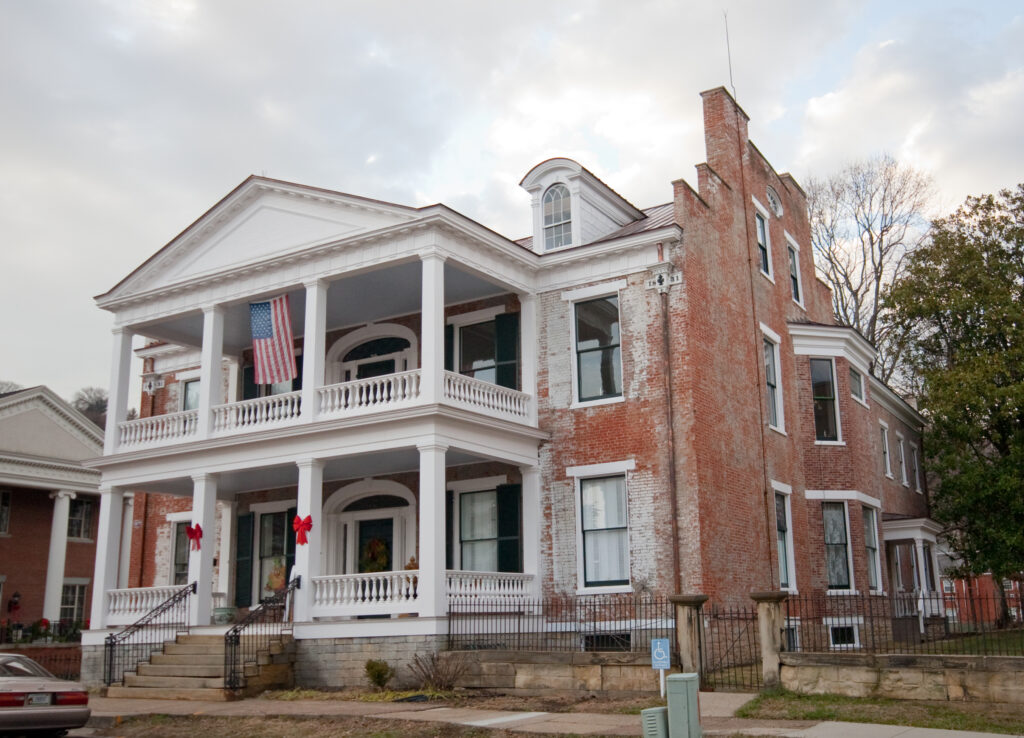
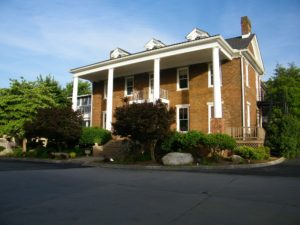
The owner was William B. Phillips, Maysville’s second mayor, listed as Mason County’s state legislator in 1820 and among those who welcomed General Lafayette during his 1825 visit to the town. The long pause in building may explain the house’s stylistic hybrid: the Sutton Street entrances are Federal, the windows are Greek Revival in size and character, and the two-tiered portico and segmental dormers lean Georgian. The stepped parapets on the end walls are peculiar to the Ohio River Valley. Underneath it all sits an artful and unique dry stacked foundation, set without mortar.
John Armstrong’s House and the Maysville Road Veto
Phillips sold his folly to the wealthy businessman John Armstrong in 1838, and Armstrong’s fingerprints are all over early Kentucky. He established the first bank in Kentucky in 1818. He was the first to sign the petition to move the county seat from Washington to Maysville. He was also a member of the company responsible for building the Maysville and Lexington Turnpike, the road at the center of the decision involving President Andrew Jackson, Secretary of State Martin Van Buren and Congressman Henry Clay known as the Maysville Road veto.
Armstrong died in the home in 1851. That detail matters to the folklore: a man who dies in a house tends to be the first name attached to its footsteps. The property passed by will to his son, Francis Woodland Armstrong, a noted abolitionist.
The Cell, the Tunnel, and Francis Armstrong’s Abolitionism
According to oral history, during Francis Woodland Armstrong’s ownership the mansion served as an important post on the Underground Railroad. Runaway slaves were held in a wooden jail cell dating to the home’s original 1831 construction, kept in the basement until it was judged safe to continue toward the nearby free state of Ohio. The logic given is counterintuitive and memorable: a jail cell was the last place slave hunters searching the house would expect to find people being helped.
Physical traces survive. The basement cell is still intact, and a tunnel leading to a secret room once used to reach the Ohio River can still be seen in the basement. That same cell is thought to have served as an early town jail back when Mayor Phillips owned the place.
A Future Supreme Court Justice Upstairs
The Reed family owned the home from 1894 to 1904, and Dr. John Reed ran a medical practice out of the basement for roughly ten years. His son spent formative years in the house before leaving for college. That son was Stanley Forman Reed, whom President Franklin D. Roosevelt nominated to the Supreme Court in 1938 and who served until his retirement in 1957. Reed was the final pivotal vote for the unanimity of the Court’s landmark decision in Brown v. Board of Education.
Who Is Said to Walk at Phillips’ Folly
The house is said to be home to several spirits. John Armstrong is one, reportedly accompanied by his Newfoundland dog. Another is John Pearce, who died in the home around 1890, either by fighting a duel in the back parlor or by suicide in the back parlor. The ambiguity has an explanation attached to it: dueling was outlawed at the time, so suicide may simply be what went into the record. Former slaves chained in the basement before the house turned abolitionist are also named among the presences reported there.
None of this is verified. These are the stories told about the building, collected locally and repeated by visitors, and the house’s documented history of death and confinement is doing much of the work in sustaining them.
Ghost Adventures Comes to Sutton Street
In March 2011, the Travel Channel’s Ghost Adventures filmed at Phillips’ Folly. The episode aired on Friday, May 13, 2011, and featured former resident and Underground Railroad historian Jerry Gore. For most people this television hour is the closest thing to a tour of the interior they are likely to get.
The Pioneer Graveyard Over the Back Fence
The home’s backyard is directly adjacent to one of the oldest known cemeteries in Kentucky, known locally as the Maysville Pioneer Graveyard. The land was acquired by city trustee Jacob Boone, a close friend, business partner and cousin of Daniel Boone. Jacob Boone and his family are buried there, in a plot noting his militia service during the American Revolutionary War.
Seeing Phillips’ Folly Without Trespassing
Phillips’ Folly is a private residence. There are no public tours of the basement cell or the tunnel, and the cell and its history belong to the people who live there now. The house can be appreciated from the street in Maysville’s historic core, where the stepped parapets and two-tiered portico are visible from the sidewalk. The adjoining pioneer graveyard is the more accessible half of the story. Treat both with the quiet they deserve, and do not knock on the door.
Address: Sutton Street, Maysville, Kentucky
See Phillips' Folly for Yourself
Sources
- National Register for Historic Places Inventory Nomination Form (National Park Service)
- Kentucky Slave House
- Phillips' Folly: The rich history of one of Maysville's oldest homes
- GeoHack – Phillips' Folly
- Wikipedia: Phillips' Folly
Frequently Asked Questions
Where is Phillips Folly Maysville Kentucky located?
Phillips Folly Maysville Kentucky is located at Sutton Street, Maysville, Kentucky.
Can you visit Phillips Folly Maysville Kentucky?
Phillips Folly Maysville Kentucky is on private property and best viewed from a distance. Always follow posted rules and respect private property.
Reader sightings
Nobody has reported anything here yet. If you have been, you would be the first.
Report your own visit to A Gambler’s House in Maysville: Phillips’ Folly Ghosts
How haunted is this place?
Be the first to rate
Ghost Tours Nearby
 Ultimate Queen City is Haunted Tourfrom $32
 Phantoms of the Pig Iron Past: Cursed Cincinnati Ghost Toursfrom $26
 Nightmare on Elm Street Walking Tourfrom $39
Affiliate links: BeyondHaunted may earn a commission, at no extra cost to you.
Leave a Reply