
Reviewed by Josh N · Updated August 26, 2026 · How we verify
Reported Phenomena
- Spectral figures
Reported by visitors & local legend. Stories, not verified claims.
People arrive at the gates looking for the haunted Rathfarnham Castle of internet listicles, and what they get instead is one of the best documented buildings in South Dublin, Ireland: a 16th-century fortified house that was besieged, remodelled by fashionable Georgian architects, run as a public dairy, occupied by Jesuits, and very nearly demolished in the 1980s. The ghost stories are thin. The history is not.
Rathfarnham Castle at a Glance
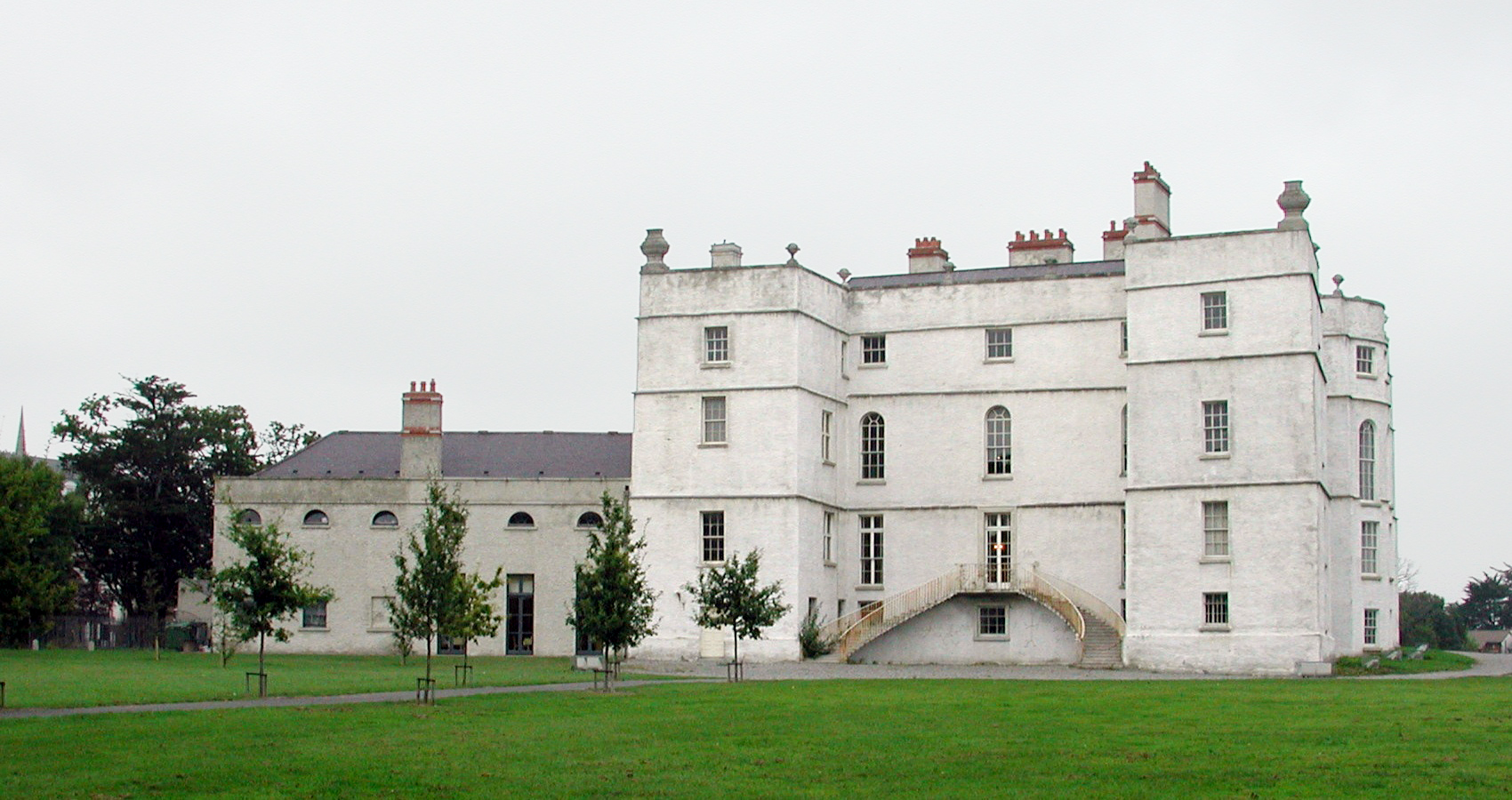
The building is a 16th-century fortified house in the village of Rathfarnham, originally semi-fortified and battlemented, heavily altered in the 18th century. It is in the care of the state, has been restored, and is open to the public. Structurally it began as a square block of four storeys with a projecting tower at each corner and walls averaging 1.5 metres (5 feet) thick. Two vaulted ground-floor apartments are divided by a wall almost 3 metres (10 feet) thick that rises the full height of the castle. The 18th-century reception rooms sit at entrance-hall level, and the floor above holds the former ballroom, later converted into a chapel.
Adam Loftus and the “Waste Village” of 1583
An earlier Irish castle stood here, occupied by the Harold family as tenants of the le Brets. The present building replaced it, raised on lands confiscated from the Eustace family of Baltinglass because of their involvement in the Second Desmond Rebellion. When Adam Loftus bought the place, Rathfarnham was described as a “waste village”. The castle is believed to have been built around 1583 for Loftus, then Archbishop, and it was barely finished before it had to withstand an attack by the Wicklow clans in 1600, during the Nine Years’ War.
The Castle That Kept Changing Armies
Ownership passed from the Archbishop to his son Dudley and then to Adam in 1616. During that Adam’s tenure the castle came under siege in the 1641 rebellion and held out against the Confederate army while the surrounding country was overrun. He then opposed the treaty of cessation intended to halt the fighting between the Irish Confederates and the English Royalists, and was imprisoned in Dublin Castle for it.
From 1641 to 1647 the castle was garrisoned by English Royalist troops. When Ormonde surrendered Dublin to the English Parliament in 1647, Parliamentary troops moved in until 1649, when, a few days before the Battle of Rathmines, the Royalists stormed and took the castle without a fight as part of the Siege of Dublin. The Roundheads re-occupied it after winning at Rathmines. Adam Loftus recovered his castle and lands under Cromwell, sided with the Parliamentarians, and was killed at the Siege of Limerick in 1651. It has also been reported, though the record is looser here, that Oliver Cromwell held a council at Rathfarnham during his Irish campaign before turning south to besiege Wexford.
The family line continued: in 1659 Dr Dudley Loftus, great-grandson of the Archbishop, took over. He held a remarkable stack of offices, Commissioner of Revenue, Judge of the Court of Admiralty, Master in Chancery, and seats for Naas, Bannow and Fethard, and is interred in St Patrick’s Cathedral.
Henry Loftus Turns a Fortress Into a Georgian Showpiece
The property passed by marriage to Philip Wharton, who lost his money in the South Sea Bubble, and in 1723 the castle sold for £62,000 to the Right Hon William Conolly, speaker of the Irish House of Commons. After a spell with Archbishop Hoadly and then Bellingham Boyle, the interest was sold in 1767 to Nicholas Hume-Loftus, second Earl of Ely, a descendant of the original builder, with a small head rent still owed to the Conollys.
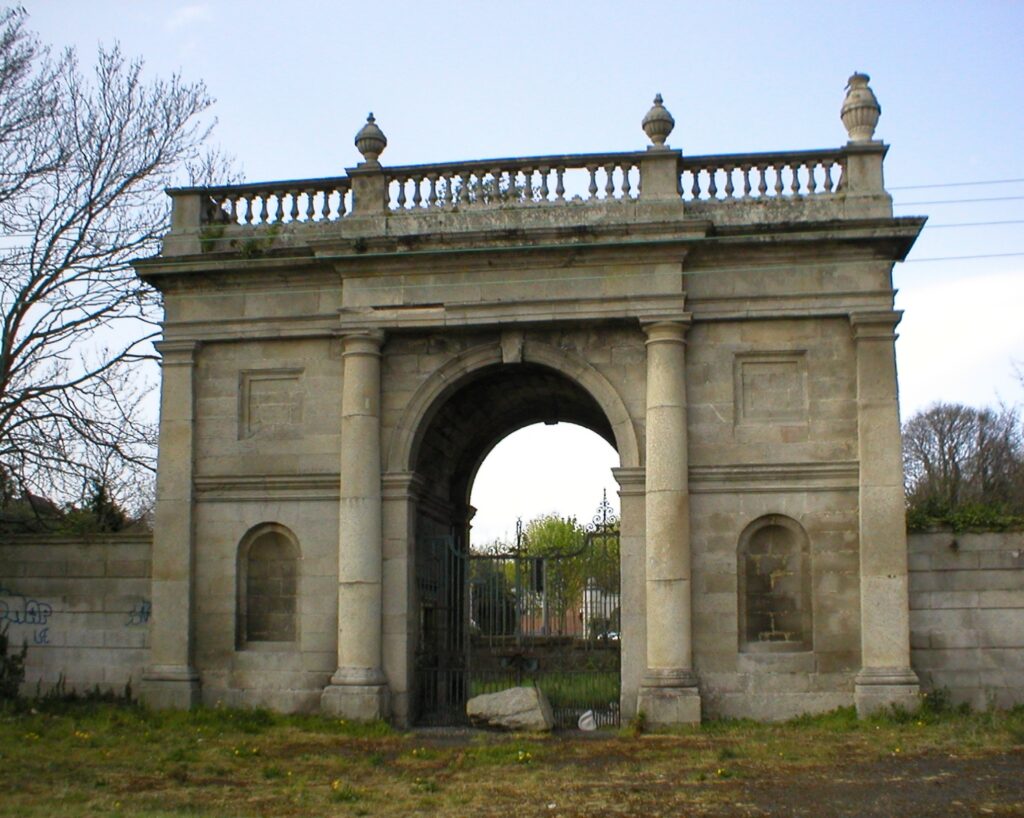
It was Nicholas’s uncle Henry Loftus, created Earl of Ely in 1771, who did most of the converting of the medieval fortified house into a Georgian mansion, employing Sir William Chambers and James ‘Athenian’ Stuart. The mullioned windows were enlarged and the battlements replaced by a coping with ornamental urns. Leading artists including Angelica Kauffman worked on the interiors. Henry died in 1783 and was succeeded by his nephew Charles Tottenham, later Marquess of Ely, a title awarded for his vote at the time of the Union. To mark the family regaining the castle and Henry’s earldom, the Loftuses built a new entrance in the form of a Roman triumphal arch. Ely’s Arch went up around 1769 to 1779 and appears on a 1779 map of Dublin as ‘the new gate’; it is loosely based on the Porta Portese in Rome, built of Irish granite with a coade stone keystone.
Eloquently Waste: The Years as a Public Dairy
In 1812 the family leased the estate to the Ropers and removed their valuable possessions to Loftus Hall in County Wexford. The lands and castle were turned over to dairy farming and fell into disrepair. A contemporary account from 1838 found the grounds “all eloquently waste, the undulating hills covered with rank herbage”, the fish-pond clogged with weeds, and noted that the structure had “been for years a public dairy, and the grounds to the extent of 300 acres” converted to its uses. In 1852 the estate was bought by the Lord Chancellor, Francis Blackburne, whose family lived there for three generations.
1913: Golfers, Jesuits and an Auction of the Contents
The property developers Bailey & Gibson acquired the castle in 1912 and carved up the estate. The eastern part became the Castle Golf Club, the northwestern part went to housing, and the castle with the southwestern portion was bought in 1913 by the Jesuit Order. An auction of the contents was held on 2 April 1913, conducted by Battersby and Company, with the Jesuits themselves buying a number of items back.
Under the Jesuits the castle acquired one of its odder claims to fame. Father O’Leary S.J. constructed a seismograph capable of detecting earth tremors and earthquakes anywhere in the world, and for a time Rathfarnham Castle was a source of earthquake information for the national media. Jesuits also spent part of their formation, the Tertianship, here. When the order sold up in 1986 they took the chapel’s Harry Clarke stained glass with them, donating some windows to Tullamore Catholic Church, which had been destroyed by fire in 1983, and others to Our Lady’s Hospice in Harold’s Cross and Temple Street Children’s Hospital.
Two other structures did not survive. A small Palladian temple with a granite and brick colonnade, a relic of Lord Ely’s time and probably built in the last quarter of the 18th century, stood near the golf club’s clubhouse. It was in disrepair but could have been restored; by decision of the club committee it was demolished in 1979. North of the castle stood a long vaulted chamber known as Cromwell’s Court or Fort, apparently a barn or storehouse with narrow loopholes in walls 1.5 metres thick. In 1922 it was absorbed into a new retreat house as its ground storey, its character hidden behind a uniform skin of cement plaster.
What Is Actually Reported Here, and What Is Not
This is the part where honesty is more useful than atmosphere. The documented history of Rathfarnham Castle contains no recorded apparitions, no named ghost, and no catalogue of visitor experiences. Its haunted reputation is built almost entirely by association: a siege in 1600, another in 1641, a storming in 1649, an owner killed at Limerick in 1651, a persistent Cromwell story, decades of decay, and a family whose other house is Loftus Hall in County Wexford, one of the most famously haunted buildings in the country. Move the treasures from Rathfarnham to Loftus Hall in 1812, as the family did, and the ghost stories tend to follow the furniture. If you hear a specific Rathfarnham ghost tale on the internet, treat it as folklore until someone can show you where it came from.
Visiting Rathfarnham Castle
After the castle was sold to Delaware Properties in 1985 there were real fears it faced demolition. Immense public pressure followed, and in 1987 the State bought it and declared it a National Monument. The Office of Public Works has carried out extensive refurbishment while keeping the building open to the public during the summer months, historically 5 May to 12 October, which allowed visitors to watch conservation work in progress and see earlier phases of the castle exposed by that work. Check current OPW opening arrangements before travelling, since seasons and tour times change. Ely’s Arch, still standing, is worth walking to while you are in the village.
Address: Rathfarnham, South Dublin, Ireland
See Rathfarnham Castle for Yourself
Sources
- 23931 « Excavations
- Archaeologist uncovers 300-year-old high heels, tea and jewels in Irish castle
- 350-Year-Old High Heels, Tea and Goblets Uncovered at Irish Castle
- The History of the County of Dublin
- Contents auction 1913
- Wikipedia: Rathfarnham Castle
Frequently Asked Questions
Where is Rathfarnham Castle South Dublin located?
Rathfarnham Castle South Dublin is located at Rathfarnham, South Dublin, Ireland.
Can you visit Rathfarnham Castle South Dublin?
Rathfarnham Castle South Dublin is open to the public. Always follow posted rules and respect private property.
Reader sightings
Nobody has reported anything here yet. If you have been, you would be the first.
Report your own visit to Sieges, Cromwell and a Seismograph: Haunted Rathfarnham Castle
How haunted is this place?
Be the first to rate
Ghost Tours Nearby
 Haunted Dublin Walking Tourfrom $27
 Dark Dublin Walking Tour: Torture, Murder and Mysteryfrom $27
 Gravedigger 2-Hour Ghost Bus Tour From Dublinfrom $34
Affiliate links: BeyondHaunted may earn a commission, at no extra cost to you.
Leave a Reply