
Reviewed by Josh N · Updated August 29, 2026 · How we verify
Reported Phenomena
- Spectral figures
Reported by visitors & local legend. Stories, not verified claims.
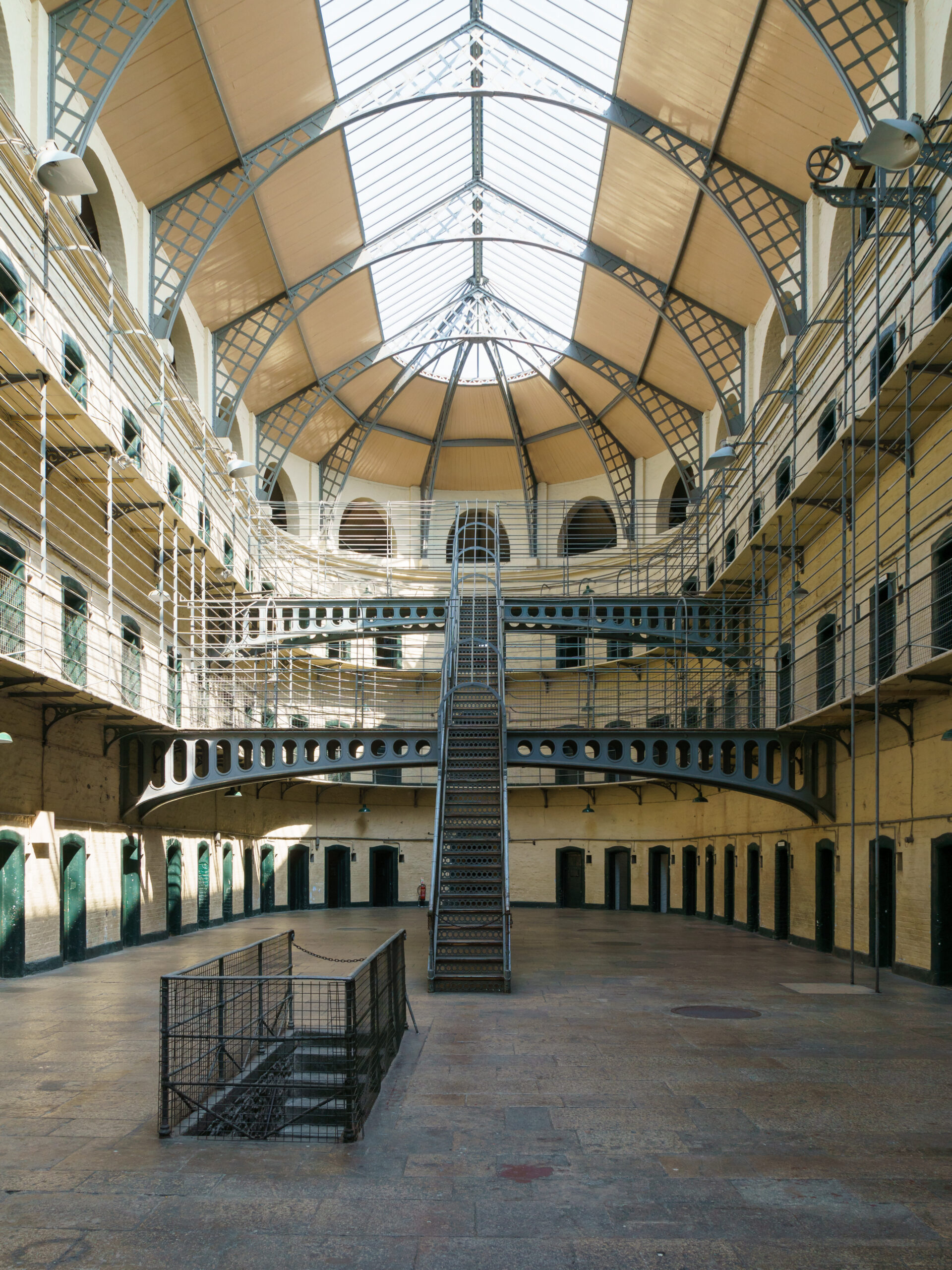
Ask about haunted Kilmainham Gaol and the answer you get is almost always about atmosphere rather than apparitions. The former County of Dublin Gaol in Kilmainham, Dublin, is one of the biggest unoccupied prisons in Europe, and nothing invented could compete with what is documented: children locked up for petty theft, five people to a cell with a single candle, and the leaders of the 1916 Easter Rising shot in its yard. Ireland has no shortage of grim buildings, but few carry a record this heavy, and none has been photographed, filmed and argued over quite so much.
Quick orientation: the gaol sits in Kilmainham on the western edge of Dublin city, it is run as a museum by the Office of Public Works, and access is by guided tour only. The neighbouring courthouse now serves as the visitor centre.
The New Gaol That Replaced a Noisome Dungeon
When it was first built in 1796, the building was known as the New Gaol, to distinguish it from the older prison it replaced, described as a noisome dungeon a few hundred metres away. Officially it was the County of Dublin Gaol, and it was originally run by the Grand Jury for County Dublin.
Public hangings once took place at the front of the prison, though from the 1820s onward very few hangings, public or private, were carried out at Kilmainham. A small hanging cell was added in 1891, on the first floor between the west and east wings. It is one of the more quietly unnerving spaces in the building, precisely because it is so ordinary.
Five to a Cell, One Candle for a Fortnight
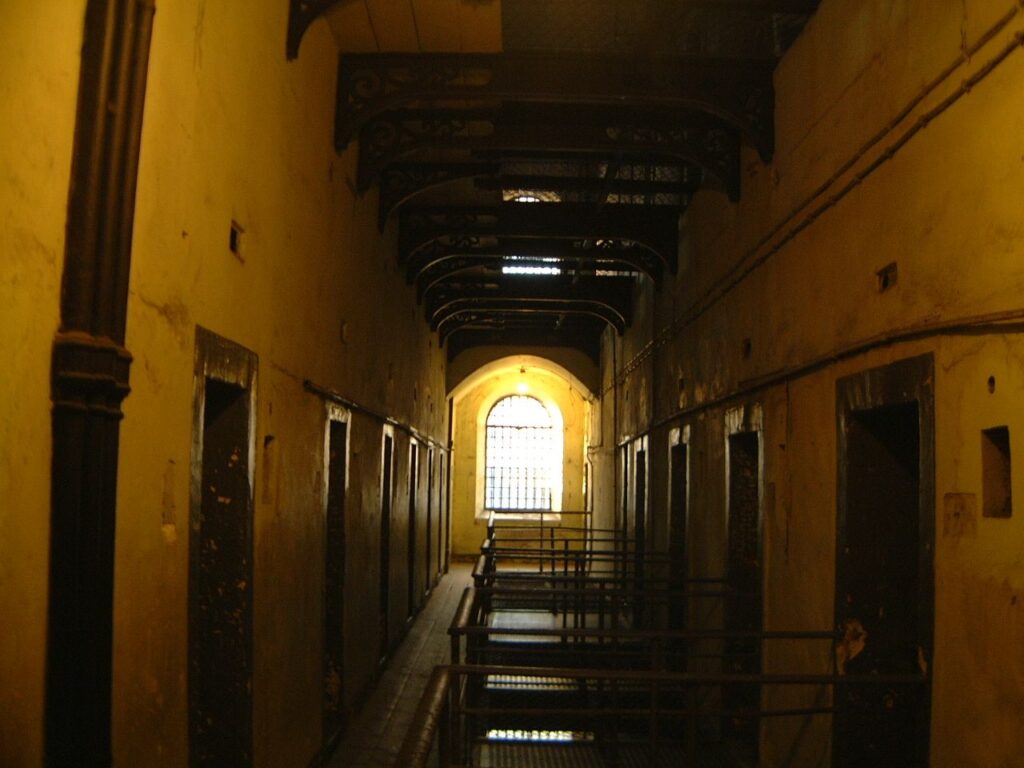
There was no segregation of prisoners. Men, women and children were held up to five to a cell, with a single candle for both light and heat, and that candle had to last two weeks. Most of a prisoner’s time was spent in cold and darkness. Children were sometimes arrested for petty theft, the youngest said to have been three years old, while many adult prisoners were transported to Australia.
Conditions for women were worse again. As early as 1809 the Inspector reported that male prisoners were supplied with iron bedsteads while females lay on straw on the flags in the cells and common halls. Half a century later there had been little improvement, and the women’s section in the west wing remained overcrowded. Thirty female cells were added in 1840 to relieve the pressure. Those improvements had barely been made when the Great Famine arrived and Kilmainham was overwhelmed by the increase in prisoners.
From Parnell to Pearse: Who Passed Through
The list of names associated with the gaol reads like a syllabus of Irish political history. Charles Stewart Parnell was imprisoned here along with most of his parliamentary colleagues in 1881 and 1882, and it was from Kilmainham that he signed the Kilmainham Treaty with William Gladstone.
Many Irish revolutionaries, including the leaders of the 1916 Easter Rising, were imprisoned and executed in the prison on the orders of the UK government. Patrick Pearse, Tom Clarke, Sean Mac Diarmada, Joseph Plunkett, Eamonn Ceannt and Thomas MacDonagh are all named in the record. James Connolly was executed at Kilmainham but was not held there. Grace Gifford, the wife of Joseph Plunkett, was a prisoner in 1922. Eamon de Valera was held in 1916 and again in 1923.
The gaol also housed prisoners during the Irish War of Independence between 1919 and 1921, and many of the anti-treaty forces during the Civil War.
The 1923 Hunger Strikes and the Death of Nan Hogan
In March 1923, 97 women went on hunger strike in Kilmainham Gaol after all of their privileges were denied without explanation. That strike ended later the same month when privileges were restored. Annie, known as Nan, Hogan of Cumann na mBan died at the age of 24 after being released from prison in September 1923 in what was described as a very emaciated state, following her participation in hunger strikes in Kilmainham and the North Dublin Union.
Empty, Condemned and Nearly Demolished
The Irish Free State government decommissioned Kilmainham as a prison in 1924. There was no appetite at the time to preserve it. It was seen principally as a site of oppression and suffering, and its potential as a place of national memory was complicated by the fact that the first four Republican prisoners executed by the Free State during the Civil War were shot in the prison yard.
The Irish Prison Board considered reopening it during the 1920s, but those plans were finally abandoned in 1929. In 1936 the government looked at demolishing it and found the cost prohibitive. A proposal by the National Graves Association to turn the site into a museum and memorial to the 1916 Rising drew no objection from the Commissioners of Public Works, who costed it at £600, but the Department of Education rejected the plan and the Emergency shelved it for the duration of the war. An architectural survey commissioned by the Office of Public Works after the Second World War found the prison in a ruinous condition.
Sixty Volunteers and a Penny a Year
The building survives because a handful of people refused to let it go. Prompted by reports that the Office of Public Works was accepting tenders for demolition, Lorcan C.G. Leonard, a young engineer from the north side of Dublin, formed the Kilmainham Gaol Restoration Society in 1958 with a small number of like-minded nationalists. To avoid splitting its own membership, the society agreed not to address any of the events connected with the Civil War period in relation to the restoration project.
In February 1960 the society’s detailed plan, which notably envisioned the site’s development as a tourist attraction, won the approval of the Department of Finance. The keys were formally handed over to a board of trustees in May 1960, with a nominal rent of one penny per annum. Work began that same month with sixty volunteers clearing overgrown vegetation, trees, fallen masonry and bird droppings. By 1962 the prison yard where the 1916 leaders were executed had been cleared of rubble and weeds, and the gaol opened to the public on 10 April 1966. The chapel was re-roofed, re-floored and its altar reconstructed, completing the restoration in 1971. The Magill family acted as residential caretakers, Joe Magill in particular working on the restoration from the beginning.
Ghost Stories at Kilmainham: What the Record Actually Supports
Kilmainham appears on plenty of lists of haunted Irish buildings, and it is easy to see why: an empty Victorian prison, executions in the yard, deaths from hunger strike, and a hanging cell on the first floor. But the documented history of the site, as recorded in the standard reference material, contains no verified paranormal incidents, no named witnesses and no catalogue of reported phenomena. What circulates is second-hand and largely anecdotal.
That is worth stating plainly rather than dressing up. Visitors describe the east wing and the yard as intensely oppressive, but oppression is what the architecture was designed to produce. If you go looking for a ghost story here, the honest position is that the building’s power comes from its record, not from anything unexplained. The three-year-old prisoner and the candle that had to last a fortnight do more work than any apparition.
A Stand-In Prison for Film Crews
Because it is empty and intact, the gaol has been used repeatedly on screen. In the Name of the Father was filmed here in 1993 and The Escapist in 2008. It also appeared in the 2012 BBC series Ripper Street and the 2015 AMC series Into the Badlands. U2 filmed the video for A Celebration in the prison in July 1982, and Fontaines D.C. played a live performance there on 14 June 2020, released as a live album for Record Store Day in 2021.
Visiting Kilmainham Gaol and the Courthouse Visitor Centre
The gaol is now a museum run by the Office of Public Works, with guided tours of the building and a museum covering the history of Irish nationalism. An art gallery on the top floor exhibits paintings, sculptures and jewellery made by prisoners in prisons across contemporary Ireland.
The adjoining Kilmainham courthouse, which served as a seat of the Dublin District Court until 2008, was handed over to the OPW in 2013 for refurbishment ahead of the centenary of the 1916 Rising. It opened in 2015 as the attached visitor centre. Tours are the only way to see the interior, and demand is high, so book ahead rather than turning up.
Address: Kilmainham, Dublin, Ireland
See Kilmainham Gaol for Yourself
Sources
- Kilmainham Jail, Dublin
- Kilmainham
- Kilmainham Tales
- Kilmainham Gaol Museum
- Loc (official)
- Wikipedia: Kilmainham Gaol
Frequently Asked Questions
Where is Kilmainham Gaol Dublin Prison 2 located?
Kilmainham Gaol Dublin Prison 2 is located at Kilmainham, Dublin, Ireland.
Can you visit Kilmainham Gaol Dublin Prison 2?
Kilmainham Gaol Dublin Prison 2 is accessible by guided tour only. Always follow posted rules and respect private property.
Reader sightings
Nobody has reported anything here yet. If you have been, you would be the first.
Report your own visit to Haunted Kilmainham Gaol: The Prison Volunteers Saved
How haunted is this place?
Be the first to rate
Ghost Tours Nearby
 Haunted Dublin Walking Tourfrom $27
 Dark Dublin Walking Tour: Torture, Murder and Mysteryfrom $27
 Gravedigger 2-Hour Ghost Bus Tour From Dublinfrom $34
Affiliate links: BeyondHaunted may earn a commission, at no extra cost to you.
Leave a Reply