

Reviewed by Josh N · Updated October 10, 2026 · How we verify
Reported Phenomena
- Captain Flint apparition
- Disembodied footsteps
- Sudden cold spots
- Unexplained voices
- Shadow figures
- Child spirit reports
- Objects moved
Reported by visitors & local legend. Stories, not verified claims.
Most of Savannah’s ghost stories start with a death. The one attached to the Pirates’ House in Savannah starts with a novel. The building at the eastern edge of Georgia’s first planned city is older than almost anything else standing in it, established in 1734 and still considered the oldest bar in the state, and the spirit most often named inside it is a character Robert Louis Stevenson invented more than a century after the first bricks went down.
Quick Orientation
- What it is: A historic restaurant and tavern in Savannah, Georgia, established in 1734.
- Oldest part: The Herb House, built in 1734 on the grounds of the Trustees’ Garden.
- The rest of it: The structures on either side of the Herb House developed between 1794 and 1871.
- Modern restaurant: Founded by Herb Traub and Jim Casey in 1953.
- Size: Fifteen dining rooms, capacity of up to 120 guests, serving a range of southern dishes.
- Status: Open to the public as a working restaurant, and one of Savannah’s most popular tourist attractions.
The Herb House Was Built for a Gardener, Not a Pirate
The documented origin of the site has nothing to do with the sea. The Herb House went up in 1734 on a ten-acre plot on the east side of James Oglethorpe’s original plan for Savannah. That ground had been set aside to become a botanical garden modeled on the Chelsea Botanical Garden in London, dedicated to Oglethorpe’s trustees and known from then on as the Trustees’ Garden. The garden itself lay beyond the footprint of the buildings that stand there today.
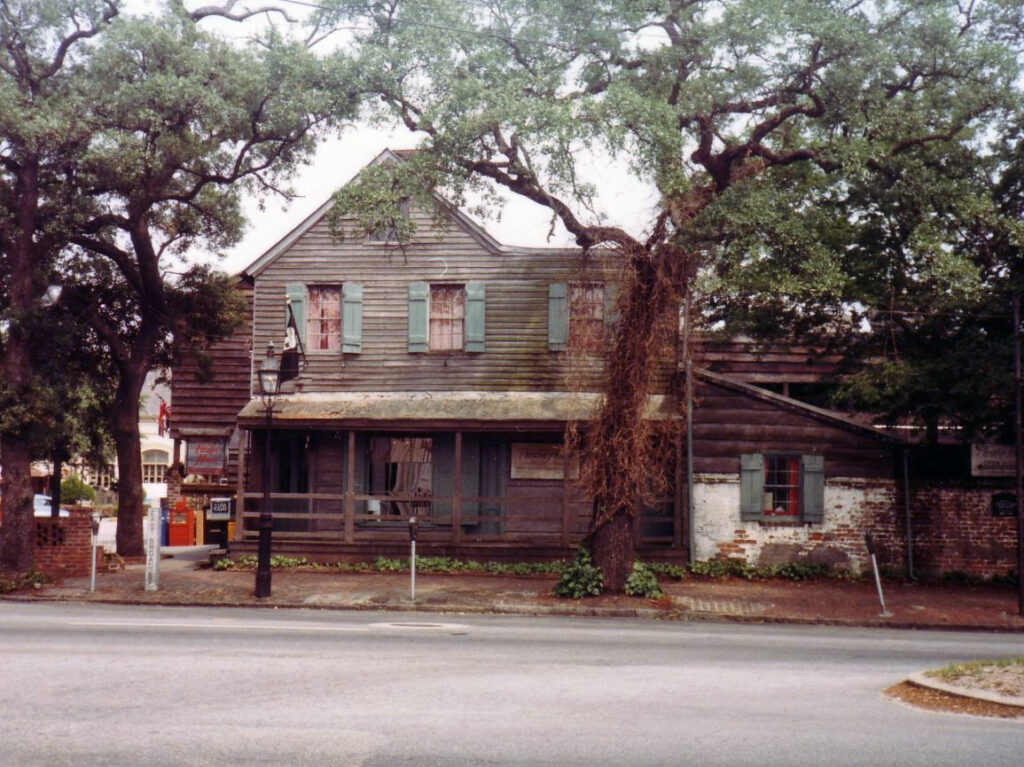
The building was raised to house the gardener who worked the plot. Its first floor held tools and gardening supplies. Its second floor was a hay loft, and that loft was where the gardener slept. It is a working outbuilding, in other words, and a plain one, which is worth holding onto when you read the more colorful accounts of the place. The popular version has the site opening as an inn for sailors and buccaneers in the 1730s. The record describes a shed and a hay loft on a colonial experiment in horticulture.
The surrounding structures came later, growing up on either side of the Herb House between 1794 and 1871. That long accretion is why the complex reads architecturally as several buildings pressed together, with Georgian, Federal, Greek Revival and Victorian features sitting side by side rather than resolving into a single style. Over those decades the property is said locally to have served variously as lodging, private quarters and storage through Savannah’s cotton years, though the surviving documentation of the site is strongest on its origin and on its twentieth century revival.
How a Gas Company Turned the Site Into a Restaurant
The Pirates’ House and the land around it were acquired by the Savannah Gas Company in 1948. The building caught the interest of Mrs. Hansell Hilyer, wife of the company’s president, who took the house museum that existed there and remade it into a restaurant. The modern operation that visitors know was then founded by Herb Traub and Jim Casey in 1953.
That is a detail the ghost tours tend to skip, and it matters. The Pirates’ House as a dining room with pirate decor is a postwar creation built on a genuinely eighteenth century core. The oldest fabric is real. The theming, and much of the storytelling that goes with it, is a little over seventy years old.
Captain Flint, Treasure Island, and a Ghost Borrowed From Fiction
The most repeated story at the Pirates’ House concerns Captain Flint, the long dead buccaneer whose treasure drives the plot of Robert Louis Stevenson’s 1883 novel Treasure Island. By the account attached to the property, the Pirates’ House is where Flint spent his last days, and where his ghost is claimed to haunt the building still.
Two things should be said plainly about that. Flint is a fictional character, so no record of his death exists to confirm or contradict. And the claim that the Pirates’ House is the room where he died is a tradition the building carries rather than a verified historical event. Visitors who are told that Flint called for his rum here are being told a very good story, not a fact.
Other names surface in the lore, including Blackbeard, and a child’s spirit often called Hannah and described as a pirate’s daughter. Neither claim has documentary support in the building’s history, and both are best treated as local legend repeated by staff and tour guides rather than as record.
What Guests and Staff Say Happens Inside
The reported phenomena at the Pirates’ House are the ordinary vocabulary of an old building with a loud reputation. Diners and employees describe footsteps crossing floors above empty rooms, sudden cold in otherwise warm dining spaces, voices with no source, and shadows moving at the edge of sight along the narrow passages between the older sections. Some attribute the small disturbances, moved objects and the like, to the child spirit of the Hannah story.
None of this has been verified, and the setting works against clean interpretation: fifteen dining rooms, a building assembled in stages across almost a century and a half, uneven floors, and a crowd of guests who arrived already primed by the pirate framing. These are reported experiences, and they are consistent ones, but they are not evidence that the place is haunted.
Eating at the Pirates’ House
No ticket or tour is required. The Pirates’ House operates as a restaurant, serving a variety of southern dishes across fifteen dining rooms with room for up to 120 guests, and it is among the busiest attractions in Savannah. That popularity is the main practical obstacle: check the restaurant’s own website for current hours and book ahead, particularly in high season and around holidays.
If the history is what draws you, ask where the Herb House portion sits and spend a moment there. It is the 1734 element, the gardener’s building with the hay loft above, and the oldest thing in the complex by sixty years. Whatever you make of Captain Flint, that corner of the building was standing when Savannah was barely a year old.
See The Pirates House for Yourself
Sources
Frequently Asked Questions
Can you visit Pirates House?
Pirates House is open to the public. Always follow posted rules and respect private property.
Reader sightings
Nobody has reported anything here yet. If you have been, you would be the first.
Report your own visit to Captain Flint and the Pirates’ House in Savannah
How haunted is this place?
Be the first to rate
Ghost Tours Nearby
 Savannah Ghosts & Gravestones Trolley Tourfrom $43
 Savannah History and Haunts Candlelit Ghost Walking Tourfrom $39
 Savannah Haunted Pub Crawl Walking Tourfrom $35
Affiliate links: BeyondHaunted may earn a commission, at no extra cost to you.
Leave a Reply