
Reviewed by Josh N · Updated March 14, 2026 · How we verify
Reported Phenomena
- Disembodied voices
Reported by visitors & local legend. Stories, not verified claims.
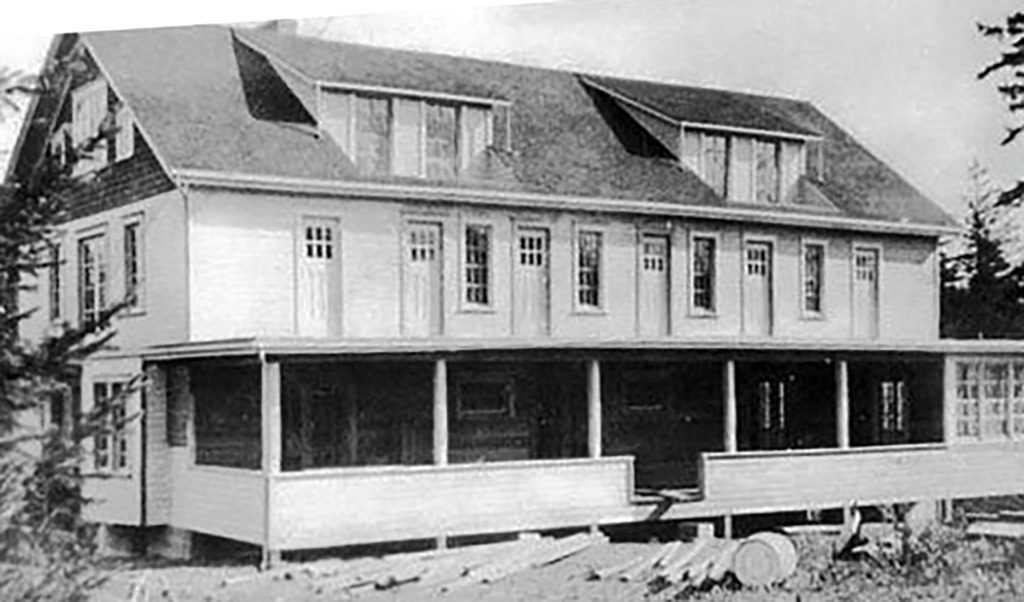
Starvation Heights was located in Olalla, Kitsap County, Washington, on private property tied to Linda Hazzard’s former Wilderness Heights operation. It is not a normal public attraction, and local reporting has made clear that trespassing has been a recurring problem around the site.
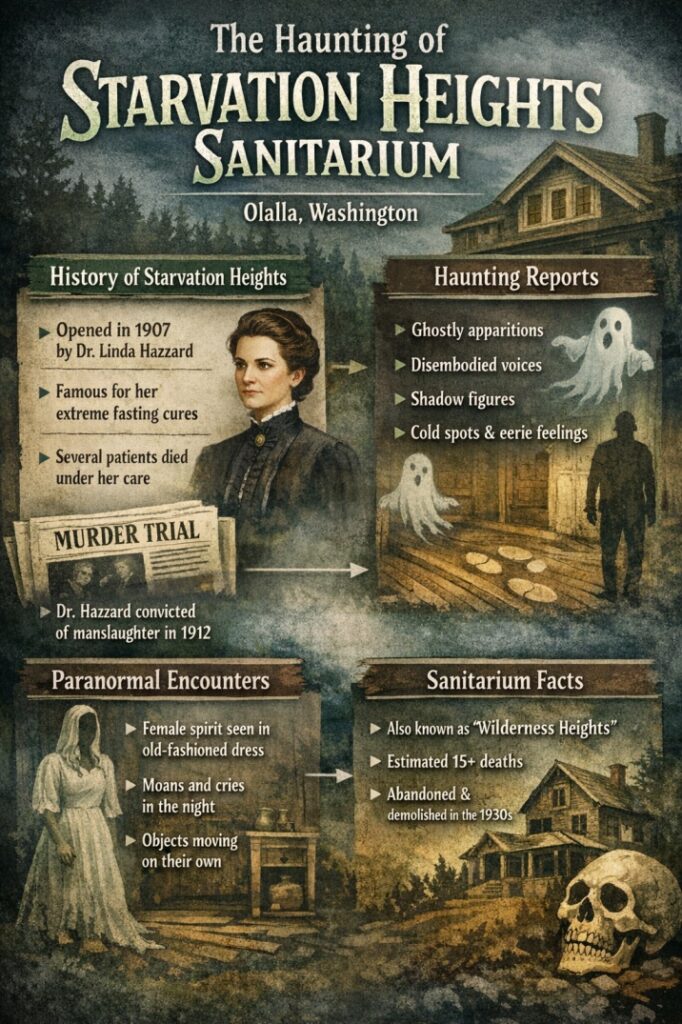
Few places in American haunted history are as disturbing as Starvation Heights because the real story is already horrific before the ghost lore even begins. Long before it became a whispered paranormal legend in Washington state, this Olalla retreat was the center of one of the strangest and cruelest medical crime stories in the Pacific Northwest. The woman behind it, Linda Burfield Hazzard, promoted extreme fasting as a cure for disease, drew wealthy patients into her orbit, and left a trail of deaths, fraud allegations, and lifelong trauma behind her.
The true history behind Starvation Heights
The place most people now call Starvation Heights was originally associated with Hazzard’s Olalla property, which she called Wilderness Heights. After moving to Washington with her husband Samuel in the mid-1900s, she began practicing in Seattle while living on a 40-acre tract in Olalla, where she planned a larger sanitarium. Locals eventually gave the place its darker nickname because of what they saw happening there, including emaciated patients and escapees stumbling down the road begging for food.
Hazzard styled herself as a doctor despite having no medical degree. Washington’s licensing rules at the time included a loophole that allowed certain practitioners of alternative medicine to work legally, and she used that opening to build a reputation as a fasting specialist. Her treatment plan centered on prolonged near-starvation, tiny amounts of broth or juice, hours-long enemas, and aggressive physical manipulation she described as massage.
What makes Starvation Heights so compelling, and so awful, is that it sat at the intersection of health fads, wealth, power, and isolation. Hazzard attracted followers who believed she could heal everything from digestive trouble to serious disease. At the same time, prosecutors and later historians concluded that she also drained patients financially, using forged documents, wills, guardianships, and power-of-attorney arrangements to gain access to their money and property.
The deaths that made Olalla infamous
The exact death toll tied to Hazzard still varies by source. The Washington State Archives says at least 14 Washingtonians died under her direct care. Smithsonian summarizes the total as at least a dozen, while local retellings and later researchers have argued the real number may have been much higher. What is not in doubt is that multiple people died after enduring her fasting regime.
Among the better-documented victims were:
- Daisey Maud Haglund, who died in 1908 after a 50-day fast under Hazzard’s care.
- Lewis Ellsworth Rader, a former legislator and publisher who wasted away while authorities struggled to intervene.
- Ivan Flux, an English patient who died after a 53-day fast and was reportedly left with almost nothing financially.
- Claire Williamson, whose death led directly to Hazzard’s prosecution.
One reason the case still shocks readers today is that many of these victims were not destitute or utterly desperate. Some were wealthy, educated, and seeking a fashionable natural cure. That helped Hazzard maintain legitimacy far longer than she should have.
The Williamson sisters case
The most famous chapter in the Starvation Heights story involved British sisters Claire and Dorothea Williamson. They came west after seeing promotional material for Hazzard’s fasting treatment while staying in Victoria, British Columbia. When they arrived in Washington in 1911, the Olalla sanitarium was not yet ready, so Hazzard first treated them in Seattle on a diet that amounted to little more than small servings of tomato broth. They were later transferred to Olalla in an increasingly weakened state.
By the time help arrived, Claire was dead and Dorothea was reduced to a skeletal condition. Margaret Conway, the sisters’ childhood nurse, realized something was terribly wrong, and Dorothea was eventually removed only after outside pressure and intervention. The investigation revealed that Hazzard and her husband had positioned themselves to benefit from the sisters’ estate and valuables. That combination of starvation, isolation, and alleged financial predation is what finally broke the case open.
Claire Williamson’s death became the turning point. In August 1911, Hazzard was arrested, and her trial opened in Port Orchard the following January. Witnesses described the sisters’ agony, the brutal treatments, and the broader pattern of what prosecutors called financial starvation. Hazzard was ultimately convicted of manslaughter.
Hazzard’s conviction did not end the story
Even after conviction and prison time, the story did not simply end. Smithsonian reports that Hazzard later received a pardon, moved to New Zealand, and then returned to Olalla in 1920, where she finally built the larger institution she had long wanted, publicly calling it a school for health rather than a sanitarium. Kitsap Sun later described that later structure as a 100-bed sanitarium built nearby.
That later building burned to the ground in 1935 and was never rebuilt. Three years later, Hazzard herself died after attempting another fast to restore her own health. It is one of the grimmest endings in American medical history, and it only deepened the legend of the place.
What remains of Starvation Heights today
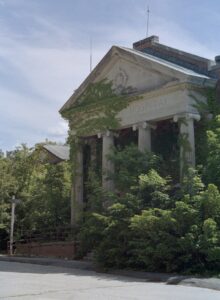
One reason people still search for Starvation Heights is because the site never fully vanished from local memory. As of the major historical coverage in 2014, reporters described ruins at the sanitarium site, including a concrete tower or incinerator-like structure and parts of the foundation hidden under ivy. The former Hazzard house was also still standing then, though it was described as being near the end of its life and expected to be dismantled.
That lingering physical footprint matters. Unlike some haunted legends that drift free of geography, Starvation Heights stayed rooted in a real place where documented suffering occurred. For paranormal fans, that creates the kind of emotional gravity that often fuels haunting narratives. For historians, it is a reminder that the horror here was not imagined.
Is Starvation Heights actually haunted?
This is where the story needs a careful line between fact and folklore.
The documented history of murder, starvation, fraud, and neglect is very strong. The documented ghost evidence is not in the same category. I did not find archival reporting from the sanitarium years describing classic ghost sightings in the way modern haunted-location writeups often claim. What I did find was a clear record that the property has become part of Washington’s paranormal culture in later decades.
Kitsap Sun reported that psychics and ghost hunters had been showing up around the property, and author Gregg Olsen said a psychic associated with a Discovery Channel visit ran into the woods crying. The same article quotes Olsen saying he gets an odd feeling in the room where Hazzard died in 1938. Those are real later-life accounts tied to the property, but they are anecdotal, not proof.
The haunting reputation also entered television. HBO Max’s episode listing confirms that The Dead Files featured “Starvation Heights – Olalla, WA” in 2012, framing the Olalla case around claims of pained spirits and the site’s history of murder. That tells you something important about Starvation Heights today. It is not only a crime site remembered by historians. It is also a place that paranormal media and ghost lore have claimed as one of Washington’s darkest legends.
So, is Starvation Heights haunted? Historically, the safest answer is this: the suffering is real, the death record is real, and the haunting claims are part of the site’s later folklore. That folklore is powerful because it grew out of a place with genuine trauma behind it.
Why Starvation Heights still unsettles people
Starvation Heights endures because it hits several fears at once. It is a true crime story, a failed medical story, a cult-of-personality story, and a haunted legend all wrapped together. It also feels modern in uncomfortable ways. Hazzard sold certainty, purity, detox, and miracle healing to people who wanted simple answers. That pattern is not buried in 1911. It still shows up whenever charisma outruns evidence. This is an inference from the history, but it is hard not to see the connection.
Please never trespass on property that is not yours without permission, and remember that ghost hunting can be dangerous, so always use caution.
Sources
- HistoryLink, “Hazzard, Linda Burfield (1867-1938)”
- Smithsonian Magazine, “The Doctor Who Starved Her Patients to Death”
- Washington State Archives, “Linda Burfield Hazzard
- Kitsap Sun, “Olalla’s ‘Starvation Heights’
Frequently Asked Questions
Where is Starvation Heights Sanitarium located?
Starvation Heights Sanitarium is located at Olalla, Kitsap County, Washington.
Reader sightings
Nobody has reported anything here yet. If you have been, you would be the first.
Report your own visit to Starvation Heights Sanitarium: History, Deaths, and Haunting Reports in Olalla, Washington
How haunted is this place?
Be the first to rate
Ghost Tours Nearby
 Sinister Sins, Scandal, and Shadows of Seattle Guided Ghost Tourfrom $26
 Haunted Seattle Booze and Boos Ghost Walking Tourfrom $39
 Seattle Terrors Spirits & Spirits Haunted Pub Crawlfrom $29
Affiliate links: BeyondHaunted may earn a commission, at no extra cost to you.

Leave a Reply