
Reviewed by Josh N · Updated September 20, 2025 · How we verify
This article discusses strategies, case histories, and research around so-called “poltergeist” phenomena. It is for informational purposes only—not medical, legal, or professional advice. If you or anyone in your household feels unsafe, please contact local authorities and seek professional support.
TL;DR
Poltergeists—literally “noisy spirits”—are reported as disturbances like knocks, thrown objects, or moving furniture. Most documented cases show links to environmental factors, family stress, and adolescent psychology. Start with safety checks (CO alarms, wiring, pests), then log disturbances carefully. Practical home repairs and open communication reduce most activity. If you want a spiritual route, work only with vetted religious traditions that require screening for natural causes first. History shows cases typically resolve with changes in environment or life circumstances.
Table of Contents
- What Is a Poltergeist?
- First, Make It Safe
- Rule Out Natural Causes That Mimic Poltergeists
- Practical Home Fixes to Quiet “Activity”
- Stress, Family Dynamics & Adolescent Links
- Religious/Spiritual Responses (and Safeguards)
- Historical Cases and How They “Ended”
- When to Seek Professional Help
- Quick FAQ
1) What Is a Poltergeist?
The word poltergeist comes from German—poltern (“to knock”) + Geist (“spirit”). These cases are marked by physical disturbances:
- Raps, knocks, and bangs
- Objects thrown or moved
- Furniture shifting
- Lights flickering or appliances turning on/off
Researchers from the Society for Psychical Research note that many poltergeist cases cluster around adolescents, often during periods of stress, grief, or family tension. Critics argue most cases involve hoaxes, misperceptions, or environmental causes, while believers suggest an unexplained external force. Whatever the interpretation, most disturbances end naturally within months to a few years.
2) First, Make It Safe
Before assuming anything supernatural:
- Check for CO & gas leaks. Carbon monoxide can cause confusion, hallucinations, and fear. Install and test alarms. The CDC reports 400+ accidental CO deaths annually in the U.S.
- Electrical inspections. Overloaded circuits or faulty wiring cause flickers, bangs, and shocks—often mistaken for paranormal activity.
- Structural noises. Old framing, expanding ducts, and water hammer can mimic thuds and knocks.
- Pest infestations. Rodents and raccoons move objects, scratch, and knock things over.

3) Rule Out Natural Causes That Mimic Poltergeists
- Infrasound & vibration. Low-frequency noise from fans, plumbing, or traffic can cause unease, shivers, and illusions of movement. Studies (like Vic Tandy’s 1998 paper) link infrasound to “haunted” feelings.
- Drafts & air pressure. Slamming doors, rattling frames, or moving lightweight objects.
- Plumbing & appliances. Pipes knock loudly when air is trapped; fridges and HVAC units boom when cycles start.
- Hoaxes or pranks. In famous cases like Enfield, investigators found evidence of children exaggerating phenomena alongside genuine oddities.
4) Practical Home Fixes to Quiet “Activity”
- Weatherproofing. Seal drafty doors/windows; add weatherstripping.
- Soundproofing. Strap pipes, insulate ducts, and secure loose floorboards.
- Declutter & stabilize. Keep fragile or lightweight objects secured so “random” tosses are less likely.
- Lighting checks. Replace buzzing fluorescents and check for overloaded sockets.
5) Stress, Family Dynamics & Adolescent Links
Psychologists point to psychosocial stressors as strong correlates with poltergeist cases. Patterns include:
- Families under conflict, divorce, or grief
- Adolescents experiencing puberty or social turmoil
- Sleep deprivation amplifying hypervigilance and startle responses
Logging incidents, encouraging open discussion, and reducing suggestion effects (“Did you hear that too?!”) help de-escalate. Counseling or structured routines often reduce perceived activity.
6) Religious/Spiritual Responses (and Safeguards)
If families choose a spiritual path:
- Catholic protocols: Exorcism requires bishop approval and thorough medical/psychological screening before any rite.
- Church of England deliverance ministry: Works in tandem with physicians and psychologists; focus is often pastoral and calming.
- Other traditions: House blessings, prayers, and rituals—use your own tradition rather than borrowing others, unless with cultural permission.
7) Historical Cases and How They “Ended”
- Enfield Poltergeist (London, 1977–79). Famous disturbances with moving furniture, levitations, and knocks. Activity waned after two years; skeptics cite child trickery, others believe genuine unknown forces.
- Rosenheim Poltergeist (Germany, 1967). Telephones, lights, and frames acted erratically in a lawyer’s office. Reports say disturbances stopped after the teenage clerk left and married.
- Borley Rectory (England, 1920s–30s). Long called “the most haunted house in England.” Activity peaked with poltergeist-style knocks and thrown objects, then subsided after demolition and clergy intervention.
Pattern: Resolution often came with family changes, relocation, or diminished stress, more than with any single ritual.
8) When to Seek Professional Help
- Immediately if you suspect CO, faulty wiring, or structural risks.
- If someone is experiencing distressing visions or thoughts, contact a healthcare provider.
- If pursuing a religious route, only seek officially sanctioned clergy with safeguarding and medical collaboration.
9) Quick FAQ
Q: Are poltergeists always tied to teenagers?
A: Not always, but historically many cases cluster around adolescents or stressed family systems.
Q: Do they last forever?
A: Almost never—records show most end within months or years, often after changes in environment.
Q: Can prayer or blessing stop it?
A: Many families report relief from rituals; skeptics argue this works via suggestion and stress relief. Either way, relief is valid if paired with safety checks.
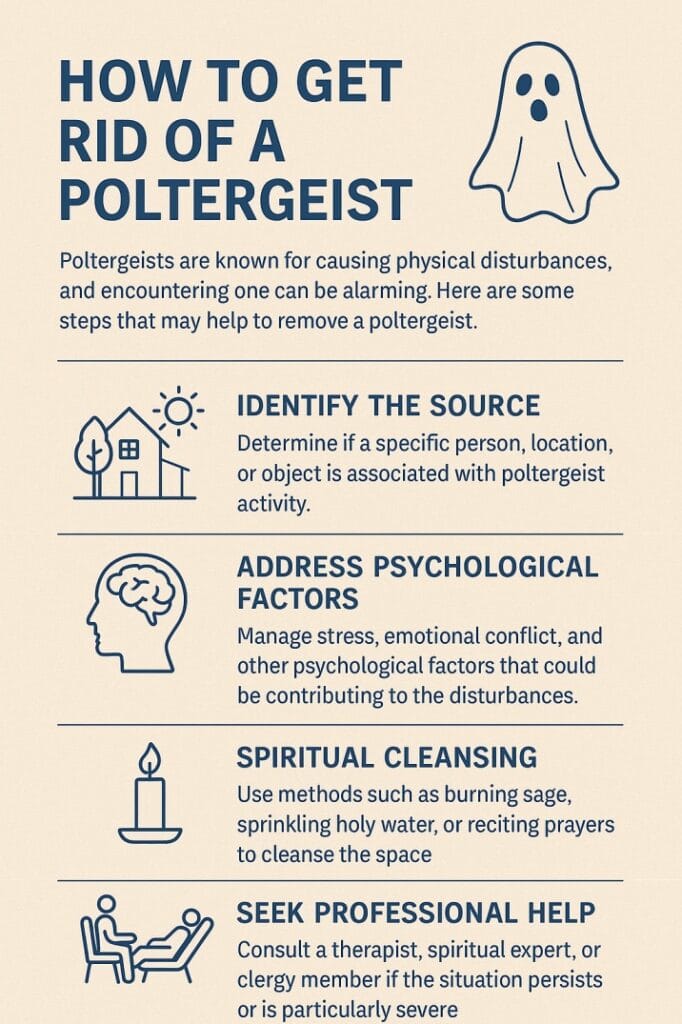
Step-by-Step “De-Poltergeisting” Checklist
- CO alarms & electrical safety. Rule out dangerous faults.
- Log disturbances. Who, when, what, and what appliances were running.
- Seal drafts, strap pipes, stabilize objects. Reduce false “activity.”
- Address stress & sleep. Routine, daylight exposure, family communication.
- Optional blessing/rite in your own tradition—with responsible screening.
- Reassess after environment/life changes. Note if phenomena subside naturally.
Bottom Line
A “poltergeist” is best approached as a household disturbance with multiple possible causes. Focus on safety, environment, stress management, and trusted community support. History shows most cases fade with time, life changes, or structured interventions—not because of movie-style confrontations.
Key Sources
- Enfield Poltergeist — detailed case of alleged poltergeist activity in Enfield, London (1977-79) around the Hodgson family. Wikipedia
- Wikipedia summary: Enfield Poltergeist Wikipedia
- People magazine: The Enfield Poltergeist: Inside the Real Story People.com
- The Ghost in the Machine (Vic Tandy & Tony R. Lawrence) — research on infrasound (~19 Hz) causing phenomena suggestive of hauntings. richardwiseman.com
- USCCB Guidelines on Exorcism — Catholic Church requirement for medical, psychological evaluation before major exorcism rites. USCCB
- Fear Frequency / Guardian Article — discussion of infrasound labs, ghost-like experiences, and how machinery or fans can produce “haunting” effects. The Guardian
- Archdiocese issues ‘Protocol for Exorcism’ — regional church source discussing how exorcism protocols include testing, screening, and caution. clarionherald.org
Reader sightings
Nobody has reported anything here yet. If you have been, you would be the first.



Leave a Reply