
Reviewed by Josh N · Updated August 25, 2026 · How we verify
Reported Phenomena
- Spectral figures
Reported by visitors & local legend. Stories, not verified claims.
Anyone searching for haunted Margam Castle will find a great deal written about ghosts and remarkably little of it anchored to anything. What the record does hold is a Grade I listed Tudor Revival mansion above Port Talbot in south Wales, built between 1830 and 1835 for one of the richest men in the country, gutted by fire in 1977, and once floated as the home of the Welsh Parliament. The ghost stories sit on top of that history rather than inside it, and the distinction is worth keeping straight before you set out.
Getting Your Bearings at Margam
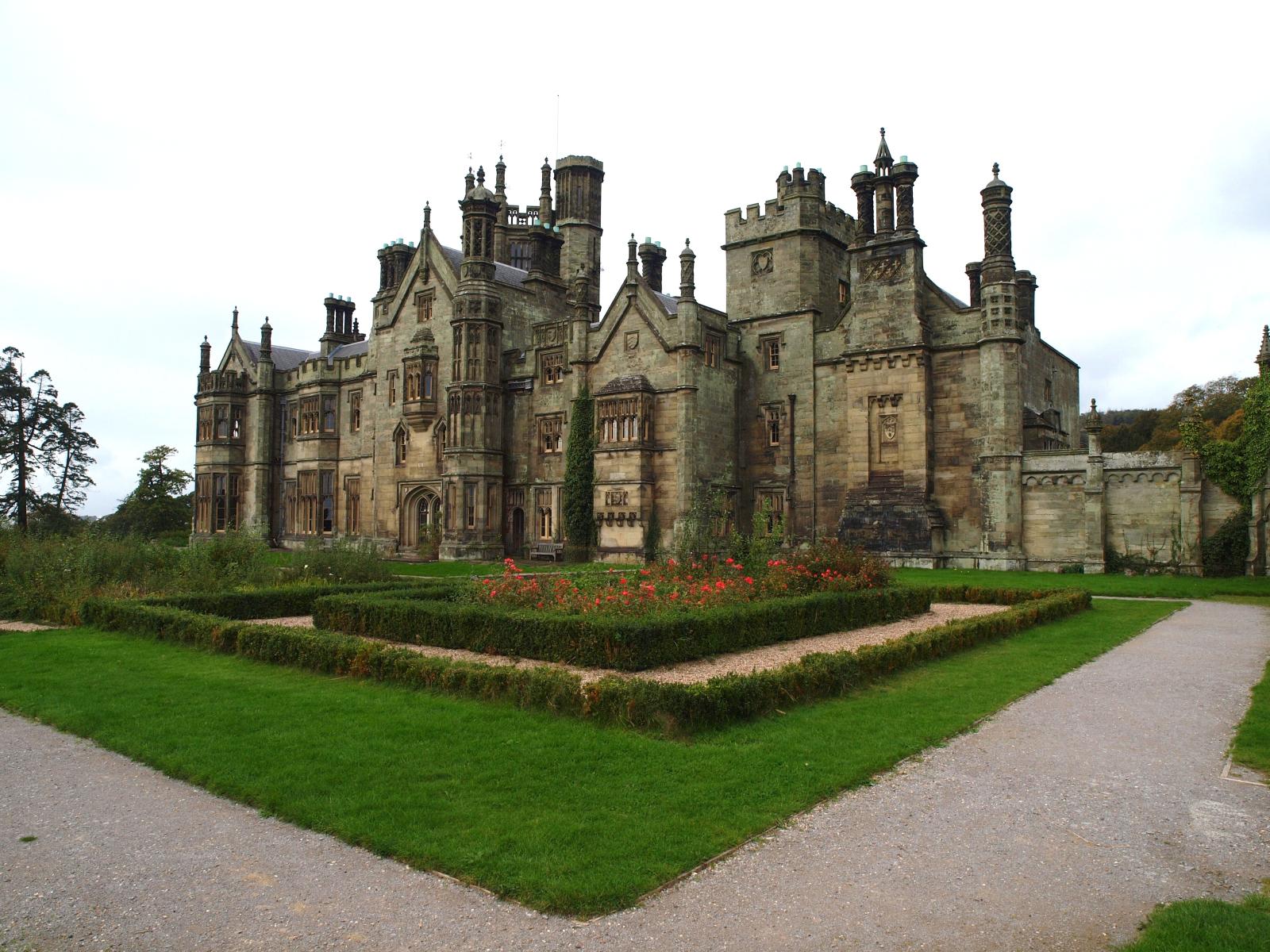
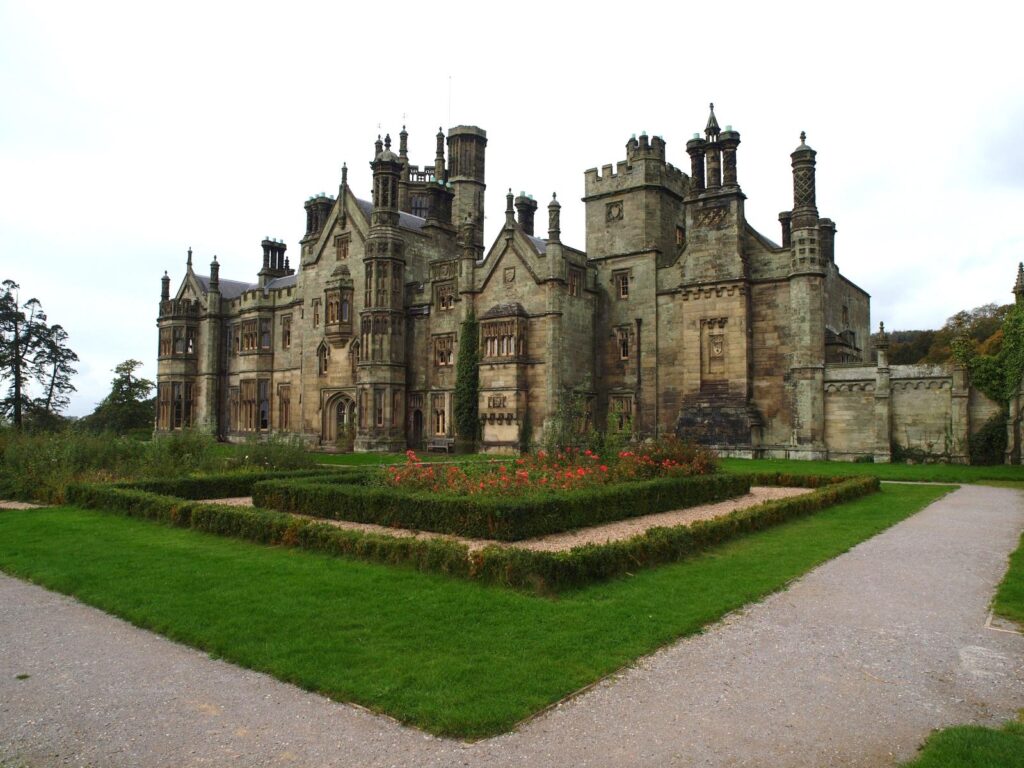
Where: Margam, Port Talbot, Wales. What it is: a late Georgian country house in the Tudor Revival style, designed by Thomas Hopper and built over a five-year period from 1830 to 1835 for Christopher Rice Mansel Talbot. Who holds it: Neath Port Talbot County Borough Council. Setting: Margam Country Park, the former estate to the house, itself listed at Grade I on the Cadw/ICOMOS Register of Parks and Gardens of Special Historic Interest in Wales.
Four Thousand Years on One Hillside
The site had been occupied for some 4,000 years before Hopper’s masons arrived. The Margam estate was occupied in the Iron Age, and the remains of a hill fort from that period, Mynydd-y-Castell, still stand north of the castle. After the Norman invasion of Wales, Robert, 1st Earl of Gloucester and Lord of Glamorgan, granted the lands at Margam to Clairvaux Abbey for a new Cistercian monastery, which became Margam Abbey.
Following the Dissolution of the Monasteries from 1536, the estate was bought by Sir Rice (Rhys) Mansel, and his descendants built a substantial Tudor mansion in the park. That house was demolished in the 18th century when the family returned to Penrice Castle, one of their earlier ancestral homes. Thomas Mansel Talbot (1747 to 1813) commissioned Anthony Keck to build a new mansion next to the castle ruins there, and also employed Keck at Margam, which he turned into a pleasure garden with an enormous orangery.
Christopher Rice Mansel Talbot’s £50,000 House
Talbot succeeded his father in 1813 at the age of ten. Enriched by the development of Port Talbot in the early 19th century, and after a Grand Tour of Europe as a young man, he returned to south Wales and from 1830 re-established Margam as his main seat. Thomas Hopper (1776 to 1856) designed the new house, with Edward Haycock Snr (1790 to 1870) acting as supervisory architect and designing parts of the interior and exterior, along with the stables, terraces and lodges.
Talbot took a keen interest himself, pushing his architects to borrow elements from Lacock Abbey in Wiltshire, ancestral home of the Talbots, and from Melbury House in Dorset, the home of his mother’s family. The result is two storeys of finely cut ashlar from a quarry at nearby Pyle, entered through an elaborate porch and crowned by a prospect tower modelled on the one at Melbury. The design is deliberately asymmetrical: irregular gables, turrets, parapets, bay, lancet and oriel windows, grouped chimney stacks and a great deal of heraldic decoration. It cost £50,000, a build quality that in John Newman’s phrase “could only be afforded by the super-rich”. Newman, writing the Glamorgan volume of the Buildings of Wales series in 1995, judged that “Margam has an accumulation of architecture and sculpture unparalleled in Wales”.
The Daguerreotype of 9 March 1841
Margam has an unusual claim on the history of photography. William Henry Fox Talbot, Christopher’s cousin and the owner of Lacock Abbey, was a frequent visitor, and the castle appears as an image in some of his early photographic experiments. The site is also the location of the earliest known Welsh photograph, a daguerreotype of the castle taken on 9 March 1841 by the Reverend Calvert Richard Jones.
Sold in 1941, Burnt in 1977
After the death of Emily Charlotte Talbot, daughter of the castle’s first owner, the house passed to her nephew and remained in use by the Talbot family until 1941, when it was sold. David Evans-Bevan bought it, found it too large to live in, and could not persuade any public organisation to take it on. It fell into disrepair. For many years it belonged to the local authority but was not open to the public. In 1977 a fire caused substantial damage, and it was only after that fire that a restoration project began in earnest.
There was one more twist. In December 1997, following the success of the devolution referendum, Margam Castle was among the proposed sites for the new Welsh Parliament building. Neath Port Talbot Council’s bid would have meant extensive renovations to fit in a debating chamber and offices for the Welsh Government, the First Minister and the cabinet. The bid was rejected at the shortlist stage.
What the Record Actually Says About Ghosts
This is where a reader deserves plain speaking. The reference source for this article is blunt on the subject: “The credulous suggest it may have ghosts.” That is the whole of it. No named apparition, no dated incident, no witness, no phenomenon described in any detail.
Margam’s reputation is real in the sense that plenty of people talk about it, and the ingredients are exactly the ones that grow ghost stories: decades of neglect, a locked building the public could not enter, and a major fire followed by a long restoration. None of that is evidence of a haunting. If you encounter confident accounts of specific spirits at Margam, treat them as folklore attached to a building rather than as documented events, and ask what record sits behind them.
Visiting Margam Castle and the Country Park
The castle stands within Margam Country Park, the former estate, so the setting is straightforward to reach and to walk. The Iron Age hill fort at Mynydd-y-Castell lies north of the house, and the terraced garden survives in listed form: the service courtyard and the terrace walls and screen are listed Grade II*, and the steps in the terraced garden Grade II.
Access to the interior is a separate question from access to the park. The building is in the care of Neath Port Talbot County Borough Council and spent long stretches of the 20th century closed to the public, so check current opening arrangements with the council or the country park before travelling rather than assuming you can walk in. Whatever the ghost tales promise, the reason to come is a Grade I listed house that Newman rated as without parallel in Wales, sitting on ground people have used for four millennia.
Address: Margam, Port Talbot, Wales
See Margam Castle for Yourself
Sources
- Margam House: Thomas Mansel Talbot and Penrice
- The Orangery
- Family gave its name to Port Talbot and laid industrial foundations
- Margam Castle, The William Henry Fox Talbot Catalogue Raisonné Search Results
- Margam Castle
- Wikipedia: Margam Castle
Frequently Asked Questions
Where is Margam Castle Port Talbot located?
Margam Castle Port Talbot is located at Margam, Port Talbot, Wales.
Can you visit Margam Castle Port Talbot?
Margam Castle Port Talbot is open to the public. Always follow posted rules and respect private property.
Reader sightings
Nobody has reported anything here yet. If you have been, you would be the first.
Report your own visit to Wales’s Earliest Photograph and Haunted Margam Castle
How haunted is this place?
Be the first to rate
Leave a Reply