

Reviewed by Josh N · Updated September 19, 2026 · How we verify
Reported Phenomena
- Helpful uniformed apparition
- Vanishing sailor 'Charlie'
- Engine room ghost guide
- Disembodied screams
- Unexplained voices below deck
Reported by visitors & local legend. Stories, not verified claims.
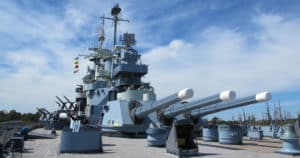
The USS Lexington in Corpus Christi, Texas, wears a nickname that sounds like it was invented for a ghost tour: the Blue Ghost. It was not. The name came from wartime broadcasts and enemy reports that kept announcing the carrier’s destruction, only for the same ship to turn up again in the next battle. Today the vessel sits permanently moored on the bay as a museum, and the stories told aboard her have shifted from combat to something quieter: a sailor in uniform who gives directions and then is not there.
Quick Orientation to the Blue Ghost
- Class and type: Essex-class aircraft carrier, designated CV-16
- Service life: in commission from 1943 to 1991, an unusually long career for a World War II carrier
- Combat record: credited with 11 Battle Stars and a Presidential Unit Citation
- Now: a museum ship at Corpus Christi, open to the public
- Reported activity: a helpful apparition nicknamed Charlie, a vanishing engine room guide, disembodied cries
The Carrier That Took a Dead Ship’s Name
The hull now floating at Corpus Christi was laid down as the USS Cabot and launched in 1942. That was the year the previous Lexington, the Lexington-class carrier commissioned in 1927, went down at the Battle of the Coral Sea. The Navy transferred the name to the new ship, and the Cabot became the Lexington before she ever saw a fight.
She was commissioned in 1943 and spent the rest of the war in the Pacific. The record is not ambiguous about what that cost: 11 Battle Stars and a Presidential Unit Citation are awarded for sustained action, not for good behavior. What is striking is how long the ship outlived the conflict that made her. She remained in commission until 1991, which means generations of sailors who were not born during World War II still served aboard the same steel that fought it.
Why She Was Called the Blue Ghost
The nickname is usually traced to Japanese propaganda broadcasts, which reportedly claimed the carrier sunk on more than one occasion. Each time, she reappeared. The ship’s dark blue camouflage scheme, unusual among American carriers that were often painted in dazzle patterns, is generally credited with the color half of the name. The ghost half was the enemy’s contribution.
It is worth being clear that this is a wartime nickname, not a paranormal one. The Blue Ghost earned her name from survival, not from hauntings. The overlap between the two ideas is a modern convenience, and it is part of why the ship’s ghost stories spread so easily.
Charlie, the Sailor Who Gives Directions
The most repeated account aboard the Lexington involves a figure visitors and staff call Charlie. Descriptions are consistent in outline: a young man in full uniform, calm and courteous, who appears to people who have lost their bearings in the ship’s interior and points them the right way. Anyone who has walked an Essex-class carrier below the hangar deck will understand why a guide is welcome. The passageways are narrow, repetitive and disorienting by design.
What makes Charlie a ghost story rather than a customer service anecdote is the ending. Witnesses say that after he answers, he is gone, and no crew member matching the description is on duty. None of this is documented in any verifiable sense. It is anecdote, passed between visitors and staff and repeated often enough to become the ship’s signature legend.
The Engine Room Talk and the Sounds of the War
A separate and more specific account places a sailor in the engine room, where he is said to deliver a detailed explanation of the ship’s turbine machinery to whoever is standing there. The level of technical detail is the part witnesses emphasize, along with what follows: he stops speaking and is no longer present. Visitors who report the encounter tend to describe it as instructive rather than frightening.
Most of the reported activity aboard the Lexington follows that pattern. The spirits, as described, are helpful or playful rather than hostile, which is not the usual character of a ghost story attached to a warship. The exception is the sound. Visitors have reported disembodied screams and cries in the ship’s lower spaces, which people inevitably connect to the carrier’s combat service in the Pacific. No account of this kind can be tested, and a steel hull in a coastal climate produces plenty of noises of its own. Report it, note it, and let the reader weigh it.
Boarding the Blue Ghost at Corpus Christi
The Lexington operates as a museum ship on the Corpus Christi waterfront and is open to the public, with self-guided routes that take visitors through the hangar and flight decks, the bridge, berthing spaces and the engineering compartments where the turbine story is set. Wear shoes you can climb ladders in. The interior tour involves steep steps and tight hatches, and the deeper compartments are exactly where the reported encounters cluster, so anyone hoping to experience the ship’s stories will need to leave the flight deck behind and go down into the hull.
Visitors come for two different reasons and generally leave satisfied on both counts: a genuinely significant piece of American naval history, and a set of ghost stories the ship has never quite shaken.
See USS Lexington for Yourself
Sources
Frequently Asked Questions
Where is Uss Lexington located?
Uss Lexington is located at 2914 N Shoreline Blvd.
Can you visit Uss Lexington?
Uss Lexington is open to the public. Always follow posted rules and respect private property.
Reader sightings
Nobody has reported anything here yet. If you have been, you would be the first.
Report your own visit to Charlie and the Blue Ghost: USS Lexington in Corpus Christi
How haunted is this place?
Be the first to rate





Leave a Reply