
Reviewed by Josh N · Updated September 4, 2026 · How we verify
Reported Phenomena
- Apparition of Colonel Fannin
- Lady in Blue sighting
- Whispers in monk's cell
- Disembodied children's laughter
- Spectral Spanish sentinel
Reported by visitors & local legend. Stories, not verified claims.
Few places in south Texas carry as much recorded death inside their walls as Presidio La Bahia, the restored Spanish fort standing above the San Antonio River at Goliad. It is a working museum, a National Historic Landmark, and a Catholic chapel that still holds services, and it is also one of the locations Texas ghost hunters name first. The stories told here are unusually specific: a colonel near the spot where his men were killed, a nun in blue, footsteps in the monk’s cell. None of it is verified. All of it is reported often enough that the fort has stopped trying to shake the reputation.
Quick Orientation for Visitors to the Goliad Fort
- What it is: a restored eighteenth century Spanish presidio, now operated as a museum
- Where: Goliad, Texas, on the San Antonio River
- Still in use: the Our Lady of Loreto Chapel continues to host Catholic services
- Status: National Historic Landmark, restored in the 1960s
- Best known for: the 1836 Goliad Massacre, in which more than 300 Texian prisoners were executed
From Matagorda Bay to the San Antonio River
The Spanish founded the presidio in 1721 near Matagorda Bay. The site proved difficult, and in 1749 the garrison was relocated to the bluff above the San Antonio River where the fort stands today. That move is what put a Spanish military post in the middle of the ground that would later be fought over repeatedly.
By the fall of 1835 the fort was a strategic prize. After the Texians’ first skirmish at Gonzales in early October, commander Stephen F. Austin judged it necessary to take possession of both Presidio La Bahia at Goliad and Bexar at San Antonio. Texian troops marched toward Goliad to reinforce Major Collinsworth at the Battle of Goliad, though part of that force was diverted by an express from Austin calling them to the attack on Bexar instead. The fort changed hands, and the revolution moved on.
The Goliad Massacre and Colonel Fannin
The event that defines the place came in 1836. More than 300 Texian rebels held at the presidio were executed on order, an act remembered as the Goliad Massacre. Colonel James Fannin, who had commanded them, died with them. It is the single largest loss of Texian life in the revolution and the reason “Remember Goliad” was shouted alongside “Remember the Alamo.”
After Texas won independence the fort passed through a series of uses before falling into decline. A major restoration in the 1960s returned it to something close to its Spanish colonial appearance, and it opened as a museum. The chapel of Our Lady of Loreto was never fully retired from religious use, which gives the compound an unusual double life: interpretive exhibits on one side of the quadrangle, an active parish space on the other.
What People Say Happens Inside the Walls
These are reported experiences, not documented events. They come from visitors, staff, and paranormal investigators, and they have accumulated over decades rather than appearing all at once.
- Fannin on the grounds: a figure identified as Colonel James Fannin is described near the massacre site, walking the fort grounds.
- The Lady in Blue: the most repeated apparition here, said to be Maria de Agreda, the Spanish nun of legend who was reported to have appeared to Native peoples in Texas. Witnesses describe a blue-robed woman on the grounds.
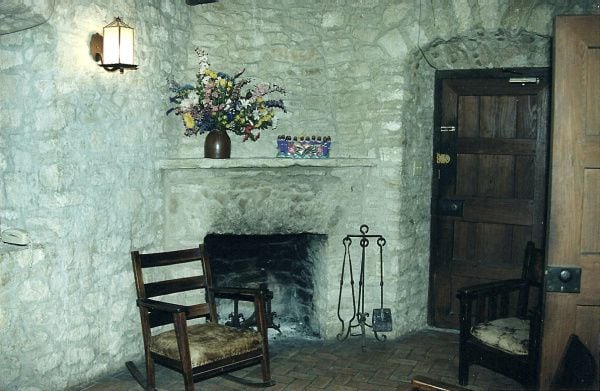
- Sounds from the monk’s cell: whispers and unexplained noises near the chapel, reported by people who were alone in that part of the compound.
- Children’s laughter: heard in the open quadrangle with no children present.
- The sentinel: a figure in Spanish military dress seen at dusk, described as if standing watch.
Worth noting for anyone assessing these accounts: the presidio is a walled stone quadrangle with a chapel at one corner. Sound behaves strangely in that kind of enclosure, and low light on old masonry does the rest. That does not settle the question. It does explain why the same handful of experiences keep recurring in the same handful of spots.
Visiting Presidio La Bahia at Goliad
The fort operates as a museum and welcomes daytime visitors. Because the Our Lady of Loreto Chapel remains in Catholic use, treat it as a place of worship rather than an exhibit, and check ahead if you are planning a visit around a service or a private event. Hours and admission are set by the site, so confirm before you drive out.
The massacre ground is the emotional center of the visit and deserves to be approached that way. Whatever you make of the reported hauntings, more than 300 men were killed here, and the fort presents that history plainly. Come for the history first. The rest of it, people say, tends to find you at dusk.
Sources
- Remember the Alamo
- DAM (Unt (official site))
- bexargenealogy.com
- Introduction to the Republic Claims | Texas State Library (Texas (official))
- Veterans of San Jacinto | The Battle of San Jacinto
- Wikipedia: Salvador Flores
Frequently Asked Questions
Where is Presido La Bahia located?
Presido La Bahia is located at 217 US-183 Hwy, Goliad, TX 77963.
Can you visit Presido La Bahia?
Presido La Bahia is open to the public. Always follow posted rules and respect private property.
Reader sightings
Nobody has reported anything here yet. If you have been, you would be the first.
Report your own visit to The Lady in Blue and Fannin’s Ghost at Presidio La Bahia
How haunted is this place?
Be the first to rate
Leave a Reply