
Reviewed by Josh N · Updated August 25, 2026 · How we verify
Reported Phenomena
- Spectral figures
Reported by visitors & local legend. Stories, not verified claims.
Anyone arriving at Duns Castle expecting a well documented haunting should know up front that the paper trail is unusually thin. Search for a Duns Castle ghost and you will find plenty of atmosphere, a Norman keep, a Gothic remodelling, a Bishops’ War general in residence, but the written record for this Berwickshire house records no named apparition, no dated incident and no witness account. What it does record is a building whose own origins nobody can pin down, which is a different kind of mystery and arguably a better one.
Duns Castle at a Glance
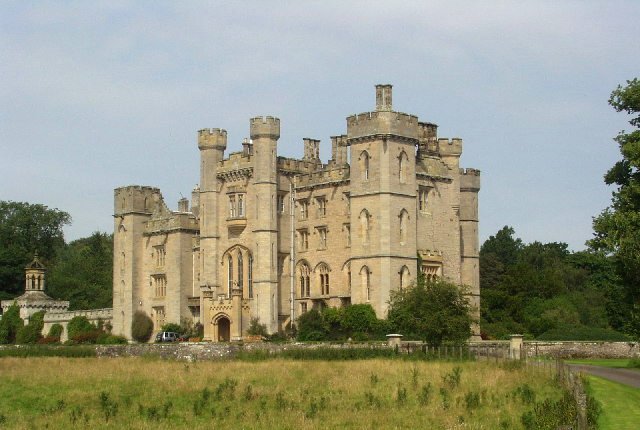
Where: Duns, Berwickshire, in the Scottish Borders. Oldest fabric: a massive Norman keep or pele tower, supposedly dating from 1320, although the dating is disputed. Status: the castle and most of the structures on the property are designated as a Category A listed building. Owners: the Hay family, continuously since 1698. Grounds: a publicly accessible park with two man-made lakes forming the Duns Castle nature reserve. Current use: a venue for weddings and corporate functions, with accommodation for guests.
A Keep on Land Granted by Robert the Bruce
The early history of the building is, in the plainest terms available, virtually unknown. What is recorded is that a keep was built on lands granted to Thomas Randolph, 1st Earl of Moray, by King Robert the Bruce in 1320. Randolph died in 1332, after which the manor and its castle appear to have passed to Patrick V, Earl of March. The following year, after the Battle of Halidon Hill, the manor was granted by King Edward III of England to Thomas de Bradestan. Multiple changes of ownership followed.
That is a great deal of turnover for a single generation, and it says something about where Duns sits: close enough to the border to change hands whenever the border moved.
The Rough Wooing and the Problem With 1320
The claim that the oldest part of the castle dates from 1320 does not survive close inspection. Architectural historians have assessed the fabric said to be of that date as belonging instead to the 15th or 16th century. The likeliest explanation is destruction and rebuilding: the original structure may have been razed by the English in the 16th century, possibly during the Rough Wooing in 1545, when the nearby town of Duns was burned to the ground.
So the tower a visitor sees is old, but probably not as old as the story attached to it. This matters for anyone weighing up the castle’s reputation, because the same habit that stretches a building’s age tends to stretch its ghost stories too.
General Leslie’s Army and the Pacification of Berwick
The castle’s most substantial appearance in national history comes in 1639, during the First Bishops’ War, when it housed General Alexander Leslie, 1st Earl of Leven. His army was quartered nearby and blocked the English from advancing into Scotland. Neither side wished to fight, and negotiations began that led to the Pacification of Berwick, which ended the war.
It is worth noting what did not happen here: no siege, no massacre, no recorded battlefield death toll on the estate. Haunted house lore usually needs an atrocity to hang itself on, and Duns Castle’s brush with the Bishops’ Wars was, by the standards of the period, remarkably bloodless.
Cockburns, Hays and Three Centuries in One Family
In 1670 Sir James Cockburn of Cockburn bought the estate and burgh of Duns from Hume of Ayton. The manor was then sold in 1698 to William Hay of Drumelzier, son of John Hay, 1st Earl of Tweeddale, and it has remained in the family ever since. Continuous family ownership of more than three hundred years is one reason the place has not accumulated the sort of lurid institutional past, asylum, gaol, hotel, that generates ghost reports.
The building itself grew by stages. The original keep is claimed to have been incorporated into an L-shaped structure at some unknown date. It was remodelled soon after its acquisition, and again between 1791 and 1798 by the architect John Baxter. Between 1818 and 1822 the architect James Gillespie Graham transformed the house into a Gothic castle, which is broadly the silhouette visitors see today. The interior woodwork was carved by the noted sculptor Sir John Steell during his apprenticeship, a detail that repays a closer look indoors.
What the Record Actually Says About Hauntings Here
Honesty is more useful than atmosphere. The documentary source consulted for this entry sets out the castle’s ownership, architecture, listing status and grounds, and contains no account of apparitions, no named spirit, no reported phenomena and no dated incident of any kind. That is not evidence that nobody has ever felt uneasy on a Gothic staircase in a fifteenth century tower. It is evidence that no such experience has been recorded in the history of the building.
A visitor should treat Duns Castle, then, as a place with all the ingredients of a haunting and none of the reports: a border tower of contested age, a probable burning in the 1540s, a war averted at the gates, and centuries of one family’s occupation. If stories exist locally, they exist in conversation rather than in the record.
The Hen Poo, the Mill Dam and Getting Onto the Estate
The most straightforward way to see the place is the nature reserve. The estate includes a publicly accessible park and two man-made lakes, the Hen Poo and the smaller Mill Dam, which together form the Duns Castle nature reserve. That is open ground, and it gives views across the estate landscape without any need to arrange access to the house.
The castle and its outbuildings themselves are currently available as a venue for weddings and corporate functions, with accommodation available for guests. In practice that means the interior is not a ticketed attraction with set opening hours: seeing Sir John Steell’s woodwork generally means being invited to an event held there, or making arrangements directly. Anyone hoping to wander the house on a whim should adjust their plans to the reserve instead, and enjoy it for what it is, which is a good walk around a lake beneath a genuinely strange old tower.
Address: Duns, Berwickshire, Scottish Borders
See Duns Castle for Yourself
Sources
- Ordnance gazetteer of Scotland: a survey of Scottish topography, statistical, biographica
- GeoHack – Duns Castle
- Wikipedia: Duns Castle
Frequently Asked Questions
Where is Duns Castle Berwickshire Keep located?
Duns Castle Berwickshire Keep is located at Duns, Berwickshire, Scottish Borders.
Can you visit Duns Castle Berwickshire Keep?
Duns Castle Berwickshire Keep is open to the public. Always follow posted rules and respect private property.
Reader sightings
Nobody has reported anything here yet. If you have been, you would be the first.
Report your own visit to Duns Castle Ghost Stories and the Keep That Cannot Be Dated
How haunted is this place?
Be the first to rate
Ghost Tours Nearby
 Underground Vaults Walking Tour in Edinburgh Old Townfrom $32
 The World Famous Underground Ghost Tourfrom $26
 Haunted Vaults and Graveyard Walking Tour in Edinburghfrom $35
Affiliate links: BeyondHaunted may earn a commission, at no extra cost to you.
Leave a Reply