
Reviewed by Josh N · Updated August 27, 2026 · How we verify
Reported Phenomena
- Soldier apparitions
- Shoulder taps
- Phantom cigar smoke
- Distant gunfire and cannon
Reported by visitors & local legend. Stories, not verified claims.
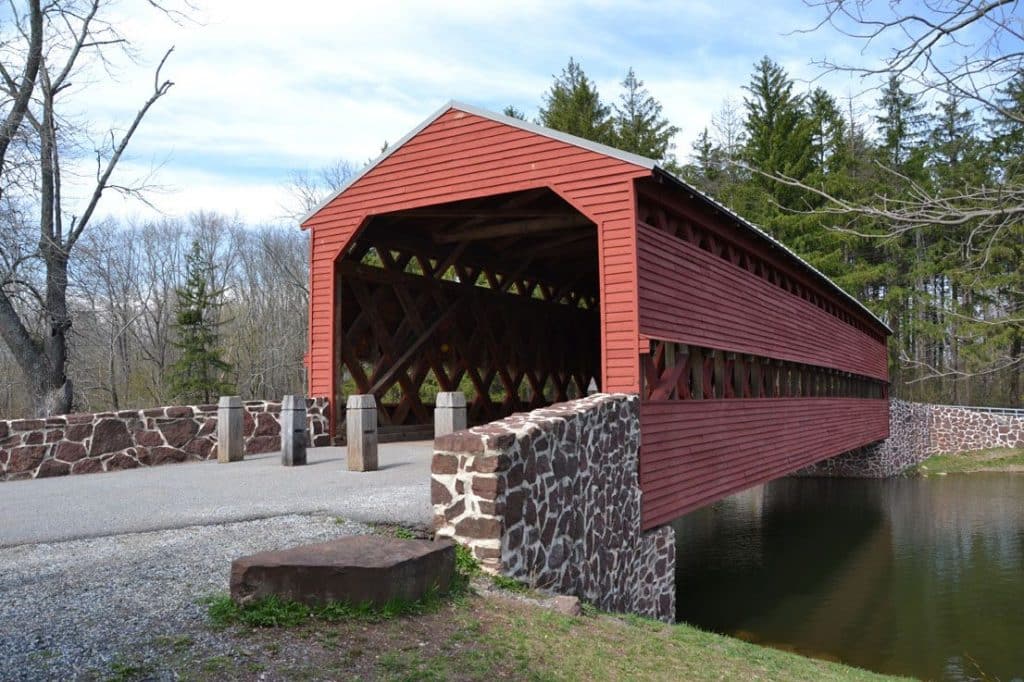
Sachs Covered Bridge crosses Marsh Creek on the western edge of the Gettysburg battlefield in Adams County, Pennsylvania, a hundred feet of latticed timber that both armies walked across within the space of five days in July 1863. It carries no cars now. What it carries instead is a reputation: local guides, ghost hunters and a steady stream of night visitors call it one of the most haunted spots in a town with no shortage of competition.
Quick Facts About the Marsh Creek Crossing
- Also known as: Sauck’s Covered Bridge and Waterworks Covered Bridge, and as the Sauches Covered Bridge at the time of the Battle of Gettysburg
- Built: around 1854, at a cost of $1,544
- Location: over Marsh Creek between Cumberland and Freedom Townships, Adams County
- Dimensions: 100 feet long, 15 feet 4 inches wide
- Design: Town truss, one of few remaining examples in Pennsylvania
- Honours: named Pennsylvania’s “most historic bridge” in 1938; listed on the National Register of Historic Places on August 25, 1980
- Access: pedestrians only since 1968
Ithiel Town’s Lattice and a $1,544 Bill
The structure is a Town truss, a design developed by Ithiel Town of Connecticut in which wooden beams are criss-crossed to form a lattice. It is a cheap, strong and quick way to span a creek, and it is why the interior of the bridge looks like a long wooden cage rather than a series of heavy triangles. Few Town truss bridges survive in Pennsylvania, which is part of what earned this one its listings and its 1938 designation as the state’s most historic bridge by the Department of Highways, the predecessor of PennDOT.
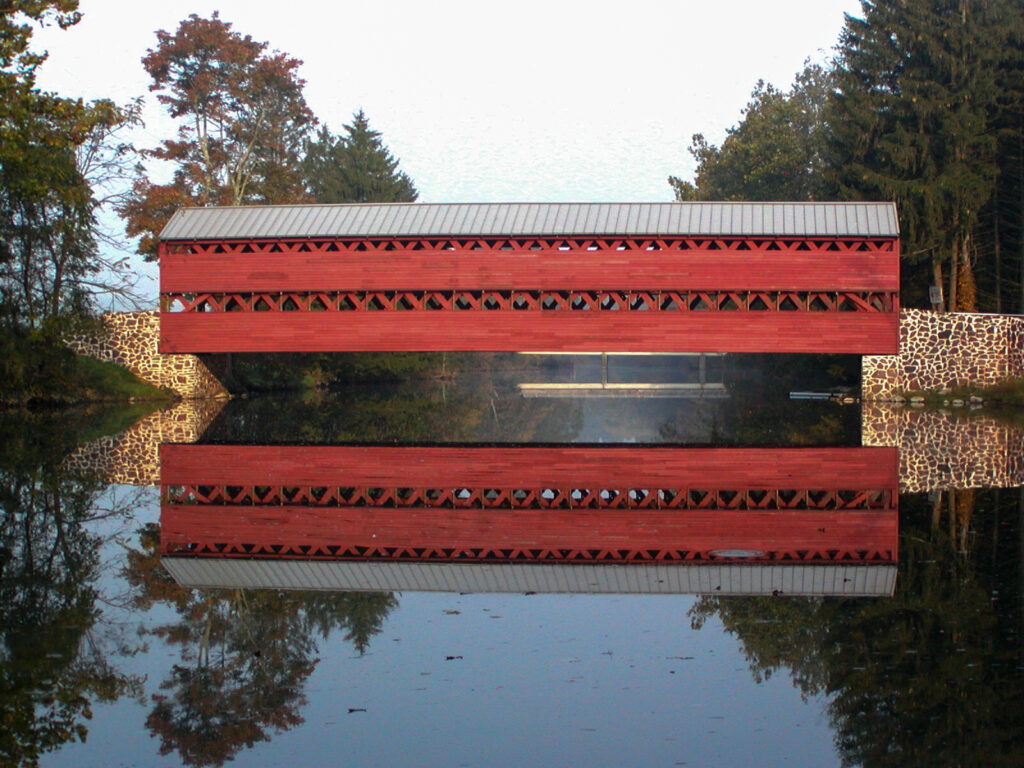
Accounts of the build date differ. The most commonly repeated local version credits builder David Stoner and the year 1852; the documented figure puts construction at around 1854 for $1,544. Either way, the bridge was already nine or ten years old and thoroughly unremarkable when the war arrived.
Two Armies in Five Days, July 1863
On July 1, 1863, two brigades of the I Corps of the Union Army crossed the bridge heading towards Gettysburg. The III Corps crossed as well, moving on towards the Black Horse Tavern. Four days later, after the Union victory, the majority of General Robert E. Lee’s Army of Northern Virginia retreated back over the same hundred feet of planking.
That is the whole of the bridge’s documented Civil War service, and it is enough. Tens of thousands of men in both uniforms passed through this single covered span in under a week, some marching towards the largest battle ever fought in North America and some limping away from it. No fighting is recorded on the bridge itself. Its significance is as a bottleneck, a place where almost everyone had to pass.
The Flash Flood of 1996
On June 19, 1996, a flash flood on Marsh Creek knocked the bridge clean off one of its abutments and left it substantially damaged. The same water heavily damaged one iron bridge on the creek and destroyed another. A $500,000 restoration was already underway when the flood hit, and a further $100,000 had to be raised to repair the new damage. The rebuilt bridge was rededicated on July 21, 1997.
This matters for anyone weighing up what they are looking at. Much of the timber a visitor touches today is late twentieth century work, faithful to the original design but not the wood that Lee’s men walked over. The bridge had already been closed to vehicles years earlier: after a 1960 plan to replace it outright, Cumberland Township officials voted on May 9, 1968 to shut it to traffic while keeping it open on foot.
The Hanged Deserters: Legend, Not Record
The story attached to the bridge more than any other holds that at least three Confederate soldiers, caught deserting in Union uniforms, were hanged from the rafters here. It is told constantly in Gettysburg, and it is the anchor for most of the apparition reports.
It should be treated as folklore. The documented history of Sachs Covered Bridge records troop movements and nothing else: no executions, no deaths on the span. That does not make the legend impossible, but no record presented alongside the bridge’s history supports it, and a reader deciding whether to come out at night deserves to know that the grimmest detail in the story is the least verifiable part of it.
What People Report on the Bridge After Dark
These are reported experiences gathered from visitors and paranormal investigators, not verified events.
- Soldier apparitions, usually described as figures matching the three men in the hanging legend
- Taps on the shoulder from nobody, a very frequently repeated account
- Phantom cigar smoke, smelled inside the covered span with no source
- Distant gunfire and cannon, heard from the direction of the fields
Bear in mind the setting. The bridge stands in open farmland beside a creek, in a county where reenactment, hunting and ordinary agricultural noise all carry a long way at night, and where every visitor arrives already primed by the story. The atmosphere here is genuine. The explanation for it is contested.
Visiting Sachs Covered Bridge and the Gettysburg Waterworks
The bridge is open to pedestrians and free to walk, sitting a short drive west of the town centre off Waterworks Road. It is a working photographic landmark as much as a ghost site: a hundred feet of red-painted timber over a slow creek, best in early morning or late light.
The waterworks name comes from the Gettysburg Waterworks, the Marsh Creek site that supplies the town’s freshwater. Originally constructed in 1894, it was rebuilt by the Pennsylvania Department of Health for the 1913 Gettysburg reunion, when the site held a pumping station, a filter plant and four drilled wells, one of them nearly dry. The reservoir draws on a 57.5 square mile catchment upstream of the bridge, which is also the reason a summer storm in 1996 could hit the structure as hard as it did.
Go in daylight if you care about the engineering and the battlefield geography. Go at night if you want the atmosphere, but respect that this is a fragile, publicly maintained historic structure in a rural township, not an attraction with staff on hand.
See Sachs Covered Bridge for Yourself
Sources
- PHMC Historical Markers
- NPS Focus
- National Register of Historic Places Registration: Pennsylvania MPS Sauck's Covered Bridge (Archives (official))
- Changes coming at pumping station
- Commissioner's Report
- Wikipedia: Sachs Covered Bridge
Address: Waterworks Road
Frequently Asked Questions
Where is Sachs Covered Bridge located?
Sachs Covered Bridge is located at Waterworks Road.
Can you visit Sachs Covered Bridge?
Sachs Covered Bridge is open to the public. Always follow posted rules and respect private property.
Reader sightings
Nobody has reported anything here yet. If you have been, you would be the first.
Report your own visit to Two Armies in Five Days: Gettysburg’s Sachs Covered Bridge
How haunted is this place?
Be the first to rate
Ghost Tours Nearby
 Civil War Ghosts: Echoes of the Fallen Gettysburg Ghost Tourfrom $26
 Ghosts of Gettysburg Ultimate Dead of Night Haunted Ghost Tourfrom $29
 Spirits of Jennie Wade Ghost Night Tour in Gettysburgfrom $20
Affiliate links: BeyondHaunted may earn a commission, at no extra cost to you.
Nearby Haunted Locations
- 1Gettysburg BattlefieldPennsylvania2.7mi
- 2What Visitors Hear at Devil’s Den in GettysburgPennsylvania3.2mi
- 3Lightner FarmhousePennsylvania4.5mi
- 4Harrisburg State HospitalPennsylvania23mi
- 5Why Haunted Shepherdstown Claims the Title of America’s Most Ghostly TownWest Virginia38mi
- 6Phantom Drums on High StreetWest Virginia41mi
Leave a Reply