
Reviewed by Josh N · Updated September 20, 2026 · How we verify
Reported Phenomena
- Soldier apparitions
- Shadow figures
- Phantom gunfire
- Disembodied cries
- Feeling of being watched
- Sudden cold spots
Reported by visitors & local legend. Stories, not verified claims.
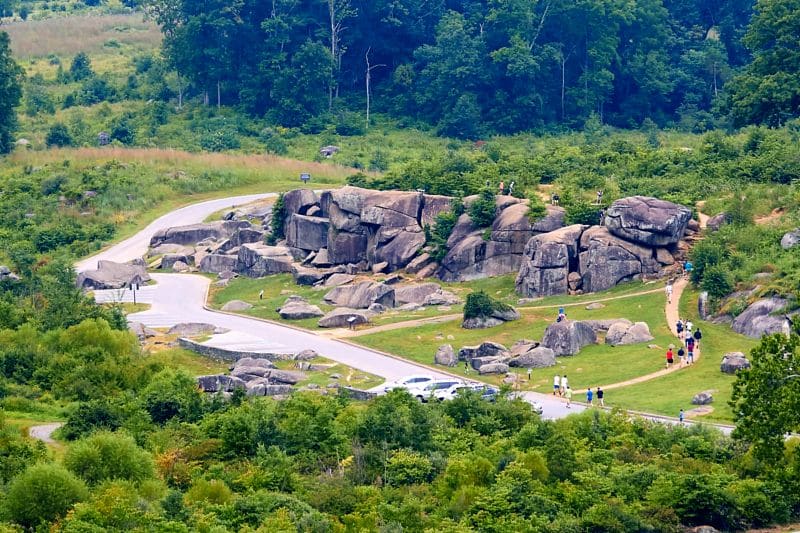
Devil’s Den in Gettysburg is a jumble of house-sized boulders at the southern end of the Pennsylvania battlefield, and it is one of the few places on that field where the ground itself does most of the storytelling. The granite is older than anything human here by an unimaginable margin, but what draws the crowds is three days in July 1863, and what keeps a certain kind of visitor coming back after sunset is everything people claim to have heard and seen among the rocks since.
It sits inside Gettysburg National Military Park, a short walk across the valley from Little Round Top, and it is free to walk. That combination, open access, famous carnage, and a landscape full of dark crevices, has made it one of the most talked-about haunted spots on any American battlefield. What follows separates what the record says from what visitors report.
Three Days in July 1863
The Battle of Gettysburg ran from July 1 through July 3, 1863, and it is generally treated as the turning point of the Civil War. Devil’s Den was not incidental to it. The outcrop anchors the low ground below Little Round Top, and its boulders offered exactly what infantry and artillery want on broken terrain: cover that does not have to be dug, elevation that does not have to be built, and firing positions that are almost impossible to dislodge once occupied.
The heaviest fighting here came on the second day, when the rocks became the object of a sustained and costly struggle. Confederate troops made use of the natural defenses the formation provided, and the Union effort to take and hold the ground met stiff resistance. Accounts attached to the site put the casualties from the fighting in and around Devil’s Den at more than five thousand. Whatever the precise figure, the important point for a visitor standing there is that a small patch of broken stone absorbed an extraordinary amount of killing in a very short time.
Why the Rocks Look the Way They Do
Part of the reputation is simply the geography. Devil’s Den is not a building with rooms and corridors where a story can be pinned to a doorway. It is a field of boulders with gaps, overhangs, and shaded hollows between them, the kind of place where sound behaves unpredictably and a figure can be visible one second and gone the next. Sightlines break every few feet. Light drops away fast in the crevices even in the middle of the day.
That matters when you read the ghost accounts, because a landscape built out of blind corners and echo chambers generates ambiguous experiences on its own. It also matters historically: the same features that produce a startling shadow today are the features that made the position worth thousands of casualties in 1863.
What People Report Among the Boulders
None of the following is documented fact. These are reported experiences, told and retold by visitors, tour guides, and paranormal investigators, and they cluster consistently enough to be worth setting out plainly.
- Figures among the rocks. Visitors describe spectral shapes and shadowy forms moving between the boulders, often taken to be soldiers. The typical account has the figure visible only briefly before it fades or steps out of sight.
- Sounds of the fighting. Gunfire, shouting, and cries of pain are the most commonly reported phenomena here, heard with no visible source. Given the terrain and the number of people on the battlefield at any hour, sound carries and distorts in ways that complicate every one of these reports.
- The sense of being watched. A persistent, specific unease is reported by people who arrive expecting nothing of the kind, sometimes paired with abrupt drops in temperature in the shaded gaps between stones.
There is no verification for any of it. What can be said honestly is that the stories are old, numerous, and attached to particular pockets of the formation rather than floating free across the park.
Visiting Devil’s Den at Gettysburg National Military Park
Devil’s Den lies within Gettysburg National Military Park in Gettysburg, Pennsylvania, and is part of the standard battlefield auto tour. Parking near the formation is limited and the road through it is narrow, so arriving early or late in the day makes the visit easier. The rocks are open to climb in places, but they are uneven, slick when wet, and full of ankle-turning gaps: this is the most common way people get hurt here, and it has nothing to do with the supernatural.
Park hours for the battlefield roads are set by the National Park Service and change seasonally, so check the current closing time before planning anything after dark. The field is a burial ground and a memorial as much as an attraction. Treat it accordingly, stay off the monuments, and leave the stones where they are.
See Devils Den for Yourself
Sources
Frequently Asked Questions
Can you visit Devils Den?
Devils Den is open to the public. Always follow posted rules and respect private property.
Reader sightings
Nobody has reported anything here yet. If you have been, you would be the first.
Report your own visit to What Visitors Hear at Devil’s Den in Gettysburg
How haunted is this place?
Be the first to rate
Ghost Tours Nearby
 Civil War Ghosts: Echoes of the Fallen Gettysburg Ghost Tourfrom $26
 Ghosts of Gettysburg Ultimate Dead of Night Haunted Ghost Tourfrom $29
 Spirits of Jennie Wade Ghost Night Tour in Gettysburgfrom $20
Affiliate links: BeyondHaunted may earn a commission, at no extra cost to you.
Leave a Reply