
Reviewed by Josh N · Updated August 26, 2026 · How we verify
Reported Phenomena
- Cold spots
- Disembodied footsteps
- Spectral cat
- Civil War captain apparition
Reported by visitors & local legend. Stories, not verified claims.
The Cleveland Grays Armory is a squat brick and sandstone fortress at 1234 Bolivar Road, one of the oldest standing buildings in downtown Cleveland, Ohio, and the only one still occupied by the private military company that paid for it. The Cleveland Grays raised the money after fire took their previous home, and they have never left. The building now houses the Grays Armory Museum, hosts weddings and concerts, and carries a reputation among ghost hunters that its own history did nothing to discourage.
Semper Paratus: The Company That Built It
The Grays were founded in 1837 as a volunteer private military company, at a moment when the constitutional militia had been left to rot by state politicians. Their purpose was practical and twofold: back up local law enforcement, and stand as a first line of defense if the fighting in Canada’s Rebellions of 1837 spilled across the border and produced a third war with the United Kingdom in under a century. The motto they chose, Semper Paratus, translates as “Always Ready.”
The first organizational meeting was held on August 28, 1837, and on September 18 seventy-eight men joined the active company. They were originally called The Cleveland City Guards. Within a year the membership decided to be known instead by the gray color of their uniforms, and on November 29, 1838 the Grays made one of their first parade appearances in full gray dress and tall black bearskin caps. Members who reached twenty-five years of service earned the status of “Pioneer,” which entitled them to leather aprons and to carry axes on parade.
The unit saw service as a unit in the Civil War and the Spanish-American War. The Militia Act of 1903 and the state and federal legislation that followed ended the era of private military companies taking official part in national military affairs. Under Ludwig S. Connelly the Grays enlisted in the Ohio National Guard for the Mexican Punitive Expedition, but they did so as a mass of private citizens rather than as a company. World War I, which began for them the moment their Guard unit was released from the Mexican border, was the last conflict in which the Grays served even as a body of enlistees. Individual members have served in the wars since.
The Fire of December 8, 1892
Before Bolivar Road the Grays moved repeatedly. Their first armory occupied the fourth floor of the Mechanics Block, newly built in 1838 at the southeast corner of Ontario and Prospect. In 1870 they took over a former fire station on Frankfort Street. By March 20, 1880 they had moved into the new City Armory on Long Street, sharing it with the 5th Regiment, Ohio National Guard.
On December 8, 1892 fire destroyed that building and much of what was inside it, including equipment and guns belonging to the Grays. Major Otto Schade and several of his men managed to pull a few items out without cost to their health or their lives. The unit recovered fast. Funds for a new armory were raised quickly, and while construction went ahead the company camped in the Gatling Gun Battery Armory on Sibley Street. That fire is the reason the building on Bolivar Road exists at all, and it is worth holding onto when the ghost stories start, because a good deal of the Grays’ physical history burned in 1892 rather than surviving into the present.
A Three-Ton Cornerstone and a Five-Story Tower
On May 30, 1893, Colonel John Frazee set a three-ton Berea sandstone foundation block in place. The building went up between 1893 and 1894 to designs by Fenimore C. Bate in the Richardsonian Romanesque style, and it was among the first structures in the United States to use structural steel.
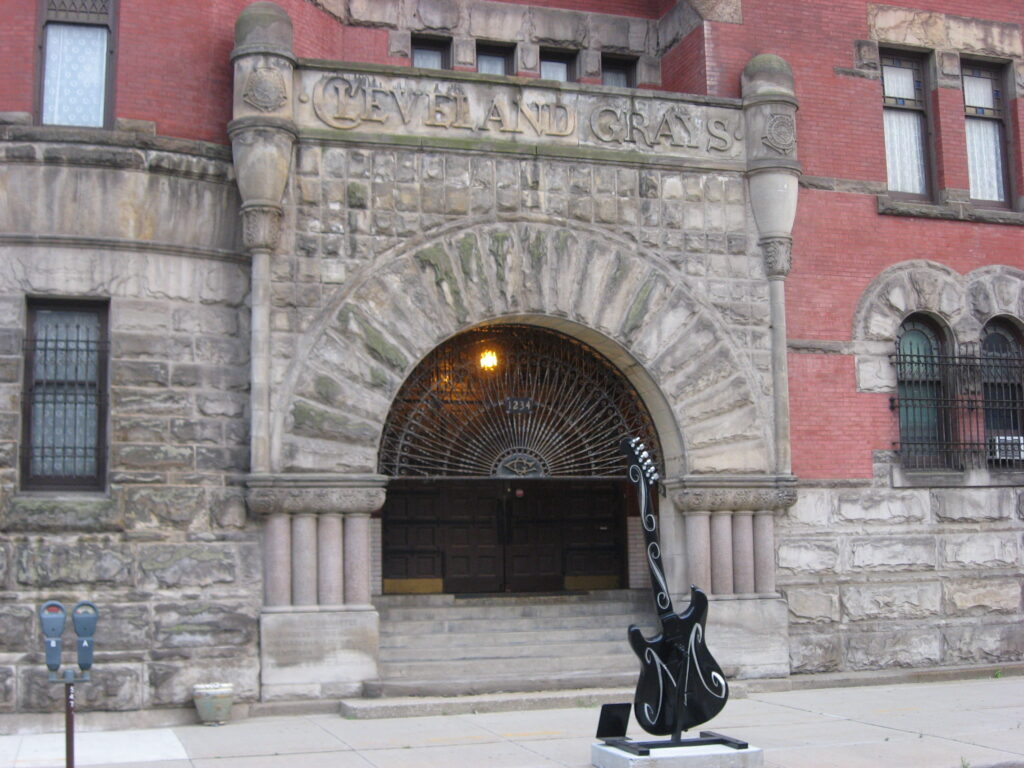
The main block runs four stories. The signature feature is the five-story tower at the northeast corner, standing on three by five foot foundation blocks. Entrance corners and front window lintels are solid rough-hewn sandstone, and the main entry arch rests on polished granite columns rising from each cornerstone. Above it sits a black iron drop-gate, with a gothic barrier between the front steps and the enormous oak doors. Pointed iron rods bolted to the scarlet brick guard the first-floor windows. The mix of color and texture is handsome, but the message is not subtle: this is an urban fortress.
Centennial Balls, Drill Hall Football and the Museum
The building was put up to store weapons and give the militia a drill hall, and it turned almost immediately into something else. Grays Armory established itself as an exclusive venue during the celebrations for Cleveland’s Centennial in 1896, and its program ran well past the military balls and band concerts typical of the period. It became a genuine community center for turn-of-the-century Clevelanders. The cavernous drill hall also served the early Cleveland Rams as a practice space.
Today the Grays Armory Museum documents and interprets the heritage of people who have served in the military and in public service, maintaining the building and conserving a collection of artifacts related to United States military history. It runs open houses aimed at a broad audience and an annual Veterans Day program that has featured patriotic orchestral performances and traveling exhibitions.
The Captain, the Cat and the Footsteps
None of what follows is a matter of record. It is what visitors and investigators say they have experienced inside the building, and it should be read as reported experience rather than documented event.
- Cold spots. Sudden localized drops in temperature, most often described in the older upper floors and stairwells.
- Disembodied footsteps. Steps heard on floors and stairs when nobody can be found to account for them.
- A spectral cat. An animal reported at the edge of vision, one of the more unusual claims attached to the building.
- A captain in Civil War dress. The best known figure here, described as a former officer in period uniform moving through the building as if still on duty.
A four-story masonry hall over a century old, with iron, oak and a five-story tower, produces noise. It contracts, settles, drafts and echoes, and a drill hall carries sound in ways that mislead people. The stories are consistent enough to be worth recording, but nothing about them has been verified, and the Grays themselves are a historical society rather than a paranormal attraction.
Visiting Grays Armory and Hearing the Warner Theater Organ
The Armory is open to the public through museum hours, open houses and its events calendar, and it takes bookings for private functions alongside history and ghost tours. Check ahead: the building is regularly given over to weddings and concerts, and a hall in use is not a hall you can wander.
The one thing worth timing a visit around is the organ. In July 1970 a three manual, seventeen rank pipe organ was installed at the Armory, brought from the Warner Theater in Erie, Pennsylvania. Three or four concerts a year are given on it, sponsored by the Western Reserve Theater Organ Society. Hearing a theater organ played inside a Romanesque drill hall is a stranger and more memorable experience than most of what the ghost tours promise.
Sources
- United States Constitution, Article I, Section 8 (Archives (official))
- The Grays Armory WurliTzer: Cleveland, Ohio
- CLEVELAND GRAYS (Case (official site))
- NPGallery Asset Detail (National Park Service)
- Library of Congress Catalog (Loc (official))
- Wikipedia: Grays Armory
Frequently Asked Questions
Where is Cleveland Grays Armory located?
Cleveland Grays Armory is located at 1234 Bolivar Road.
Can you visit Cleveland Grays Armory?
Cleveland Grays Armory is open to the public. Always follow posted rules and respect private property.
Reader sightings
Nobody has reported anything here yet. If you have been, you would be the first.
Report your own visit to The Cleveland Grays Armory: Urban Fortress on Bolivar Road
How haunted is this place?
Be the first to rate
Ghost Tours Nearby
 Phantom's Parade on Prospect: Cleveland Ghost Toursfrom $26
 Buckland Museum of Witchcraft and Magick- Cleveland – Admissionfrom $10
Affiliate links: BeyondHaunted may earn a commission, at no extra cost to you.

Leave a Reply