Reviewed by Josh N · Updated August 31, 2026 · How we verify
Reported Phenomena
- Spectral figures
Reported by visitors & local legend. Stories, not verified claims.
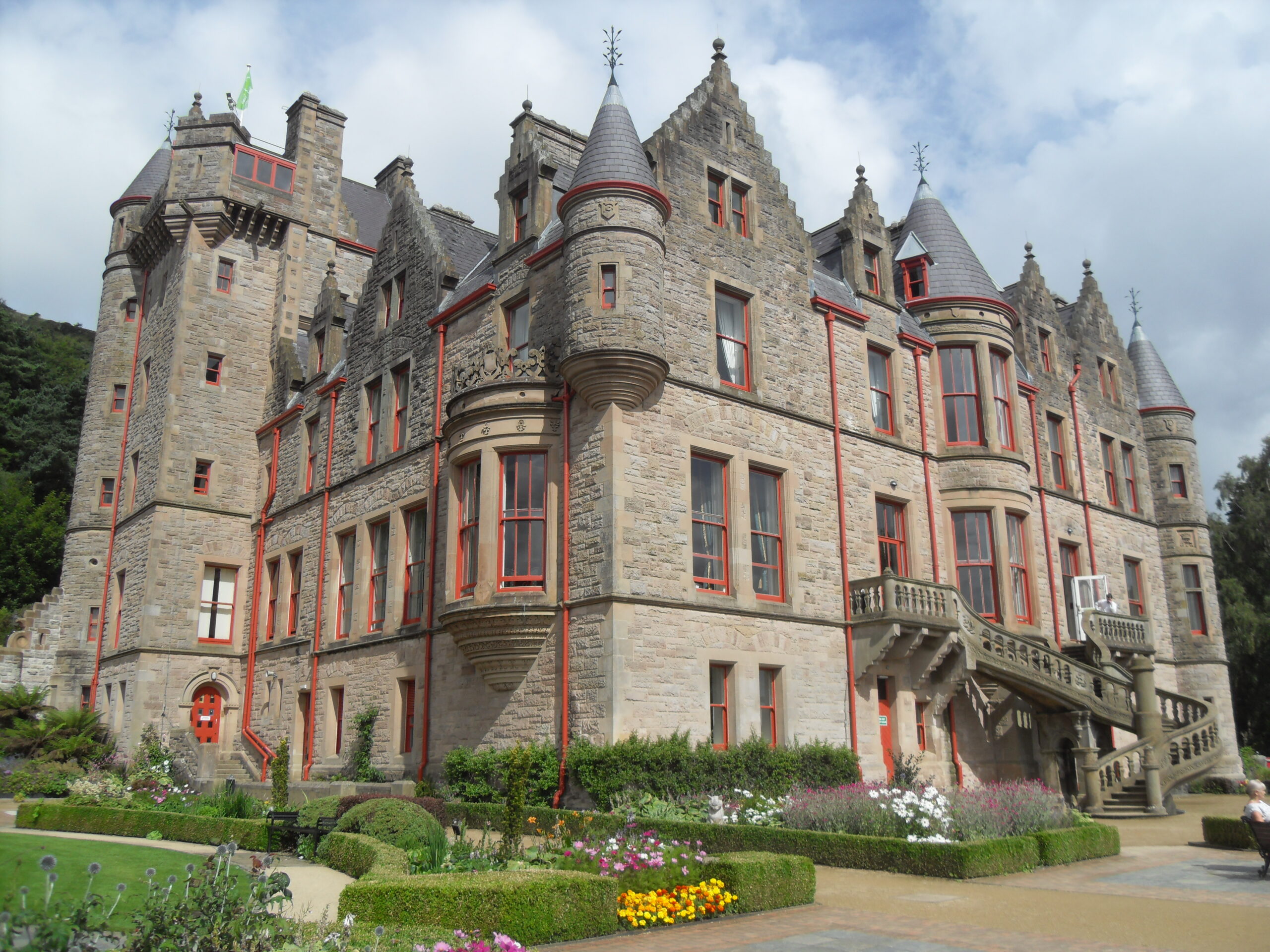
Anyone chasing the haunted Belfast Castle story runs into an awkward problem straight away: the building on Cave Hill is not the castle where the killing happened. Belfast Castle is a mansion in Cave Hill Country Park in Belfast, Northern Ireland, sitting in a prominent position 400 feet (120 m) above sea level with unobstructed views over the city and Belfast Lough. It is Victorian, it is Grade A listed, and it was built between 1867 and 1870. The blood, the massacre and the fatal fire all belong to earlier buildings of the same name, several miles away and several centuries earlier, on ground now buried under the city centre.
Belfast Castle at a Glance
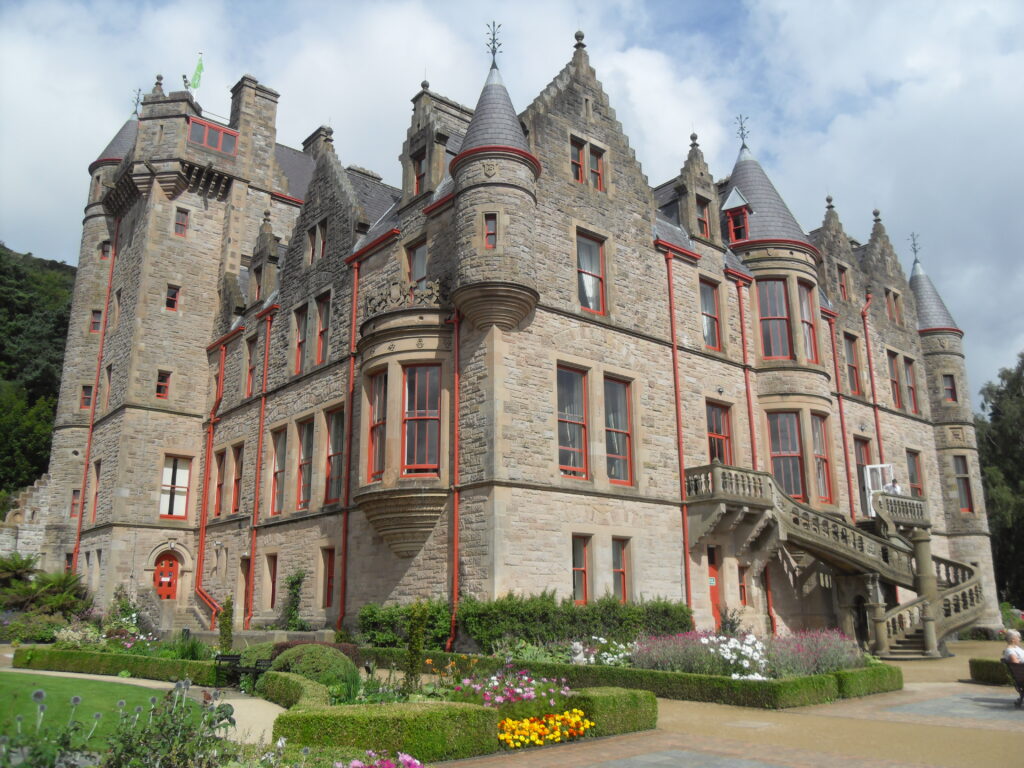
The present castle was built in the Scots Baronial style and designed by the Belfast firm of Lanyon, Lynn and Lanyon, though which partner actually drew it remains disputed. It is open to the public daily, with a visitor centre, an antique shop, the Millennium Herb Garden, a restaurant and a playground. The main entrance into the demesne is now where Innisfayle Park meets Downview Park West, just off the Antrim Road. Sir Charles Brett described the result as “a rugged and determined exercise in the fullness of the Scottish Baronial style, perched on a highly romantic site with a superb view”, which is about right.
Several Castles, One Borrowed Name
There have been several structures called Belfast Castle over the centuries, and not all of them stood on the same site. A castle had been erected at Béal Feirste by the 1220s, probably to guard the important ford across the River Lagan, and it was rebuilt repeatedly between the 1220s and the 1550s. That original castle stood in the area now bounded by Donegall Place, Castle Place, Cornmarket and Castle Lane, in the middle of what is today the city centre.
It was seized by a branch of the Uí Néill, who held it as one of the main residences of Clandeboye through the fifteenth and sixteenth centuries, and it changed hands violently and often. In 1476 Éinri mac Eoghain Ó Néill “attacked the castle of Belfast which he took and demolished”. In 1489 Aodh Ruadh Ó Domhnaill I “took and demolished the Castle of Belfast, and then returned safe to his house loaded with immense spoils”. The Earls of Kildare sacked it in 1503, again in 1512, and once more in 1523, after which the 9th Earl reported to Henry VIII: “I brake a castell of his, called Belfast, and burned 24 myle of his country”.
The Clandeboye Massacre of October 1574
This is the episode most often attached to the castle’s dark reputation, and unlike ghost lore it is a matter of record. In October 1574, during the Enterprise of Ulster, the 1st Earl of Essex and his retinue were invited to a feast at Belfast Castle by Sir Brian mac Feidhlimidh Ó Néill, Lord of Lower Clandeboye, to celebrate a newly signed peace agreement with the English Crown. After three days and nights of feasting inside the castle, the soldiers accompanying Essex set upon and killed most of Sir Brian’s family and retainers. Sir Brian himself survived the massacre. He, his wife and his brother were arrested and all three were executed in Dublin later that same year.
The violence did not stop there. In June 1597 the forces of Shane McBrian O’Neill overpowered the castle’s English garrison and summarily executed all the prisoners they captured. Sir John Chichester retook it the following month and reported that his men had “put those wee found in yt to the sworde”. Chichester himself was killed by the MacDonnells in November 1597 at Altfrackyn, where an English force lost 180 men, possibly by being beheaded during or immediately after the battle.
The Fire of 24 April 1708
Sir Arthur Chichester had the ruined castle largely rebuilt in brick in the early 1610s, almost certainly on the site of the Uí Néill towerhouse. That Plantation era building is the one that burned. On 24 April 1708 it accidentally caught fire and was destroyed, killing three sisters and one servant of the 4th Earl of Donegall. It was never rebuilt. The senior line of the Donegall family left Belfast afterwards and the head of the family would not live in the town again for almost a century, until the 2nd Marquess settled there in 1802.
If any part of the Belfast Castle legend deserves a reader’s attention, it is those four deaths. They are documented, they are specific, and they happened on a site now covered by shops and streets rather than at the mansion visitors actually walk into.
Lord Donegall’s Mansion on the Old Deer Park
The 3rd Marquess of Donegall sold off almost all of his family’s Belfast estate in the 1850s, and then, curiously, decided he wanted to live there. His new house went up in the 1860s on what had been the family’s deer park on the slopes of Cave Hill, then the northern outskirts of the town. He called it Belfast Castle in a nod to family history, although by that decade nothing of the earlier castles remained above ground.
It was built mainly between 1867 and 1870 in pink Scrabo sandstone from the north of County Down, with Giffnock sandstone dressings imported from Renfrewshire, all on a rock faced basalt plinth. Costs ran well over the £11,000 set aside, and Lord Donegall had to ask his son in law, Baron Ashley, for money to finish it. The winding stone staircase on the garden façade, greyish brown against the sandstone, came later: it was added for the 9th Earl of Shaftesbury in 1894, and its architect is unknown.
From Shaftesbury Family Home to City Property
The castle and estates passed to Lady Harriet Chichester and her husband in October 1883. He died in April 1886, and his sixteen year old son became the 9th Earl of Shaftesbury, who owned the castle longer than any other private owner. He became Lord Mayor of Belfast in 1907 and Chancellor of The Queen’s University of Belfast from 1909 to 1923, and he and his wife Constance regularly held fundraising events in the grounds. As the family’s Irish estates were broken up and sold under the Land Acts, the house became a financial burden, and he spent less time there after the First World War. He gifted the castle and its demesne to the City of Belfast in January 1934.
The city then argued about what to do with it. One early proposal was a tea and dance room, another a museum and art gallery, with plans for an open air theatre, clay pigeon shooting, archery, tennis courts, bowling greens, squash courts and mini golf in the grounds. A sub committee put the minimum cost at £160,000. Housing estates built in the 1950s and 1960s along the Antrim Road, including Innisfayle Park, Downview Park West and Strathmore Park, cut the demesne down sharply, and almost all of the demesne wall along the Antrim Road was demolished to make room for them. The castle closed in 1978 for restoration by Hewitt and Haslam, a project costing over £2 million, and reopened on Armistice Day, 11 November 1988. A further refurbishment followed in May 2003.
The Chapel of the Resurrection and Its Desecrated Graves
Built for the 3rd Marquess in the late 1860s at the same time as the castle, this Church of Ireland chapel was designed as a mortuary chapel and mausoleum, a memorial to Frederick Richard, Earl of Belfast, who had died in Naples aged 25 from scarlatina in February 1853. It seems to have been converted in 1891 into a family chapel for regular worship while remaining a mausoleum. The 9th Earl handed it to the Diocese of Down, Connor and Dromore in 1938.
Post war housing left the chapel marooned in the middle of the new estates, no longer part of the demesne. The last service was held in 1972. After it closed the building suffered extensive vandalism across four decades, with all of the glass in its windows removed or destroyed and the graves of the deceased inside desecrated. Derelict for almost fifty years, it was converted into luxury flats, with work completed in 2020, and is now called The Chapel, part of the Donegall Park Gardens development off Innisfayle Park. The Patrick McDowell marble sculpture that once stood inside, showing the dying Lord Belfast mourned by his lace capped mother, was moved to the foyer of Belfast City Hall after the chapel closed and remains there.
What the Record Actually Supports
Readers should know that the documented history used here records no apparitions, no witnessed phenomena and no named encounters at Belfast Castle. What it records instead is a long chain of real violence and real deaths attached to the earlier buildings that shared the name: a massacre at a feast in 1574, a garrison put to the sword in 1597, and four people killed by fire in 1708. Local ghost stories circulate around the mansion, as they do around most large Victorian houses with a fifteenth century back story, but nothing in this source verifies them. Anyone visiting in hope of a haunting is visiting a Victorian country house on the hill, not the castle where the killing took place.
Visiting the Castle and the Cavehill Visitor Centre
Belfast Castle is open to the public daily and free to walk into, with the Cavehill Visitor Centre inside the building. Visitors can see a bedroom set up in the style of the 1920s, presented as a snapshot of the house at the end of its life as a private residence. Many of the rooms are now public tea rooms or can be reserved for private functions, and the castle has been a popular venue for weddings, afternoon teas and business meetings since 1945. The former Main Gate Lodge on the Antrim Road, designed by John Lanyon in the Scots Baronial style and described by the architectural historian Dixie Dean as a “High Victorian Picturesque essay”, still stands but is now a dental practice surrounded by modern housing.
Address: Cave Hill Country Park, off the Antrim Road, Belfast, County Antrim
See Belfast Castle for Yourself
Sources
- Irish Castles – Belfast Castle
- Belfast Castle Estate – Belfast
- Belfast: The hidden castles under the city's shops
- Historic Building Details – Belfast Castle
- The history of the town of Belfast, with an accurate account of its former and present state: to which are added a statistical survey of the parish of Belfast and a description of some remarkable antiquities in its neighbourhood
- Wikipedia: Belfast Castle
Frequently Asked Questions
Where is Belfast Castle Cave Hill located?
Belfast Castle Cave Hill is located at Cave Hill Country Park, off the Antrim Road, Belfast, County Antrim.
Can you visit Belfast Castle Cave Hill?
Belfast Castle Cave Hill is open to the public. Always follow posted rules and respect private property.
Reader sightings
Nobody has reported anything here yet. If you have been, you would be the first.
Report your own visit to Three Sisters and a Fire: the Haunted Belfast Castle Story
How haunted is this place?
Be the first to rate
Ghost Tours Nearby

Affiliate links: BeyondHaunted may earn a commission, at no extra cost to you.
Leave a Reply