

Reviewed by Josh N · Updated October 15, 2026 · How we verify
Reported Phenomena
- Unexplained noises
- Shadow figures
- Spectral lights
- Sounds near graves
Reported by visitors & local legend. Stories, not verified claims.
Few American cities display their worst year as openly as this one. In 1692, nineteen people were executed by hanging on witchcraft convictions in Salem, Massachusetts, and one more, Giles Corey, was pressed to death under stones for refusing to plead innocent or guilty. Three centuries later the city has built a civic identity on that catastrophe. Haunted Salem is partly a tourism product, partly a working coastal city of about 44,000 people, and partly a handful of genuinely old buildings and burial grounds where visitors say they have heard and seen things they cannot explain. Sorting the three out is most of the work of a good visit.
Getting Your Bearings in Witch City
- Where: a coastal city in Essex County on the North Shore, with downtown about 15 miles northeast of Boston.
- Size: population 44,480 at the 2020 census.
- Founded: continuous English settlement began in 1626; Salem was incorporated as a city on March 23, 1836.
- The sites people come for: the Witch House, the Proctor’s Ledge memorial, Burying Point, the House of the Seven Gables, the Peabody Essex Museum, Salem Maritime National Historic Site and Pioneer Village.
- Busiest season: October, when the Haunted Happenings festival draws crowds that have topped a million visitors in peak periods.
- Getting there: Salem has a station on the MBTA Commuter Rail’s Newburyport/Rockport Line, and a seasonal ferry runs from Boston in 50 minutes between May and October.
Naumkeag, and the Settlement That Took Its Place
The peninsula was called Naumkeag long before it was Salem, and it was a major settlement for an Indigenous group whose territory ran from the Merrimack to the Mystic rivers. The contact period devastated them. A smallpox epidemic between 1617 and 1619 killed many of the Naumkeag, including the powerful sachem Nanepashemet, and a second epidemic in 1633 killed two of his successors and scarred his remaining heir, Wenepoykin. That collapse, more than anything else, is why English settlers met little resistance when they arrived.
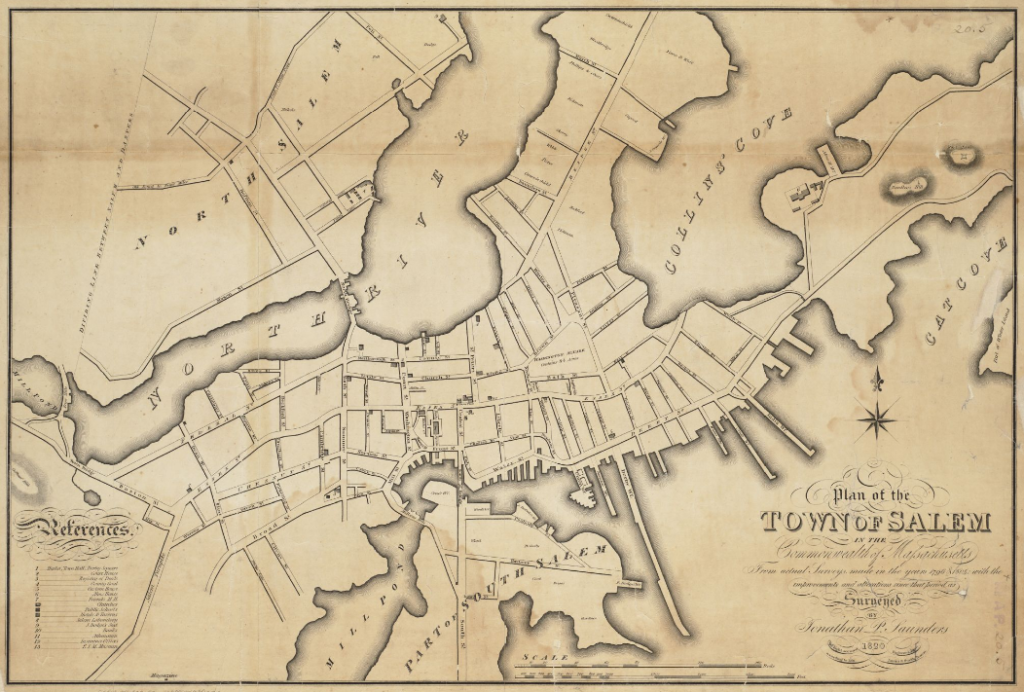
Those settlers were a company of fishermen who came from Cape Ann in 1626 under Roger Conant. Conant’s leadership carried them through the first two difficult years before the Massachusetts Bay Company sent John Endecott to replace him; Conant stepped aside and was granted 200 acres in compensation. The new name marked that peaceful handover. Salem is the hellenized form of Shalem, the royal city of Melchizedek, identified with Jerusalem.
What followed was not a backwater. Salem became one of the most significant seaports in early American history, the sixth-largest city in the country by 1790, and a world-famous name in the China Trade. On February 26, 1775, patriots raised the drawbridge at the North River to stop Colonel Alexander Leslie and 300 British troops from seizing hidden stores and ammunition, a standoff that ended without bloodshed weeks before Lexington and Concord. Prosperity left the fine Federal architecture that still lines Chestnut Street, much of it designed by Samuel McIntire. Some of that fabric was lost later: the Great Salem Fire of 1914 destroyed over 400 homes and left 3,500 families homeless, though it spared the Chestnut Street houses.
What the Record Actually Says About 1692
The accusations began with Abigail Williams, Betty Parris and their friends playing, in the language of the period, “with a Venus glase & an Egg” to learn what trade their future husbands would follow. From that small act of fortune-telling the crisis spread. Nineteen people were hanged on false accusations. Giles Corey, refusing to enter a plea, was pressed to death and so died an innocent man rather than a convicted one.
The judges were local men. Judge John Hathorne, son of the prominent early settler William Hathorne, is the best known of them and earned the name the “Hanging Judge” for sentencing accused witches to death. Salem’s legal record holds other grim firsts too, including the Dorothy Talbye trial, in which a mentally ill woman was hanged for murdering her daughter because Massachusetts law at the time drew no distinction between insanity and criminal behavior.
None of this is folklore. It is court record, and it is worth carrying with you past the gift shops.
Gallows Hill, Proctor’s Ledge, and a Site Corrected in 2016
For generations the top of Gallows Hill was assumed to be where the 1692 executions took place. In 2016 researchers identified a different spot, a site near the foot of the hill called Proctor’s Ledge, as the location of the public hangings. Gallows Hill is now a city park. The Ledge was made a memorial to the victims, intended, in the city’s own description, as a place of reflection.
It is a small, quiet site in a residential pocket of the city, and it is the single most historically grounded stop on any witch trials itinerary. Visitors looking for atmosphere sometimes find it underwhelming. Visitors looking for the actual ground tend to find it the opposite.
The Witch House, the Last Building That Saw the Trials
The Witch House, also called the Jonathan Corwin House and dating to roughly 1642, is the only structure standing in Salem with direct ties to the witch trials of 1692. Corwin was one of the magistrates who investigated the accusations. The house is owned and operated by the City of Salem as a historic house museum, and it sits within the Samuel McIntire Historic District among some of the oldest domestic buildings in the country.
It is also the building most often named when people talk about reported activity in Salem. Visitors have described unexplained noises and shadowy movement inside, and the stories attached to those experiences usually cast them as the accused rather than the accusers. Those accounts are anecdotal. The house’s documented connection to the trials is not, which is precisely why the two get tangled together so easily here.
Burying Point, the Pickman House and the Witch Trials Memorial
The Burying Point on Charter Street is the second oldest burying ground in the United States, and the c. 1664 Pickman House abuts both the cemetery and the witch trials memorial beside it. Between the leaning slate markers and the memorial benches, this is the most heavily walked ground in the city after Essex Street.
Reports from the cemetery tend toward lights and sounds: visitors describe spectral glimmers among the stones and noises with no obvious source. Again, these are visitor accounts rather than documented events, and a packed seventeenth-century graveyard at dusk in October is not a controlled environment. The history underfoot needs no embellishment.
Two Darker Corners Most Visitors Walk Past
The Gardner-Pingree House on Essex Street, built in 1804 by Samuel McIntire, was the home of Captain Joseph White, who was murdered inside it in 1830 by his nephew Stephen White. It remains one of the most notorious crimes in the city’s history and one of the handsomest buildings in New England, which is a very Salem combination.
A few blocks away, the Old Salem Jail was an active correctional facility until 1991. The main jail building dates to 1813 and was renovated in 1884, and the complex once held captured British soldiers from the War of 1812. After the jail was shuttered and the county government dissolved, the Commonwealth sold the property to the City of Salem for one dollar. Following a $12 million renovation completed in 2010, the complex was renamed 50 Saint Peter Street and is now private property containing private residences, so it is a look-from-the-sidewalk stop only.
How Salem Wears Its Reputation
The city does not hedge. Some Salem police cars carry witch logos, a public elementary school is named Witchcraft Heights, and the Salem High School teams are the Witches. There is a street called Witch Way and a bronze statue of Elizabeth Montgomery as Samantha from Bewitched, erected by TV Land in 2005 and argued over at the time by residents who felt public property was being used for commercial promotion. That debate has never really ended: some locals would rather the city market itself as an upscale cultural destination than as Witch City.
Pop culture keeps feeding the fire. Eight episodes of the seventh season of Bewitched were shot here in 1970 while the Hollywood set was repaired after a fire, Hocus Pocus was both set and filmed in Salem, and Rob Zombie’s The Lords of Salem was shot here in 2012. For horror fans, Count Orlok’s Nightmare Gallery is a dedicated horror film museum in the city.
Nathaniel Hawthorne, whose writing made the Salem area a fixture of American literature in the nineteenth century, was overseer of the port from 1846 until 1849 and worked in the Custom House near Pickering Wharf, the setting he used to open The Scarlet Letter. The 1668 House of the Seven Gables still stands and still draws a line at the door.
Planning a Visit to Salem
Most of what you came for is walkable. The Witch House, Burying Point, the Peabody Essex Museum, founded in 1799 and one of the oldest continuously operating museums in the country, and Salem Maritime National Historic Site, described as the only remaining intact waterfront from the American age of sail, all sit within a tight downtown. Pioneer Village at Forest River Park, created in 1930 as America’s first living-history museum, re-creates a Puritan settlement on three acres and is a short ride out. Proctor’s Ledge sits apart from the cluster and is worth the detour.
October is the hardest month to visit well. Haunted Happenings brings enormous crowds, and October traffic in and out of the city can be brutal. Coming by rail on the Newburyport/Rockport Line or by the seasonal Boston ferry saves a great deal of aggravation. Spring and early fall give you the same buildings with room to stand in front of them.
A closing note that matters in a city this crowded: several of the most atmospheric buildings here, including 50 Saint Peter Street, are private homes. Respect the property lines, respect the memorials at Proctor’s Ledge and Charter Street, and remember that the names carved there belong to people who were killed by their neighbors.
Sources
- U.S. Census Bureau QuickFacts (US Census Bureau)
- 2020 U.S. Gazetteer Files (Census (official))
- Essex | Massachusetts Bay, Salem, Ipswich | Britannica
- Peabody Essex Museum Collections
- Proctor's Ledge in Salem confirmed as witch execution site
- Wikipedia: Salem, Massachusetts
Frequently Asked Questions
Can you visit Salem?
Salem is open to the public. Always follow posted rules and respect private property.
Reader sightings
Nobody has reported anything here yet. If you have been, you would be the first.
Report your own visit to Witch City After Dark: A Visitor’s Guide to Haunted Salem
How haunted is this place?
Be the first to rate
Ghost Tours Nearby
 History and Hauntings of Salem Guided Walking Tourfrom $36
 Salem's Best Ghost Tourfrom $24
 The Official "Hocus Pocus" Movie Locations Tour of Salemfrom $50
Affiliate links: BeyondHaunted may earn a commission, at no extra cost to you.
Leave a Reply