
Reviewed by Josh N · Updated October 5, 2026 · How we verify
Reported Phenomena
- Phantom cat on stairs
- Brushing against legs
- Shadowy figures on beach
- Whispers near the surf
- Gray Man before storms
Reported by visitors & local legend. Stories, not verified claims.
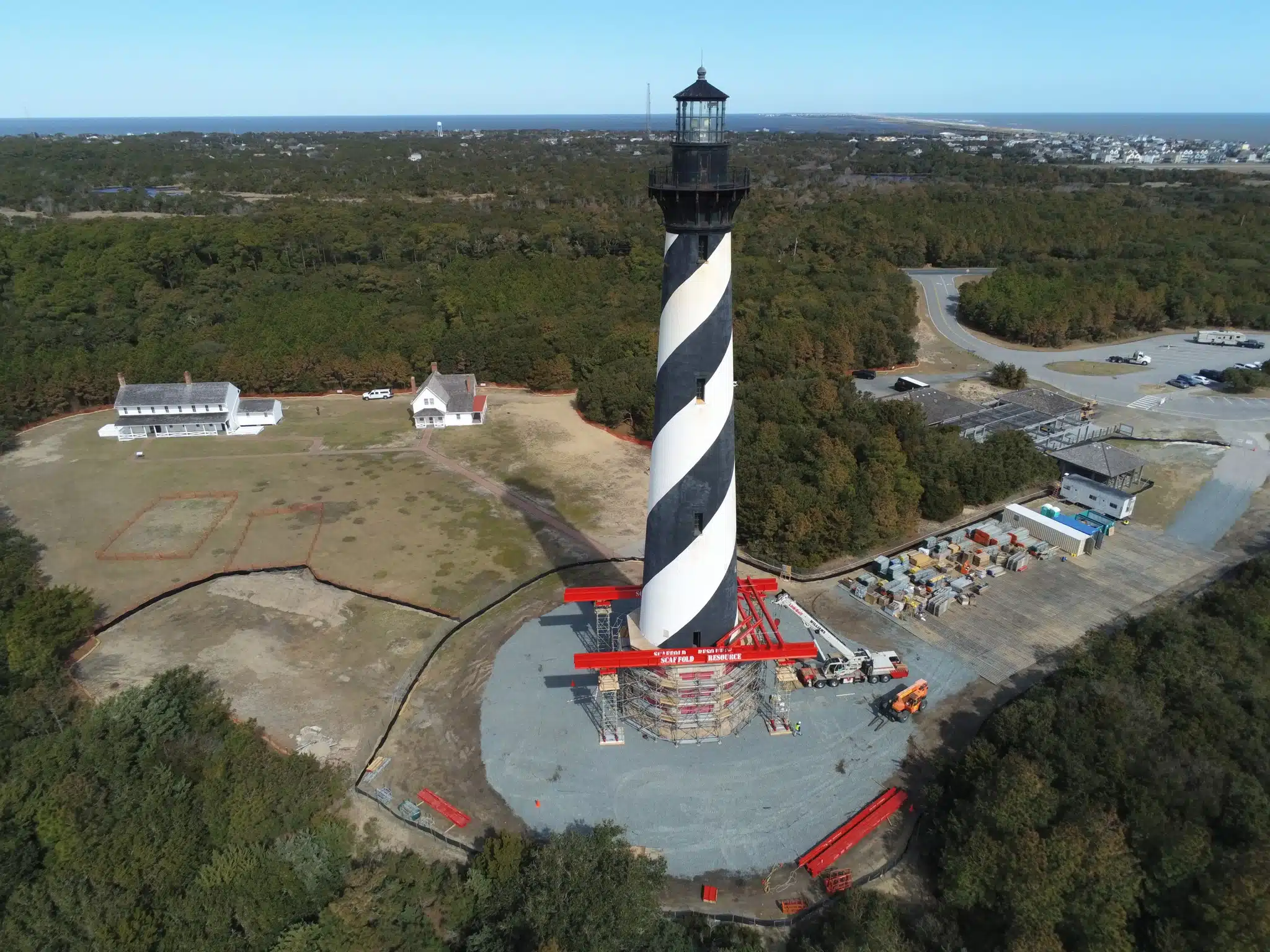
Few American landmarks are as instantly recognizable as the Cape Hatteras Lighthouse, the black-and-white spiral tower standing on the Outer Banks of North Carolina. It is the tallest brick lighthouse in the United States at 198 feet, and it was built for one job: to keep ships off Diamond Shoals, the shifting underwater sandbars that lie offshore and have sunk so many vessels that this stretch of coast earned the name the Graveyard of the Atlantic. The lighthouse’s documented history is dramatic enough on its own. The ghost stories attached to it are folklore, and the difference is worth holding onto as you read.
What to Know Before You Drive to Buxton
- Height: 198 feet, the tallest brick lighthouse in the country.
- Steps to the top: 257, when climbing is permitted.
- Managed by: the National Park Service, as part of Cape Hatteras National Seashore.
- Grounds: open daily, year-round.
- Climbing season: typically April through October, with closures for restoration work.
Two Towers Against Diamond Shoals
The first lighthouse on this site was completed in 1803 and stood 90 feet tall. That was not enough. Diamond Shoals is not a fixed hazard but a moving one, a series of sandbars that rearrange themselves with current and storm, and mariners needed a light they could trust from a long way out.
A second, taller tower was finished in 1870. This is the structure visitors see today, and it carries the feature that makes it famous: the spiral black-and-white daymark, often called the barber pole. The pattern is not decoration. Lighthouses need to be identifiable in daylight as well as after dark, and the spiral told a captain exactly which point of the Outer Banks he was looking at. A light that cannot be distinguished from the next light down the coast is close to useless.
Moving 198 Feet of Brick, 2,900 Feet Inland
The Atlantic that the lighthouse was built to watch eventually came for it. By the late 20th century, erosion had carried the surf dangerously near the base of the tower, and the choice narrowed to losing the lighthouse or moving it.
In 1999, engineers moved the entire structure 2,900 feet inland, one of the most ambitious relocation projects ever attempted on a building of its size and material. Brick towers are not designed to travel. The fact that this one arrived intact is the reason you can still stand at its base, and it is the single most impressive thing about the site that has nothing to do with ghosts.
The Cat on the Stairs, and Other Outer Banks Lore
The stories below are folklore. None of them is a documented event, and the National Park Service presents the lighthouse as a maritime and engineering landmark, not a haunted one. They circulate through ghost tours and through locals who enjoy keeping them in rotation, which is how coastal legends usually survive.
The ghost cat. The most repeated tale involves a black-and-white cat said to have belonged to a lighthouse keeper. Visitors have described the unmistakable brush of an animal against their legs on the stairs and looked down to find nothing there. Others claim to have glimpsed the cat on the steps, appearing and vanishing without explanation. There is a neat symmetry to the story that may explain its staying power: a black-and-white animal haunting a black-and-white tower.
Shipwrecked spirits. With centuries of wrecks offshore, it is not surprising that some residents believe drowned sailors still walk the beaches. Reports attached to this belief are vague by nature: shadowy figures near the surf, whispers under the sound of the waves. The Graveyard of the Atlantic supplies more than enough real tragedy to feed the legend.
The Gray Man. Described as a hazy figure seen along the dunes before storms, the Gray Man is said to serve as a warning to residents and travelers rather than a threat to them. He is a protective apparition, which is a recurring character type along the southeastern coast, and here he is folded into Outer Banks storytelling alongside the lighthouse itself.
Climbing the Cape Hatteras Lighthouse
The climb is 257 steps, normally available between spring and early fall. Check National Park Service updates before you travel, because restoration work has paused climbing in the past and the climbing season is not guaranteed in any given year.
The keeper’s quarters now serve as a visitor center and museum, with maritime and lighthouse exhibits, so there is something to see even when the tower itself is closed. The grounds, the beaches, and the nearby trails are open regardless and give you the coastline views that brought most people out to Buxton in the first place.
One practical note for anyone hoping to look for the cat: this is federal parkland with posted hours, and after-dark access is not part of the deal. Stay on the grounds when they are open, respect closures, and treat the site as what the record says it is, a working monument to the Graveyard of the Atlantic that happens to carry a few good stories.
Address: 46379 Lighthouse Road
Frequently Asked Questions
Where is Cape Hatteras Lighthouse History Legends And Hauntings located?
Cape Hatteras Lighthouse History Legends And Hauntings is located at 46379 Lighthouse Road.
Can you visit Cape Hatteras Lighthouse History Legends And Hauntings?
Cape Hatteras Lighthouse History Legends And Hauntings is open to the public. Always follow posted rules and respect private property.
Reader sightings
Nobody has reported anything here yet. If you have been, you would be the first.
Report your own visit to The Ghost Cat on the Stairs: Cape Hatteras Lighthouse
How haunted is this place?
Be the first to rate
Ghost Tours Nearby
 OBX Ghost Tours: Lighthouse Wraiths & Dune Shadows of Manteofrom $26
 OBX Ghost Tours- The Original Ghost Tour of the Outer Banksfrom $25
Affiliate links: BeyondHaunted may earn a commission, at no extra cost to you.
Leave a Reply