
Reviewed by Josh N · Updated August 4, 2026 · How we verify
Reported Phenomena
- Reported apparitions
- Entombed workers legend
- Uneasy interior galleries
- Suicide site lore
- Drowned town
Reported by visitors & local legend. Stories, not verified claims.
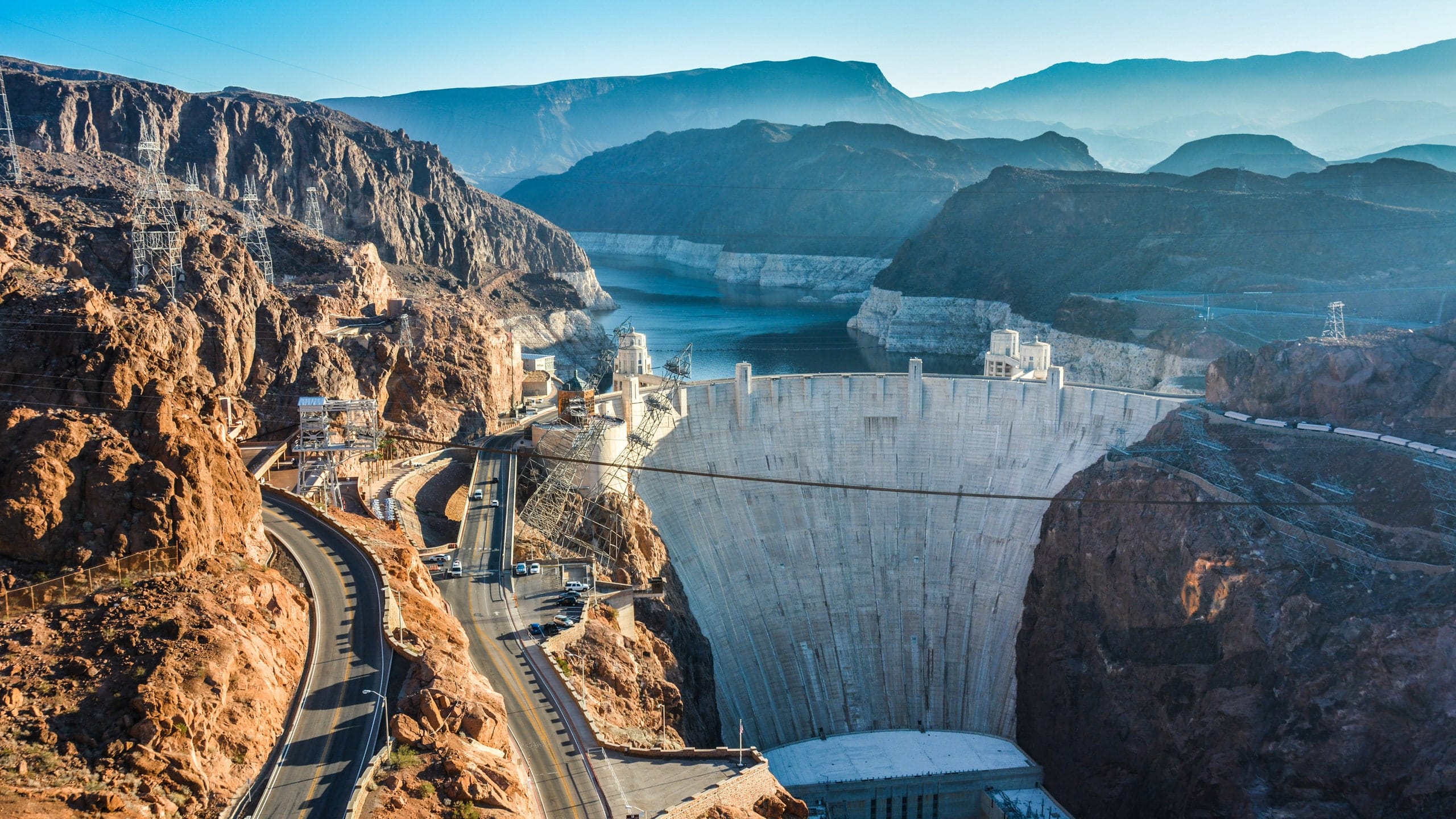
Most Hoover Dam ghost stories begin with a number rather than an apparition. The concrete arch-gravity dam that plugs the Black Canyon of the Colorado River, on the line between Nevada and Arizona, killed 112 people on the official reckoning, and the arithmetic of that toll has fed decades of rumour: that men fell into the pour and are still standing upright inside the wall, that the tunnels swallowed workers whose deaths were quietly reclassified, that the parapet has drawn the desperate ever since. Some of that is documented fact. Some of it is provably false. Sorting one from the other is the most interesting thing you can do on the tour.
Quick Facts on the Dam in Black Canyon
- Where: Black Canyon of the Colorado River, on the Nevada and Arizona boundary, near Boulder City, Nevada, roughly 30 miles southeast of Las Vegas.
- Built: 1931 to 1936. Dedicated by President Franklin D. Roosevelt on September 30, 1935, and formally handed to the federal government on March 1, 1936, more than two years ahead of schedule.
- Builder: Six Companies, Inc., a joint venture whose winning bid of $48,890,955 came within $24,000 of the confidential government estimate.
- Recorded construction deaths: 112 on the official list, with a further 42 recorded as pneumonia and excluded from it.
- Status: Guided tours run by the Bureau of Reclamation, plus a visitor centre. Through traffic across the crest ended in 2010.
- Recognition: National Register of Historic Places, 1981. National Historic Landmark, 1985.
Why Anyone Dammed the Colorado Here
The river had been eyed since the 1890s, when land speculator William Beatty cut the Alamo Canal toward the tract he named the Imperial Valley. That scheme ended badly: a catastrophic breach sent the Colorado into the Salton Sea, and the Southern Pacific Railroad spent $3 million in 1906 and 1907 stabilising the waterway. In 1902 the Edison Electric Company of Los Angeles surveyed the river hoping to build a 40 foot rock dam, then let its land options lapse, including the option on the ground where Hoover Dam now stands, because power could not be transmitted more than 80 miles.
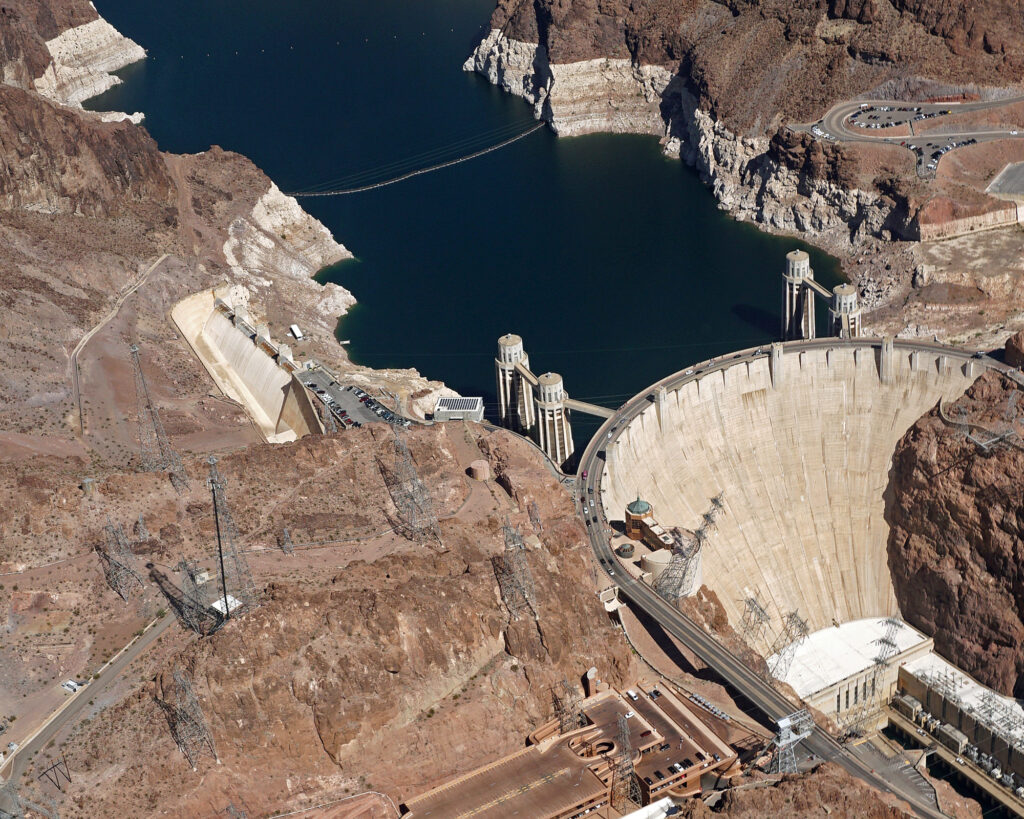
The Bureau of Reclamation’s 1922 Fall-Davis report called for a dam “at or near Boulder Canyon”, but that canyon turned out to be bisected by a geologic fault and too narrow for a construction camp. Black Canyon was chosen instead, though the scheme kept the name Boulder Canyon Project. Congress authorised it on December 21, 1928, after the 1927 Mississippi flood softened opposition and after the collapse of the St. Francis Dam in Los Angeles, which killed up to 600 people, hardened it again. The review board that examined the plans was blunt about the stakes: if the dam failed, every downstream community on the Colorado would be destroyed, so the structure “should be constructed on conservative if not ultra-conservative lines.”
Ragtown, the High Scalers, and a Summer at 119 Degrees
Depression unemployment did the rest. Las Vegas, a city of some 5,000, saw between 10,000 and 20,000 jobless people arrive. A squatters’ camp called McKeeversville grew up around the government survey camp, and a second settlement on the river flats, officially Williamsville, was known to everyone who lived there as Ragtown. Six Companies had more than 3,000 on the payroll by 1932 and peaked at 5,251 in July 1934, so the great majority of the men who came never got a job. The contract barred Chinese labour outright, and the number of Black workers Six Companies employed never exceeded thirty, kept in a segregated crew on the lowest pay scale and issued separate water buckets.
The heat is not folklore. President Hoover ordered work to start in March 1931 rather than October, before Boulder City existed, and the summer that followed had a daytime high averaging 119.9 degrees Fahrenheit. Between June 25 and July 26, 1931, sixteen workers and riverbank residents died of heat prostration. When wages for tunnel workers were cut that August, the men organised, and general superintendent Frank Crowe answered by shutting the job down and laying off almost the entire workforce with an order to be off the premises by 5 p.m. The strike collapsed within a week for nothing but a promise of no further cuts.
The most photographed workers were the high scalers, who hung from ropes on the canyon walls and stripped away loose rock with jackhammers and dynamite. Falling objects were the single most common cause of death on the site, so their job was itself a safety measure. Some of them dipped cloth hats in tar and let them harden; men struck hard enough to break their jaws walked away with their skulls intact, and Six Companies ordered thousands of what were first called “hard boiled hats”. One high scaler caught a government inspector who had lost his grip on a safety line and pulled him back into the air.
The 112 Names, and the 42 That Were Left Off
The official fatality list is where the dam’s reputation comes from, and it is worth reading closely. The first death was Bureau of Reclamation employee Harold Connelly, who fell from a barge on May 15, 1921, while surveying for a dam site. The second was surveyor John Gregory Tierney, drowned in a flash flood on December 20, 1922. The last name on the list belongs to Patrick Tierney, electrician’s helper and J.G. Tierney’s son, who fell from one of the Arizona-side intake towers on December 20, 1935: father and son, thirteen years apart, to the day. It is coincidence rather than curse, but it is the kind of coincidence that keeps a legend alive.
Ninety-six of the deaths happened at the site. Three men on the list took their own lives there, one in 1932 and two in 1933. And 42 more deaths were recorded as pneumonia and kept off the tally altogether. Workers alleged that the diagnosis was cover for carbon monoxide poisoning, caused by running gasoline-fuelled vehicles inside diversion tunnels that frequently reached 140 degrees Fahrenheit and filled with exhaust, and that the classification let Six Companies avoid paying compensation claims. Notably, no non-worker in Boulder City died of pneumonia during the construction period. Nobody was ever listed as dying of carbon monoxide.
No One Is Standing Inside the Concrete
The most durable Hoover Dam legend is the least likely. Concrete went in as columns of blocks poured from steel buckets that held eight cubic yards, and each bucket raised the level in a form by roughly one inch. A body could not have been lost in that, and Six Companies engineers would not have tolerated the flaw. Uneven cooling was the real fear: engineers calculated that a single continuous pour would have taken 125 years to cure and would have cracked the dam apart, so more than 582 miles of pipe were embedded in the concrete to run first river water and then refrigerated water through it. Cores taken in 1995 showed the concrete has continued to gain strength.
Two other threads feed the lore. The dam and Lake Mead have long attracted people intent on jumping from the crest, and a figure of roughly a hundred such deaths circulates locally; it is a repeated claim rather than a published official count, and it belongs to no construction-era record. And beneath the reservoir lies St. Thomas, Nevada, a town drowned when Lake Mead filled and re-exposed in recent years as water levels dropped. Lake Mead hit a record low of 1,071.55 feet in June 2021, and the reappearance of foundations and streets in the mud has done more for the area’s ghost-town atmosphere than any single reported sighting at the dam itself.
What People Report at the Dam
Set beside the volume of visitors, the dam produces remarkably few specific ghost accounts. There are scattered reports of apparitions from tourists and staff, an uneasy feeling in the long interior galleries, and the persistent conviction among some visitors that the men who died here are physically present in the structure. What there is not, and this matters if you are travelling for the paranormal rather than the engineering, is a canon of named spirits, room numbers, or documented investigations. The haunting attached to Hoover Dam is a haunting of scale and of record keeping: 112 names on a plaque, 42 more that never made it there, and a myth about bodies in the wall that the pour method rules out.
Taking the Tour at Hoover Dam
The dam opened to tours in 1937, closed to the public after the attack on Pearl Harbor, reopened on September 2, 1945, and closed again on September 11, 2001. Modified tours resumed that December and a “Discovery Tour” was added the following year. Around 7 million people visit annually and nearly a million take the Bureau of Reclamation tours. Tickets are sold on site only, with the choice of a guided tour of the whole facility or the power plant alone; the visitor centre is the only self-guided option, with exhibits and a 360 degree view over the canyon.
Bring an eye for the Art Deco. Los Angeles architect Gordon B. Kaufmann was brought in to replace a Gothic balustrade and eagle statues with sculpted turrets and the intake tower clocks, one set for Nevada time and one for Arizona. Denver artist Allen Tupper True designed the walls and floors using Navajo and Pueblo motifs of rain, lightning, serpents and stepped mesas, though security restrictions now keep visitors out of most interior spaces and few of True’s decorations can still be seen. Oskar J. W. Hansen’s dedication plaza on the Nevada abutment holds the 30 foot bronze Winged Figures of the Republic, a terrazzo star map fixing the sky at the moment of Roosevelt’s dedication, and the plaque memorialising the workers killed building it.
Through traffic no longer crosses the crest. The four-lane Hoover Dam Bypass and its Mike O’Callaghan-Pat Tillman Memorial Bridge opened on October 19, 2010, 1,500 feet downstream, and dam visitors now approach from the Nevada side and cross to the Arizona parking lots. One last piece of trivia for the drive in: the dam was called Boulder Dam officially from 1933 to 1947 after Interior Secretary Harold Ickes tried to strip Herbert Hoover’s name from it, saying “Boulder Dam” five times in thirty seconds at the dedication. Congress restored the name Hoover Dam unanimously in 1947.
See Hoover Dam for Yourself
Sources
- What you need to know about Lake Mead's falling water levels
- Construction of Hoover Dam
- Nevada and Arizona: Hoover Dam (U.S. National Park Service)
- Sharing Colorado River Water: History, Public Policy and the Colorado River Compact (Arizona (official site))
- Impacts of the 1928 St. Francis Dam Failure on Geology, Civil Engineering, and America
- Wikipedia: Hoover Dam
Frequently Asked Questions
Can you visit Hoover Dam?
Hoover Dam is accessible by guided tour only. Always follow posted rules and respect private property.
Reader sightings
Nobody has reported anything here yet. If you have been, you would be the first.
Report your own visit to No Bodies in the Concrete: Hoover Dam Ghost Stories
How haunted is this place?
Be the first to rate
Leave a Reply