
Reviewed by Josh N · Updated August 10, 2026 · How we verify
Reported Phenomena
- Headless phantom bushwhacker
- Cursed tree
- Vengeful revenant
- Unburied dead
Reported by visitors & local legend. Stories, not verified claims.
The Avilla Death Tree story is unusual among American ghost legends because the grisly detail at its centre is not folklore at all: it is in the written history of this small Jasper County village in Missouri. A rebel bushwhacker’s skull really was hung from a tree limb here, beside a road, for over a year. What came afterwards, the headless phantom said to walk the roadsides looking for it, belongs firmly to legend.
Avilla is a rural village of 103 people as of the 2020 census, ten miles east of Carthage on MO Route 96, which older maps and older residents still know as U.S. Route 66. It is the fourth-oldest settlement in Jasper County, founded in 1856 and platted for public use on 23 July 1858 by Andrew L. Love and David S. Holman. The land was Osage hunting ground before that, with camps recorded at nearby Spring River.
A Union Village Ringed by the Confederacy
Understanding the legend requires understanding how exposed Avilla was in 1861. The town’s leaders were Unconditional Unionists in a border state that was tearing itself apart. Neighbouring Sarcoxie raised the first regional Confederate flag; the Stars and Bars flew over Carthage after the Confederate victory at the Battle of Carthage on 5 July 1861; and on 28 October that year Governor Claiborne Fox Jackson met the Missouri General Assembly at Neosho and declared Missouri the twelfth state of the Confederacy. In spite of being engulfed by the Confederacy, the United States flag continued to fly over Avilla, hoisted on a flagpole in the town centre park and guarded by the townsmen.
Dr Jaquillian M. Stemmons had arrived with his family in 1853 as the first physician to practise medicine in the area, working from a 400 acre farm. In 1861 he organised a company of local men, the “Avilla Home Guard”, made up predominantly of the oldest citizens because the younger men had left for regular military service. Local secessionists opposed it, and it was rumoured that a price had been placed on the doctor’s head.
The Night the Stemmons Cabin Burned
After nightfall on 8 March 1862, a force of over a hundred pro-Confederate guerrillas, believed to have been led by William T. Anderson, struck northeast of Avilla, routed the perimeter sentries and engaged defenders at the Stemmons home. Around 25 town militiamen were inside, along with men from Carthage attending a meeting about a county-wide patrol and a Union cavalry recruiting officer, Captain Tanner. The attackers eventually set the two-storey log home alight and it burned to the ground. Dr Stemmons and militiaman Lathan Duncan were killed, several others were shot and burned, and two men were taken prisoner. The surviving militia scattered in the darkness, re-formed at the north edge of town and braced for a second assault that never came.
The reprisals ran on for years. Humphrey Robinson, one of the men named among the defenders, was abducted from his Lawrence County farm by bushwhackers in 1864 and never seen again. By 1863 the Enrolled Missouri Militia was garrisoned in the village under Major Morgan, and the place became known informally as “Camp Avilla”.
The Skull in the Dunlap Apple Orchard
The attack backfired. The town went from defence to offence, and the surrounding countryside became dangerous for irregulars. In one recorded account, a rebel’s skeleton was found just south of town with a bullet hole in the skull, and his name was never identified. He had apparently been killed in an earlier skirmish with militiamen, his remains only discovered when they were far gone. The skull was then hung from what became known as the “Death Tree” in Avilla, suspended from a limb for over a year near the road at the Dunlap apple orchard, explicitly as a warning to other bushwhackers.
That is where the documented history stops. The sources do not record what became of the skull, and they do not identify the tree that survives, if any does.
What People Say About Rotten Johnny Reb
The legend built on top of that account is known as the “Avilla Phantom Bushwhacker” or the “Death Tree Legend”, and the ghost is nicknamed “Rotten Johnny Reb”. As the story is told, the dead guerrilla’s remains were never properly buried, and the tree that held his skull was left charged with dark or evil energy. In one version the phantom is not only searching for his missing head but seeking vengeance on the townspeople. These are reported hauntings and folklore, passed down locally, not verified events, and no specific witness accounts appear in the historical record used here.
The 1932 Robbery That Reached the Supreme Court
Avilla’s other dark chapter is a matter of court record rather than rumour. The Bank of Avilla, established on 18 September 1914 with the building completed in 1915, was robbed at gunpoint on 18 May 1932 by members of the “Irish O’Malley Gang”, who also kidnapped cashier Ivy E. Russell and threw him out of a car by the roadside toward Carthage. One of the culprits, a sawed-off shotgun-wielding gangster named Jack Miller, drove the getaway car. In 1938 Miller and Frank Layton were stopped by police in Arkansas and charged under the 1934 National Firearms Act because of that shotgun, producing the landmark Second Amendment case United States v. Miller. Miller was murdered a month before the decision came down; his bullet-riddled body was found on the bank of Spencer Creek in Rogers County, Oklahoma. Local lore, unproven, adds that Clyde Barrow once walked into the bank, saw Russell’s holstered.45 behind the teller window, tipped his hat and left.
Driving Into Avilla Today
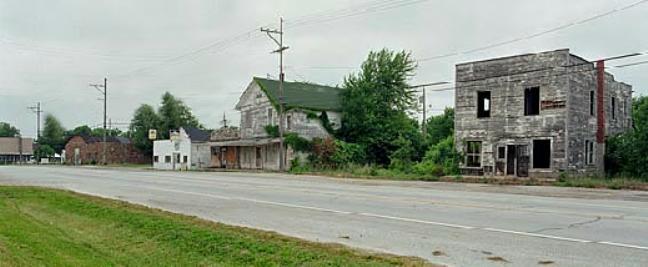
Avilla is a public village and freely accessible, but manage expectations. It boomed during Reconstruction while Carthage and Sarcoxie rebuilt, then stalled because the railroad was never built through it. The 1960s bypassing of Route 66 by Interstate 44 finished off most of what remained, a 1971 fire destroyed much of the lumberyard, the Boy Scout hall and some homes, and Route 66 through town was redesignated MO Route 96 in 1985. It is now counted among the living “ghost towns of old Route 66”, never fully abandoned and still holding village status.
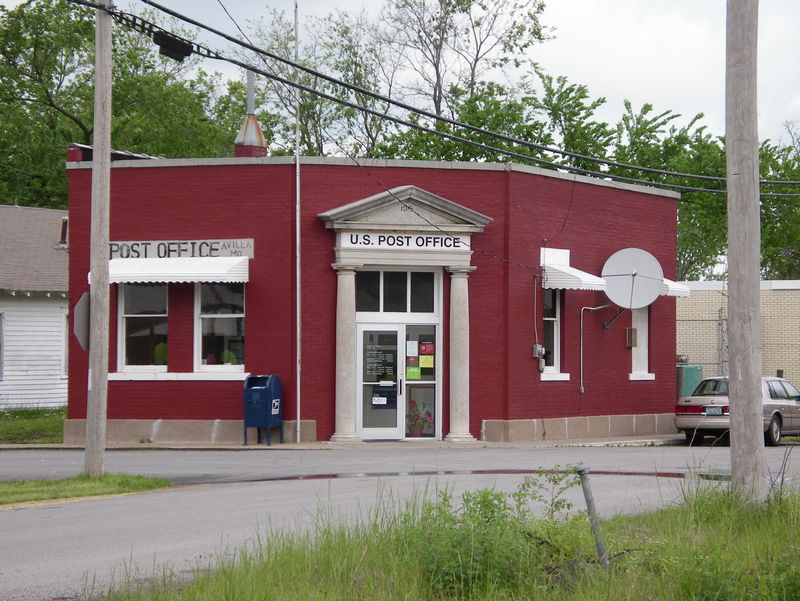
What survives is worth the detour for anyone tracing the Mother Road: the 19th-century Avilla (United) Methodist Church in the northeast part of town, the first church established here; the Civil War-era Stemmons and Rives mercantile building near the old park at the west entrance; and the 1915 bank building, listed on the National Register of Historic Places in 2022, still fitted with its old teller windows, vault and vintage postal equipment while serving as the village post office. Everything else is farmland, pasture and vacant lots where a town of several hundred once stood.
Address: Avilla, Jasper County, Missouri
See Avilla for Yourself
Sources
- ArcGIS REST Services Directory (Census (official))
- U.S. Census website (US Census Bureau)
- Explore Census Data (Census (official))
- Two Girls Held in Bank Robbery
- Bank of Avilla building in Avilla, Missouri, added to National Register of Historic Places
- Wikipedia: Avilla, Missouri
Frequently Asked Questions
Where is Avilla Death Tree Legend located?
Avilla Death Tree Legend is located at Avilla, Jasper County, Missouri.
Can you visit Avilla Death Tree Legend?
Avilla Death Tree Legend is open to the public. Always follow posted rules and respect private property.
Reader sightings
Nobody has reported anything here yet. If you have been, you would be the first.
Report your own visit to Rotten Johnny Reb and the Avilla Death Tree
How haunted is this place?
Be the first to rate
Ghost Tours Nearby

Affiliate links: BeyondHaunted may earn a commission, at no extra cost to you.
Leave a Reply