
Reviewed by Josh N · Updated August 26, 2026 · How we verify
Reported Phenomena
- Spectral caretaker apparition
- Death premonition vision
- Mismatched step counts
- Disembodied counting voices
- Unseen pushing force
- Rooted in place sensation
Reported by visitors & local legend. Stories, not verified claims.
Indiana keeps some of its best-known folklore at the end of gravel roads, and the 100 Step Cemetery is one of them. It sits off North County Road 675 West, on a wooded rise reached by a staircase, with weathered markers on the crest dating back to the 1860s. The burial ground takes its name from that climb, and almost every story told about the place depends on it. Very little of what circulates about the cemetery is documented history. Most of it is a dare with rules attached.
What the Hill Itself Can Tell You
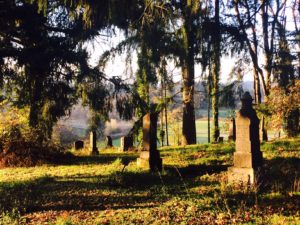
The cemetery’s recorded history reaches back to the Civil War era, and the oldest stones visitors find on the crest carry dates from the 1860s. That places its founding in the middle of a decade when small rural Indiana communities were burying men who had left for the war and civilians who never went anywhere at all. There is no single catastrophe attached to the ground, no fire, no epidemic, no famous name. It is a country burial ground of a type that exists by the hundreds across the Midwest, distinguished mostly by its siting: elevated, set back from the road, and approached by a flight of steps rather than a level path.
That geography matters more than any single grave here. Cemeteries built on a rise required an approach, and the approach is what turned this one into a legend. Visitors describe the climb as the part that stays with them, the sense of leaving a modern road behind and arriving somewhere that belongs to the 1860s.
The Caretaker and the Rule of the Count
The story that made the cemetery famous concerns a caretaker who is said to appear to people who climb the steps after dark. In the telling, the visitor is supposed to count each step on the way up. If the caretaker shows himself, he shows the visitor the manner and timing of their own death.
The test comes on the way back down. Count the steps a second time, so the legend goes, and if the two numbers match, the vision is binding. If the counts disagree, the prophecy fails. That single mechanism explains the rest of the folklore attached to the place, because everything else in the legend exists to interfere with the count. Some versions have the final step opening into nothing beneath the foot. Others describe disembodied voices calling numbers out of sequence during the descent, muddling the tally and, depending on how you read it, either cheating the visitor of an answer or saving their life.
None of this is verifiable, and it should be read as folklore rather than testimony. The caretaker has no name in the stories, no documented burial, and no death date. What the legend does have is an unusual internal logic, which is probably why it has outlasted plainer ghost stories from the same part of the state.
What Visitors Report on the Steps
Separate from the caretaker legend, people who have made the climb describe experiences that are more mundane in shape and harder to pin down:
- A physical resistance on the stairway, described as an unseen force pushing back against anyone trying to ascend around midnight
- A sensation of being rooted in place partway up, unable to move forward or back
- Whispering heard on the steps and among the older markers, sometimes reported as counting
- Apparitions of a figure taken to be the caretaker, generally reported only at night
These are accounts, not findings. A steep flight of steps at night, in a dark rural setting, with a story already in the visitor’s head, is close to ideal conditions for the mind to supply what it expects. That does not make the reports dishonest. It does mean they are best treated as reported experiences rather than evidence of anything.
Sixty Steps and a Legend Built for a Hundred
The staircase visitors climb today is not the one the legend was built around. The original flight was replaced with a shorter, roughly sixty step version for safety reasons, which leaves the folklore in an awkward position. The whole ritual depends on counting, and the count has changed. Local storytellers have gone in both directions on this: either the caretaker keeps his appointments regardless of the carpentry, or the legend was tied to the original hundred steps and quietly ended when they came out. It is a rare case of a ghost story with an infrastructure problem.
Visiting the 100 Step Cemetery
This is a working rural burial ground on a county road, not an attraction, and the graves on the crest belong to families with descendants nearby. Daylight visits are the sensible choice: the setting is remote, the stones from the 1860s are fragile, and the stairway is the reason the old one was replaced. Treat the site as you would any small country cemetery. Stay on the steps and paths, leave the markers alone, take nothing, and observe any posted hours or restrictions rather than assuming a legend grants access after dark. The story survives just as well told at the bottom of the stairs.
See 100 step Cemetery for Yourself
Sources
- Annual Park Ranking Report for Recreation Visits in: 2022 (Nps (official))
- The Story Behind Indiana's First National Park
- City West: Lost Metropolis of the Indiana Dunes
- The Ecological Relations of the Vegetation on the Sand Dunes of Lake Michigan. Part I.-Geographical Relations of the Dune Floras
- Indiana Dunes National Park (U.S. National Park Service)
- Wikipedia: Indiana Dunes National Park
Address: N County Road 675 W
Frequently Asked Questions
Where is 100 Step Cemetery located?
100 Step Cemetery is located at N County Road 675 W.
Can you visit 100 Step Cemetery?
100 Step Cemetery is open to the public. Always follow posted rules and respect private property.
Reader sightings
Nobody has reported anything here yet. If you have been, you would be the first.
Report your own visit to The Step You Cannot Count: Indiana’s 100 Step Cemetery
How haunted is this place?
Be the first to rate
Nearby Haunted Locations
- 1Haunted Highland Lawn Cemetery in Terre Haute, IndianaIndiana6.4mi
- 2Vigo County Historical MuseumIndiana9.3mi
- 3Inside Haunted Ashmore Estates, the Coles County AlmshouseIllinois42mi
- 4Honk Your HornIndiana47mi
- 5The Woman in White at the James Allison Mansion, IndianapolisIndiana59mi
- 6Seven SteeplesIndiana59mi


Leave a Reply