

Reviewed by Josh N · Updated October 1, 2026 · How we verify
Reported Phenomena
- Phantom hitchhiker
- Vanishing falling figures
- Disembodied voices
- Unexplained humming
- Foghorn tones in fog
Reported by visitors & local legend. Stories, not verified claims.
Stories about Golden Gate Bridge ghosts do not begin with a creaking staircase or a locked attic. They begin with fog, a one-mile strait in California with water 372 feet deep at the center of the channel, and a structure that has absorbed more documented death than almost any other piece of American infrastructure. The bridge is not a ruin and nobody runs a ghost tour across it. What it has instead is a history grim enough that the folklore barely has to exaggerate.
Below is what the record actually says, and where the record stops and the stories start.
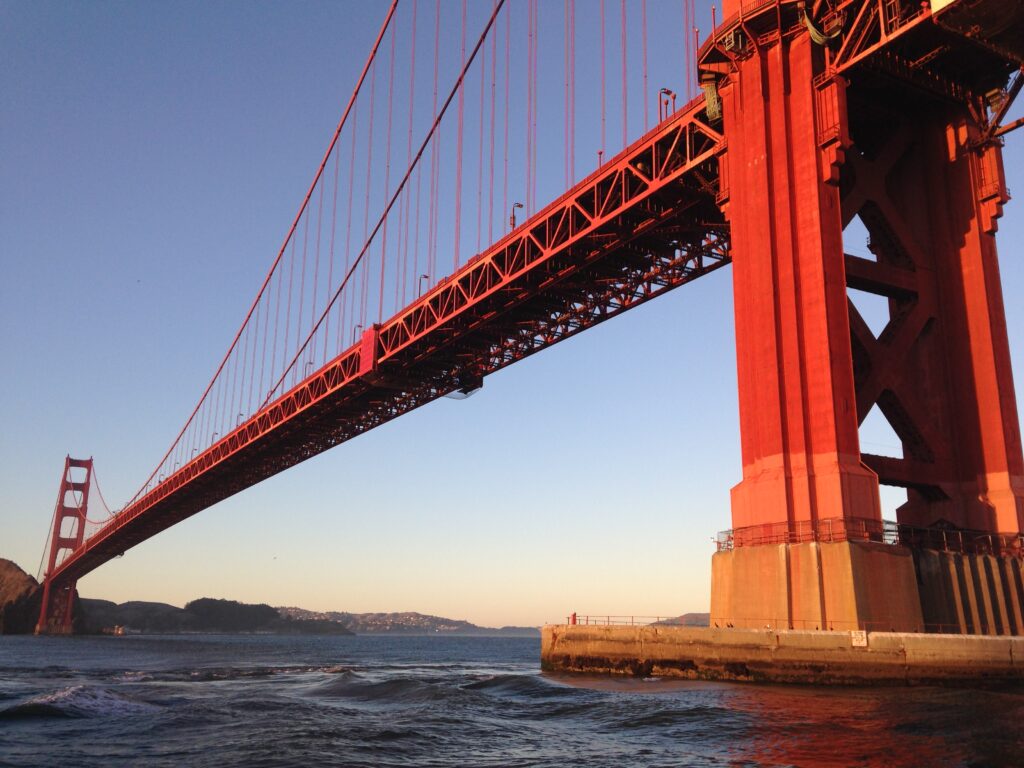
Quick Facts for the Golden Gate Strait Crossing
- Opened: to the public on May 27, 1937, with vehicle traffic beginning the following day
- Main span: 4,200 feet, the longest suspension span in the world until 1964
- Towers: 746 feet above the water, the tallest on any suspension bridge until 1993
- Color: an orange vermilion officially called international orange, chosen by architect Irving Morrow
- Traffic: roughly 112,000 vehicles a day, plus pedestrians and bicycles on walkways either side
- Cost to walk it: nothing. Pedestrian and bicycle traffic is toll free
The Crossing Experts Said Could Not Be Built
Before 1937, the only practical short route between San Francisco and what is now Marin County was by boat. Ferry service across the bay ran as early as 1820, with regularly scheduled sailings from the 1840s. By the late 1920s the Southern Pacific-Golden Gate Ferries operation was the largest ferry business in the world, and the crossing from the Hyde Street Pier to Sausalito took about twenty minutes and cost a dollar per vehicle.
San Francisco was the largest American city still served primarily by ferry boats, and without a permanent link its growth lagged the national average. Plenty of engineers said a fixed crossing was impossible: the strait had strong, swirling tides and currents, deep water, and frequent heavy winds, and the experts warned that ferocious winds and blinding fogs would stop both construction and operation.
The proposal that finally stuck appeared in a 1916 San Francisco Bulletin article by a former engineering student named James Wilkins. The city engineer put the cost at $100 million and called it impractical. Joseph Strauss, an ambitious engineer and poet whose graduate thesis had been a 55-mile railroad bridge across the Bering Strait, answered that he could do it for $17 million. He then spent more than a decade fighting off the Department of War, the US Navy, unions, and the Southern Pacific Railroad, which sued to protect its ferry fleet and triggered a public boycott in return.
The Man Who Designed It and Got Nothing
Strauss was chief engineer, but he had little experience with cable suspension design, and his first proposal, two double cantilevers joined by a central suspension segment, was rejected largely on looks. The suspension design was conceived and championed by Leon Moisseiff, engineer of the Manhattan Bridge. Irving Morrow, a relatively unknown residential architect, shaped the towers, the lighting, and the Art Deco detail, and picked international orange over the Navy’s suggestion of black and yellow stripes.
The principal engineer was Charles Alton Ellis, a Greek scholar and mathematician who had taught engineering at the University of Illinois before holding an engineering degree. He also solved the problem at the southern end, designing a steel arch that carried the roadway over Fort Point rather than demolishing the pre-Civil War fortification. In November 1931, Strauss fired him, ostensibly for wasting money on telegrams to Moisseiff. Ellis, unable to find other work in the Depression and unable to let the project go, kept working seventy hours a week without pay and turned in ten volumes of hand calculations. He received none of the credit in his lifetime. Only in May 2007 did the Golden Gate Bridge District formally give him major credit for the design.
Eleven Men, and the Half Way to Hell Club
Construction began on January 5, 1933 and finished ahead of schedule and $1.3 million under budget. Strauss introduced movable safety netting strung beneath the workers, an innovation that was genuinely new and that saved lives: nineteen men who fell into it formed what they called the Half Way to Hell Club.
Eleven men still died in falls. Ten of them died on February 17, 1937, when a scaffold holding twelve men, secured with undersized bolts, dropped into the net and tore straight through it. Two of the twelve survived the 200-foot fall into the water. That single morning accounts for most of the bridge’s construction death toll, and it is the one piece of the bridge’s history that ghost stories are most often attached to.
The Darker Record Beneath the Railing
Any honest account of this place has to say plainly that the Golden Gate Bridge was, for decades, the most used suicide site in the world, with an estimated death toll of more than 2,000 before prevention work began. Installation of suicide prevention barriers started in April 2017 and the stainless steel nets, which extend twenty feet out and sit twenty feet below the walkway, were completed in January 2024. They have worked. As of November 21, 2024, the bridge district reported eight deaths by suicide year to date, down from an average of 33.5.
This history is the soil the bridge’s ghost lore grows in, and it is worth remembering that the figures behind the folklore were real people, many of them within living memory.
What People Say They See on the Span
None of what follows is verified, and none of it appears in the bridge’s engineering or operational record. It circulates as local folklore and as accounts passed between visitors.
- A phantom hitchhiker. The most repeated tale is of a woman in 1940s clothing picked up near the bridge who is gone from the car before the far side.
- Figures that fall and vanish. Some visitors describe seeing someone go over the rail, only for nothing to reach the water and no report to follow.
- Voices in the fog. Whispers and crying sounds are reported along the walkways, usually attributed by tellers to the bridge’s death toll.
Two things on the bridge make eerie noise for entirely documented reasons, and both are worth knowing before you credit anything to the dead. The first is the foghorn system installed in 1937 and still operating: two horns at the base of the south tower sound a low two-second blast every eighteen seconds, with three more at midspan answering in a higher, dual-toned note. In summer fog thick enough to swallow the whole structure, those tones carry strangely.
The second is newer. In June 2020, residents on both sides of the strait started hearing a hum from the bridge, variously described as eerie, as a shrill screeching sound, and as something that made listeners feel that something bad is about to happen. The bridge district traced it to new, more flexible railing slats installed from 2019 to raise the structure’s wind tolerance to 100 mph. At 22 mph of wind the slats produce a low tone between 280 and 700 hertz; at 27 mph and the right angle, a far higher one around 1.1 kHz. An independent analysis of a 2020 recording found the notes F4, G4, A4 and B4. The bridge is, quite literally, singing, and it is physics rather than anything else.
Walking the Golden Gate Bridge
Anyone can cross on foot. The main walkway is on the eastern side, shared with bicycles on weekday mornings and early afternoons from 5:00 a.m. to 3:30 p.m., then pedestrians only until 6:00 p.m., or 9:00 p.m. during daylight saving time. On weekends the eastern walkway is reserved for pedestrians from 5:00 a.m., and bicyclists get it overnight. The western walkway is for bicycles only, during the hours they are off the east side.
On the San Francisco side, the Golden Gate Bridge Welcome Center opened in 2012 beside the southeast parking lot, with a cafe, outdoor exhibits and restrooms nearby. The Round House Cafe at the southeastern end is an Art Deco design by Alfred Finnila completed in 1938 and renovated in 2012. On the Marin side, the H. Dana Bower Rest Area and Vista Point is reachable only from the northbound lanes. Golden Gate Transit buses run across the bridge throughout the week, and Muni line 28 serves the southern end daily from 5:30 a.m. to midnight.
Tolls are collected only from southbound traffic, electronically, with no cash booths since 2013. Pedestrians have crossed free since December 1970, when the ten cent sidewalk turnstile toll was dropped. If the fog lifts, look down as well as out: the waters and headlands around the bridge hold harbor seals, sea lions and bobcats, and three whale species absent for years have been recolonizing the area, with researchers asking that people watch from the bridge or from land rather than crowding them by boat.
One practical note on the atmosphere. Summer is the foggiest season, which is when the horns run and when the bridge most resembles the one in the stories. It is also when you will see least of it. Clear winter mornings give you the better view and the worse ghost story.
Sources
- About Us
- City of San Francisco Designated Landmarks
- American Society of Civil Engineers Seven Wonders
- Golden Gate Bridge
- Two Bay Area Bridges (Dot (official))
- Wikipedia: Golden Gate Bridge
Frequently Asked Questions
Where is Golden Gate Bridge located?
Golden Gate Bridge is located at US-101.
Can you visit Golden Gate Bridge?
Golden Gate Bridge is open to the public. Always follow posted rules and respect private property.
Reader sightings
Nobody has reported anything here yet. If you have been, you would be the first.
Report your own visit to The Half Way to Hell Club and Golden Gate Bridge Ghosts
How haunted is this place?
Be the first to rate
Leave a Reply