
Reviewed by Josh N · Updated September 29, 2026 · How we verify
Reported Phenomena
- Cell 14-D cold spots
- Phantom banjo music
- Unexplained cannon fire
- Apparitions in prison garb
- Disembodied sobbing
- Unexplained blue lights
- Footsteps in empty corridors
Reported by visitors & local legend. Stories, not verified claims.
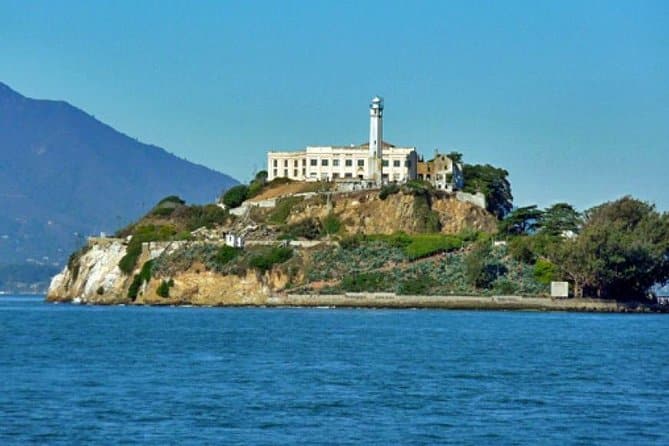
A crossing of a little over a mile separates San Francisco’s waterfront from the most photographed prison ruin in California, and stories about Alcatraz Island ghosts have been riding the ferries back to shore for decades. The building people report them in is the concrete main cellhouse, finished in 1912, but the island’s record of confinement runs much further back: Civil War prisoners, Hopi men who refused to surrender their children to boarding schools, conscientious objectors, and finally the gangsters who gave the place its nickname. Nothing about the hauntings is verified. The history, by contrast, is unusually well documented, and it is the better reason to make the trip.
Quick Facts About the Rock
- Roughly 1.25 miles offshore from San Francisco in San Francisco Bay, near the Golden Gate strait.
- About 22 acres, measuring 1,675 feet by 590 feet and rising 135 feet at its highest point at mean tide.
- Home to the oldest operating lighthouse on the West Coast of the United States.
- Alcatraz Federal Penitentiary operated from 1934 until it closed on March 21, 1963.
- Transferred to the Department of the Interior in 1972, listed on the National Register of Historic Places in 1976, and designated a National Historic Landmark in 1986.
- Managed by the National Park Service, with nearly 1.4 million visitors a year.
The Island of the Pelicans, and a Name That Moved
Spanish naval officer Juan Manuel de Ayala charted San Francisco Bay in 1775 and applied the name “La Isla de los Alcatraces” not to this rock but to what is now Yerba Buena Island. The label was later transferred to the island we call Alcatraz by the English naval officer Captain Frederick W. Beechey. The archaic Spanish alcatraz meant pelican, and in August 1827 the French captain Auguste Bernard Duhaut-Cilly described running past the island “covered with a countless number of these birds.” The California brown pelican is not known to nest there today.

The earliest recorded private owner was Julian Workman, given the island by Mexican Governor Pio Pico in June 1846 on the understanding that he would build a lighthouse. Later that year John C. Fremont, acting as military governor of California, bought it for $5,000 in the name of the United States government. The government subsequently invalidated the sale and paid Fremont nothing; he and his heirs sued into the 1890s and lost. In 1850 President Millard Fillmore ordered the island set aside as a United States military reservation.
Fort Alcatraz and the Guns That Never Fired
In 1853, under the direction of Zealous B. Tower, the Army Corps of Engineers began fortifying the island. Work continued until 1858, and the first garrison of about 200 soldiers arrived at the end of that year. When the Civil War broke out in 1861 the island mounted 85 cannons, increased to 105 by 1866, though the small garrison could work only a fraction of them at once. Alcatraz also served as the San Francisco Arsenal, storing firearms to keep them out of the hands of Confederate sympathizers. Its guns were never fired at an enemy.
The isolation that made the island useless for defense made it ideal for detention. Soldiers convicted of crimes were held there as early as 1859, and by 1861 the fort was the military prison for the Department of the Pacific. From 1863, with habeas corpus suspended, the Army also held private citizens accused of treason. A brick jailhouse went up in 1867, replacing the guardhouse basement, and in 1868 Alcatraz was officially designated a long-term detention facility for military prisoners. Among those confined were Confederates caught on the West Coast and a group of Hopi men in the 1870s who refused orders to send their children to Indian boarding schools. The Spanish-American War pushed the prison population from 26 to over 450 in 1898, and after the 1906 earthquake civilian prisoners were moved out to the island for safe confinement. On March 21, 1907, it became the Western U.S. Military Prison.
One piece of Alcatraz folklore has a paper trail behind it. Construction of the main cell block, designed by Major Reuben Turner, began in 1909 and finished in 1912. To make room, the Citadel, a three-story barracks sunk in an excavated pit with a defensive dry moat, was demolished down to its first floor, which sat below ground level and was folded into the new building as a basement. That buried floor is the origin of the persistent legend of “dungeons” beneath the cellhouse. Archaeology has since confirmed how much survives underfoot: in 2019 Binghamton University archaeologist Timothy de Smet and colleagues used ground-penetrating radar to locate a “bombproof” earthwork traverse, a vaulted brick masonry tunnel with ventilation ducts, and ammunition magazines beneath the recreation yard.
Twenty-Nine Years as a Federal Penitentiary
The Disciplinary Barracks were deactivated in October 1933 and acquired by the Department of Justice on October 12 of that year. The island was designated a federal prison in August 1934, built to hold men who caused continual trouble elsewhere in the federal system. At 9:40 a.m. on August 11, 1934, the first 137 prisoners arrived, shipped by rail from Leavenworth and escorted in high security coaches under guard by 60 FBI agents, U.S. Marshals, and railway security officials. The initial staff of 155 was led by the first warden, James A. Johnston, and associate warden J. E. Shuttleworth, both described as “iron men.” Staff were trained in security rather than rehabilitation, yet some prisoners actually requested transfer to the island for its single-cell occupancy and the quality of the food.
Over 29 years the penitentiary held Al Capone, Robert Franklin Stroud (the “Birdman of Alcatraz”), George “Machine Gun” Kelly, Bumpy Johnson, Mickey Cohen, Arthur “Doc” Barker, and Alvin “Creepy” Karpis, who served longer there than any other inmate. It was also a residential community: correctional officers and their families lived in island apartment buildings and their children attended a school on the rock.
The prison claimed no successful escape. Thirty-six prisoners made 14 attempts, two of them trying twice. Twenty-three were caught alive, six were shot and killed, two drowned, and five are listed as missing and presumed drowned. The most violent episode came on May 2, 1946, when a failed break by six prisoners became the Battle of Alcatraz. The most famous came at around 10 p.m. on June 11, 1962, when Frank Morris and brothers John and Clarence Anglin left papier-mache dummy heads finished with hair clippings in their beds, went out through a vent they had worked at for months with sharpened spoons and a vacuum cleaner motor drill, and pushed off on a raft made of prison raincoats and life preservers. They were never seen again. A fourth man, Allen West, failed to get out of his cell in time and later gave the FBI the details. That same year prisoner John Paul Scott did reach the shore, where police found him unconscious in hypothermic shock.
Why the Prison Closed in 1963
The reasons were mundane. Alcatraz cost nearly $10 per prisoner per day to run against about $3 at Atlanta. The island had no fresh water, so close to a million gallons a week had to be barged from the mainland. Half a century of salt saturation had eaten the buildings. Three prisoners had purportedly escaped in 1962. The penitentiary shut on March 21, 1963, and the San Francisco mayor’s office began fielding proposals for what to do with the rock.
Nineteen Months and Nine Days: The Native American Occupation
Native American activists first occupied the island on March 8, 1964, in a protest proposed by Lakota Sioux activist Belva Cottier and joined by about 35 others. The larger occupation began on November 20, 1969, when a group calling itself United Indians of All Tribes, mostly college students from San Francisco, landed to protest federal Indian policy. They claimed Alcatraz under provisions of the 1868 Treaty of Fort Laramie and by right of discovery, and asked that the facilities be converted into an Indian education center, ecology center, and cultural center. Urban activists from the American Indian Movement joined from Minneapolis and elsewhere.
During the nineteen months and nine days of occupation, several buildings burned, including the lighthouse keeper’s home, the warden’s home, the Officers’ Club, the recreation hall, and the Coast Guard quarters. The origin of the fires is disputed. The government demolished further buildings afterward, which is why so much of the island reads as ruin today, and graffiti from the occupation is still visible in many places. The occupation ended on June 11, 1971. While it was underway, President Richard Nixon rescinded the Indian termination policy and established a policy of self-determination, a shift credited in part to the publicity the protest generated.
What Visitors and Former Staff Say Happens in the Cellhouse
None of what follows is documented fact. These are reported experiences, repeated by visitors, tour guests, and former guards and inmates, and they are the substance of Alcatraz’s paranormal reputation rather than evidence for it.
- Sounds without a source. Accounts describe gunshots and cannon fire with no discernible origin, along with footsteps and voices in empty corridors.
- Figures in old prison clothing. Some visitors report apparitions dressed in nineteenth-century prison garb, which would place them in the military era rather than the federal one.
- D Block and cell 14-D. The isolation cell known as “the hole” draws the most reports: sudden temperature drops and a heavy sense of despair.
- Capone’s banjo. The best known Alcatraz legend has Al Capone still playing, usually placed in the shower room late at night.
- Blue lights. Unexplained lights and noises are sometimes tied by storytellers to the Native American men confined here during the military period.
- A woman crying. Warden James A. Johnston is said to have reported hearing inexplicable sobbing.
It is worth weighing all of this against the building itself. Reinforced concrete soaked in salt air, a cellhouse designed to carry sound down long galleries, wind coming off open water, and a site whose “dungeons” turned out to be a buried barracks floor: Alcatraz generates atmosphere honestly, without help.
Visiting Alcatraz Island
The island is part of the Golden Gate National Recreation Area and is managed by the National Park Service. Ferries leave from Pier 33, between the San Francisco Ferry Building and Fisherman’s Wharf, run under contract by Hornblower Cruises operating as Alcatraz City Cruises. A development plan approved in 1980 doubled the area open to the public, and later reports note that former prison buildings continue to be conserved and seismically upgraded, with more of the island opened as hazards are cleared. Renovations begun in 2011 added solar panels on the cell house roof and stabilized slopes and outer cellhouse walls. The island closed to the public for more than a year during the COVID-19 pandemic and reopened in March 2021, so checking current access before booking is sensible.
Landmarks worth finding beyond the Main Cellhouse include the Dining Hall, the lighthouse, the ruins of the Warden’s House and the Officers’ Club, the Parade Grounds, Building 64, the Water Tower, the Model Industries and New Industries buildings, and the Recreation Yard. The island is also a working seabird colony, with western gulls, cormorants, egrets, pigeon guillemots, and black-crowned night herons nesting on the cliffs and parade grounds; harbor seals turn up on the small beach below the western cliffs. The gardens planted by Army families and later by guards’ families went feral after 1963 and have been restored by staff and volunteers, who found original plantings still alive after more than a century, among them a Welsh rose, Bardou Job, that had been thought extinct.
Indigenous groups including the International Indian Treaty Council hold Sunrise Gatherings on the island each Columbus Day and Thanksgiving Day. The prison’s future has been argued over more than once: a 2008 San Francisco ballot proposition to raze it for a peace center was rejected by 72 percent of voters, and on May 4, 2025, President Donald Trump proposed reopening the prison, with a 2026 White House budget request of $152 million to do so.
See Alcatraz for Yourself
Sources
- Alcatraz Island
- The Rock: A History of Alcatraz: The Fort/The Prison
- Why Was Alcatraz Closed?
- The March of Portolá and the Log of the San Carlos, Zoeth S. Eldredge & E. J. Molera, Log of the San Carlos
- History: Military Fortress
- Wikipedia: Alcatraz Island
Frequently Asked Questions
Where is Alcatraz located?
Alcatraz is located at Alcatraz Island, San Francisco, CA 94133.
Can you visit Alcatraz?
Alcatraz is accessible by guided tour only. Always follow posted rules and respect private property.
Reader sightings
Nobody has reported anything here yet. If you have been, you would be the first.
Report your own visit to Cell 14-D and a Banjo: Alcatraz Island Ghosts
How haunted is this place?
Be the first to rate
Ghost Tours Nearby
 Ghost Hunt in SF Chinatown with a Professional Investigatorfrom $55
 San Francisco Ghost Hunt Walking Tourfrom $29
 San Francisco Ghost Tours: Gold and Ghouls Tourfrom $26
Affiliate links: BeyondHaunted may earn a commission, at no extra cost to you.
Leave a Reply