
Reviewed by Josh N · Updated September 5, 2025 · How we verify
Nearly six decades after more than 200 schoolchildren and staff reported seeing a mysterious object hovering above a Melbourne suburb, the Westall UFO incident of 1966 is back in the headlines. Advocates and eyewitnesses are pressing the Australian government to formally revisit one of the country’s most famous unexplained encounters.
The Day That Stopped a School
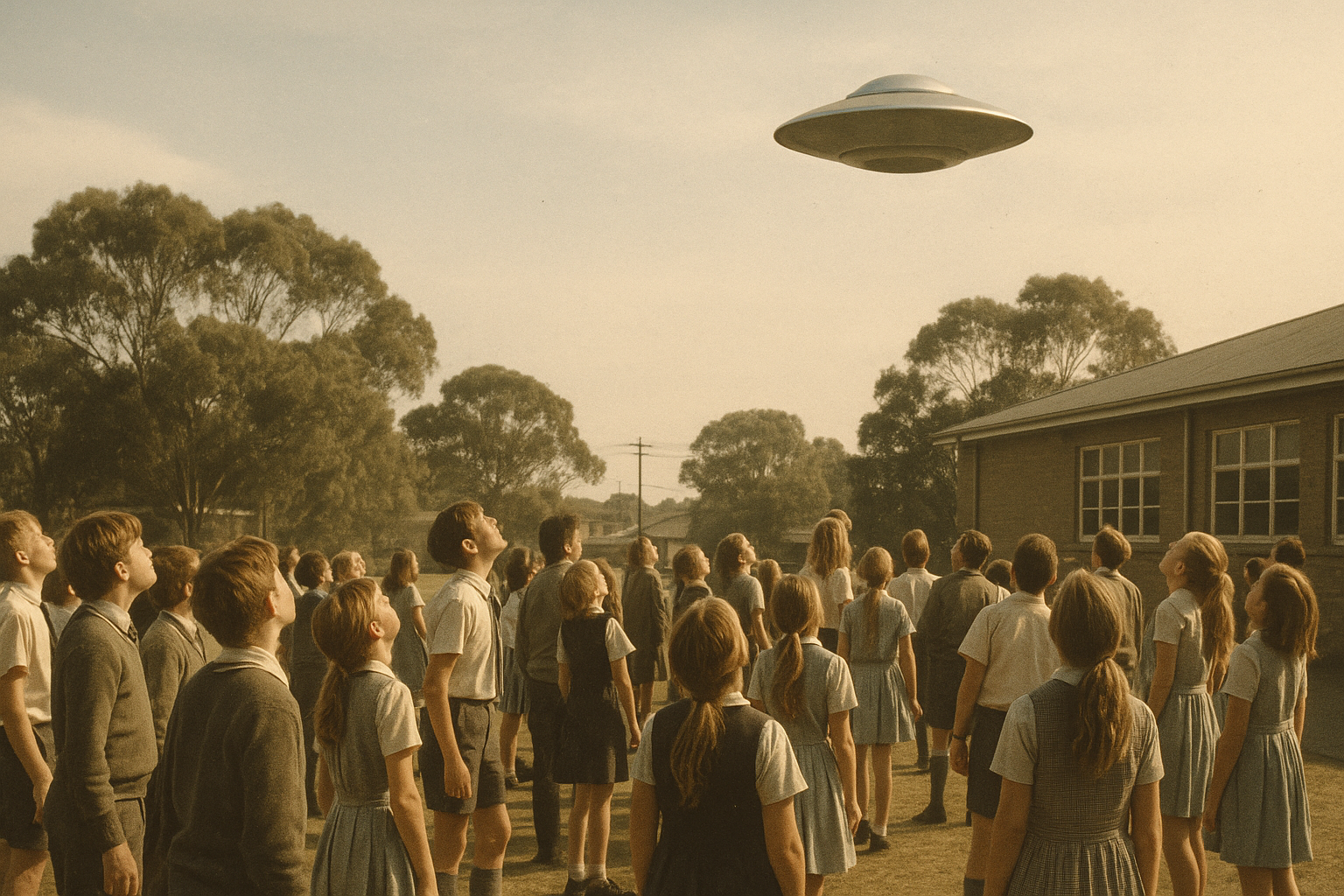
On the morning of April 6, 1966, students from Westall High School and the neighboring Westall State School in Victoria looked skyward and saw a large, silver, saucer-shaped craft moving silently above the playing fields. Witnesses recalled the object descending into a nearby open area—known locally as the Grange Reserve—before lifting away at speed. Within minutes, dozens of children, teachers, and local residents were describing the same event, making it one of the most widely witnessed UFO sightings in Australian history.
Despite the large number of observers, official documentation has always been scarce. At the time, the Royal Australian Air Force (RAAF) offered little public comment, and reports suggest students were discouraged from discussing the sighting. No official investigation was made public, leading to decades of speculation and folklore.
Competing Explanations
Over the years, theories have ranged from the extraordinary to the mundane. Some researchers have argued the object was a secret military test craft. Others suggest it could have been a misidentified HIBAL balloon—large, high-altitude balloons launched in Australia during the 1960s for U.S. nuclear monitoring programs. Yet many eyewitnesses reject these explanations, insisting what they saw was far too structured, controlled, and maneuverable to have been a balloon.
Renewed Push for Government Action
This week, campaigners announced a new parliamentary petition calling on the Australian government to investigate the Westall incident formally. The petition argues that with the global conversation on Unidentified Aerial Phenomena (UAPs) growing—spurred on by U.S. congressional hearings and fresh whistleblower testimony—Australia should review its own historic cases and adopt transparent investigative procedures.
Currently, the RAAF does not investigate UAP sightings. Advocates say that leaves significant questions unanswered and undermines public trust in government openness. Several surviving eyewitnesses have also renewed their calls for recognition, stressing that what they saw that day in 1966 has stayed with them for a lifetime.
Why It Matters Today
The Westall case endures not only because of the dramatic number of witnesses but also because it sits at the intersection of Cold War secrecy, Australian defense history, and the wider global mystery of UAPs. With renewed public and political interest, Westall may once again serve as a test case for how governments handle extraordinary eyewitness testimony in the absence of conclusive evidence.
Reader sightings
Nobody has reported anything here yet. If you have been, you would be the first.

Leave a Reply