
Reviewed by Josh N · Updated August 25, 2026 · How we verify
Reported Phenomena
- Ghost named Betty
Reported by visitors & local legend. Stories, not verified claims.
Ask about the Carbisdale Castle ghost in this corner of the Scottish Highlands and you will get a single name back: Betty. That is the whole of it. No documented death, no dated incident, no witness on record. What Carbisdale does have, in abundance, is a documented family feud so bitter that it produced a building designed as an insult, and that story is the more remarkable of the two.
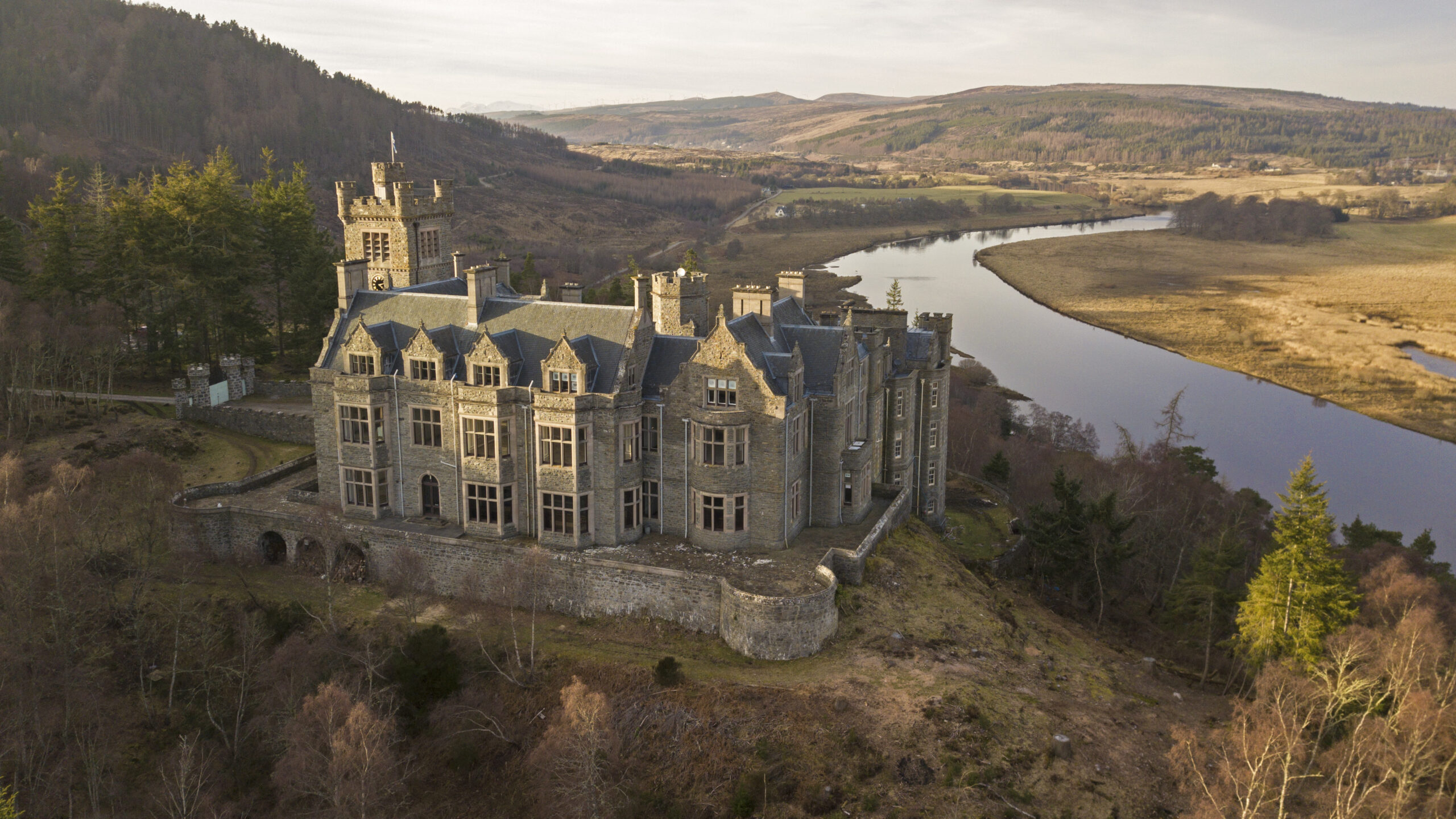
The castle was built in 1907 for the Duchess of Sutherland on a hill across the Kyle of Sutherland from Invershin, north of the village of Culrain and around 5 kilometres, or 3.1 miles, north-west of Bonar Bridge. It is Scottish baronial in style, has 365 windows, covers 41,433 square feet, or 3,849.3 square metres, and is protected as a category B listed building.
Duchess Blair and the Will That Sent Her to Holloway
Mary Caroline was the second wife of George Sutherland-Leveson-Gower, 3rd Duke of Sutherland, whom she married in 1889. She is better remembered as Duchess Blair, after her first marriage to Captain Arthur Kindersley Blair of the 71st Highland Light Infantry, who died in a hunting accident in 1883 near Pitlochry. The Sutherland family did not care for the match.
When the Duke died in 1892, his will, which favoured the Duchess, was contested by his son and heir Cromartie. In the court process that followed, the Duchess was found guilty of destroying documents and was imprisoned for six weeks in Holloway Prison. A settlement eventually followed, giving her a substantial sum, and one further condition: the family agreed to build her a castle, provided it stood outside Sutherland lands.
Why the Clock Tower Has Only Three Faces
She employed a firm of Ayrshire builders and put the castle up between 1906 and 1917, just beyond the boundary in Ross-shire. Wikipedia gives 1907 as the build date in one place and a longer construction span in another, so the precise completion is not clean, but the siting is not in doubt. The hillside was chosen to be visible across a large part of Sutherland, and in particular from the main road and the railway line the family would have to use travelling south. It became known as the Castle of Spite.
The best-known detail belongs to the tower. Its clock has faces on three of its four sides, and the side looking towards Sutherland is blank. The traditional explanation, repeated for over a century and impossible to verify, is that the Duchess would not give her former relatives the time of day.
A Norwegian King in Exile at Carbisdale
Colonel Theodore Salvesen, a wealthy Scottish businessman of Norwegian extraction, bought the castle in 1933. During the Nazi occupation of Norway he made it available as a refuge for King Haakon VII and Crown Prince Olav, later King Olav V. It also hosted serious wartime business. At the Carbisdale Conference on 22 June 1941 it was agreed that should Russian forces enter Norwegian territory, they would not remain there after the war. On 25 October 1944 the Red Army entered Norway and captured thirty towns, and later withdrew under the terms of that agreement.
Sixty-Six Years as a Youth Hostel
After the Colonel’s death his son, Captain Harold Salvesen, inherited Carbisdale and handed the contents and estate to the Scottish Youth Hostels Association. Carbisdale Castle Youth Hostel opened to members on 2 June 1945, and generations of walkers slept in a building still hung with its art collection, some pieces dating back to 1680, and lined with Italian marble statues. This is where most of the ghost talk comes from: a large, cold, half-lit castle full of teenagers and strangers on bunks is an efficient machine for producing stories.
Frost damage closed the hostel for repairs in February 2011, and further structural damage was found once work began. The SYHA advertised the castle for sale in 2014 at £1.2 million, and in May 2015 auctioned 17 marble sculptures and 36 paintings, raising a further £1 million.
What Is Actually Claimed About Betty
The claim is thin and worth stating plainly. The castle is rumoured to be haunted by a ghost called Betty. The source material offers no death, no date, no description of what she is supposed to do, and no account of an investigation. Anything more detailed that you read about Betty online is folklore accumulated around a hostel, not record. Treat it accordingly.
Can You Visit Carbisdale Castle?
Not readily. In September 2016 the castle was purchased by FCFM Group Ltd, who planned to turn it into a world-class private residence. It went back on the market in April 2021 at £1.5 million and was sold in October 2022 to the barrister Samantha Kane, who has since restored it. Kane, now known as Lady Carbisdale, used the castle as her residence and intended to open part of it to the public. As of June 2025 it is on the market again, with a guide price of £3.5 million.
For now, treat it as private property. The compensation is that the Duchess did the work for you: the castle was deliberately sited to be seen from the road and the railway, and the view from the Culrain and Invershin side of the Kyle of Sutherland is the one she intended her in-laws to have.
Address: Culrain, near Bonar Bridge, Scottish Highlands
See Carbisdale Castle for Yourself
Sources
- Carbisdale Castle History
- Sutherland's 'Castle of Spite' hostel may close for good
- Carbisdale Castle Sale
- Scotland's last castle, yours for less than the price of a London flat
- Victorian marble goddesses and nymphs from Carbisdale Castle coming to market
- Wikipedia: Carbisdale Castle
Frequently Asked Questions
Can you visit Carbisdale Castle Of Spite?
Carbisdale Castle Of Spite is on private property and best viewed from a distance. Always follow posted rules and respect private property.
Reader sightings
Nobody has reported anything here yet. If you have been, you would be the first.
Report your own visit to The Castle of Spite and the Carbisdale Castle Ghost, Betty
How haunted is this place?
Be the first to rate
Leave a Reply